
Unearthing Resiliency with Plant Kin ft. Lupita Tineo
In today’s episode with my guest and dear friend, Lupita Tineo of Yolia Botanica, we’ll explore how we continue to navigate the grief and blessings of being alive and reflect on how forming emotional connections with our plant family can help expand our resiliency during intense grief.
I trust you are doing your best to be with the grief and blessings of this moment while also rising to the continued calls to speak out against what’s happening. It takes all of us so. If you’re hungry for deeper resiliency too, I hope you’ll stay and listen.

Tender heart, let’s take a moment to honor the grief in the world right now. As many continue to witness and aim to end multiple genocides, how is your heart, and in what ways are you allowing your grief to arise? With the continued and unnecessary extinguishing of human and more-than-human life right now in Palestine, Sudan, Congo, and more, you might find yourself going to bed and rising with the weight of this grief heavy in your heart. I know I do and that I’m not alone in this.
In today’s episode with my guest and dear friend, Lupita Tineo of Yolia Botanica, we’ll explore how we continue to navigate the grief and blessings of being alive and reflect on how forming emotional connections with our plant family can help expand our resiliency during intense grief.
If you feel like you’re resiliency is waning, this is normal, rest, acknowledge, but please come back. It’s as important as ever that we remain steadfast in raising our voices, especially from places of privilege, to speak out against what’s happening and not turn away.
The weight of the world is too much for one body to hold or fix and you are not intended to do it alone. There are beings, seen and unseen, human and more than human available to help us root deeper into our resiliency.
I trust you are doing your best to be with the grief and blessings of this moment while also rising to the continued calls to speak out against what’s happening. It takes all of us so. If you’re hungry for deeper resiliency, I hope you’ll stay and listen.
Let’s get into this bounty of wisdom. Here’s more about my dear friend, Lupita Tineo, and her shop, Yolia Botanica.
Yolia Botanica is woman-owned and operated, blending Mexican curanderismo and paganism to provide respectful alternatives that help people take care of their spiritual bodies. Our products are created for modern brujas of all levels with the foundation of respecting sacred herbs, tribes, and practices. At Yolia Botanica, we don’t currently work with white sage or palo santo. Instead, we provide appropriate options that respect the life of the plant and the sanctity of spiritual traditions, specifically of Indigenous peoples of the Americas. Everything is made by Guadalupe aka Lulu, who was born and raised in Sonora, Mexico, and is on a reclaiming and reconnecting journey to her Indigenous ancestry.
Here’s our chat. Click below to listen. Keep scrolling to read the transcript.
Cassie: Welcome, my dear friend, Lulu, to the show. I'm so happy to have you here. Finally.
Lupita: Thank you. Thank you, Cassie. I appreciate it. We went around for months.
Cassie: I know, we did, but we made it happen. I always like to start off by just asking you a little bit about your lineage, and that could be your ancestry, your teaching lineage, or anything that you feel like you want to speak about what's shaped who you are today and your work.
Lupita: I was born in Ciudad Obregón, Sonora, and this particular city in Sonora has the County name of Cajeme, which is really something that fills me with pride. I'm like, yes, it might not be the city's name, but it's the county's name. Cajemé was an Indigenous warrior who, in the 1900s, was part of, I guess you could say, the war that happened against the Yaqui people.
So this one has a lot of story. Cajemé County is vast, not just to Ciudad Obregón. It covers a bunch of other small towns around it. The primary tribe that resides in this area is the Mexican Yaquis. or the Yoeme. We do have the, I guess you could say, other side of the border. Yaqui, which are called the Pascua Yaqui.
Unfortunately, they are divided by a border now. And so they have different benefits, and they do have different conditions of life because of this. So Cajemé was an Indigenous warrior who, when the Spanish came. And they took over Mexico. Now we're talking about the early 1900s; the Mexican government was still fighting the indigenous people.
Okay. They still wanted to take their lands and deplete their resources. And so they were the very same Mexicans who primarily Spanish leaders led at this time, were on a hunt for the resources of the Yaqui, which is southern, central, west of Sonora, it covers a very large portion of Sonora because then we start entering the Arizona tribes and he had been contracted by one of them, a Spanish legislator to lead a Mexican army into the lands and pretty much kill them all and take their land.
Cajemé wasn't for anyone he had grown up in poverty. He did what he had to and for whom he had to do it, but he learned of this person's true goal, which was to eradicate the Yaqui tribe. They wanted to completely erase them so that there would be no trace so that there would be no one to give land back to ever.
Cajemé, being of this tribe, I guess, you know, people change, turned on this man who paid him a lot of money to lead their Mexican army, and he got together with the leaders of the Yaqui tribe and taught them what the plan was. And Cajemé had been In a lot of wars, a lot of fights, a lot of guerrilla groups.
So, he knew a lot about fighting and defending. What the Yaquis didn't have weapons, but Cajemé taught them how to make them with rocks, sticks, city, and arrowheads, all of the good stuff. To make it short, they succeeded in this battle. Unfortunately, it was not for long until a bigger army was sent that ended up slaughtering that whole village, which is where Sula Lobregón is now.
And so the County was named after Cajemé. Because of what he had done, of what he had stood for the Yaqui communities, his own community, so I, I like to think that I'm from Cajeme and not from Ciudad Obregón, because Ciudad Obregón is named after that very same legislator who slaughtered the entire region, of the Yaqui tribe, and There's a really amazing documentary on YouTube called Yaqui's, it's a Mexican man who goes on a very extensive history search for the landmarks, the stories and the evidence of a genocide against the Yaqui people, which lasted approximately 44 to 46 years.
This is one of the longest persecutions against an indigenous tribe. We're not talking about, oh, they slaughtered them for 10 years straight. And that was it. It went on for four decades, and it is very heartbreaking because we see in the documentary how the communities are now living because of this, the scraps of resources that they have to live with, how they unite and they stick together, and they're still teaching their children their native tongue, and Spanish is their second tongue.
And so it's this beautiful rendition of pain and persecution and the unity that follows into the very few. Yaqui people that remain today. So that's where a lot of my lineage comes from. Whether my mom's side, primarily Spanish, has any ties to that. I'm not sure, but my dad's side for sure has it.
I was able to find a picture from my dad's family, which is the oldest picture we were able to date, which is from around 1948. So, up until 1948, we have nothing prior. We have no records, we have no pictures, we have no idea of the names of people or where they were from. And there's a picture of this woman who would have been my father's side, my grandmother's great-grandmother.
And you look at this woman, and you say, This is an indigenous woman, but my dad's family didn't grow up that way. My dad's family grew up, I guess, not seeing themselves as indigenous. They saw themselves as
the rejection of society, the dark ones, the short ones, the ugly ones. And I know this because my dad's sister, whom I'm very, very close to, till this day, she'll call herself names, and she's this short little dark brown woman who got polio as a child.
And so she has a hump on her back, and she was she's the most amazing woman I know. And to hear her talk about herself in that sense, not acknowledging the beautiful culture and richness that she comes from rather. Forcing on herself the derogatory things that society has told her. My aunt praises white people. Okay? I'm not kidding. She adores white skin.
She adores blonde hair. And she's always dreamed of being like that. Because she says it is the most beautiful skin and hair on earth that she will never have. I was little, I could tell you like flashbacks of her just saying things, and she didn't say it in like a pity me. Way, she would just say it because she really believed it.
And so I grew up hearing about her brown skin, dark hair, and features. And so it does things to a child on my mom's side. My grandmother is very light-skinned. She has no hair anywhere. And so I remember my grandmother. Always pointing things out. Oh, look at your dark knees. Look at your dark elbows.
Look how hairy you are. Me and my sister and comparing our skin color to hers
or her families again, not in a way of making us. I don't think she ever really meant to hurt us, right? It's usually how it happens, but that's what she did. And then here we have my aunt. Where do we lie? Where is there a positive for our existence, our identity, and our body?
There wasn't. There wasn't. There were negative sides coming from the light-skinned people side, negative things being said and pointed out for as long as we can remember because we were dark because our features were different because we had more hair, dark hair at that. And then my aunt, who looked like us, who looked more like us, saying what she had, what she looked like, was the worst of the worst.
So you build these foundations. Off of that, you internalize it, and then you live your life like that. Having internalized all of that colorist, racist, discriminatory. Language all of our lives. So that's more of who I am, where I come from, but also what it meant for me growing up, what that did not really have pride in an identity, not really having to belong to an identity because I wasn't Mexican enough.
I wasn't white enough. Wasn't indigenous enough. There was nothing that I could be enough of. But now, as I'm older, I've reclaimed a lot of things, and you know this: I've reclaimed a lot of things. I've reclaimed many things that brought me shame, starting with my name, which is Guadalupe, and Guadalupes in Mexico are called Lupitas.
And more often now, I try to introduce myself as Lupita because I know where Lulu came from, and it came from a lot of self-hatred. And embarrassment and shame because people couldn't pronounce my name and that brought me a lot of shame, having to assimilate into this country and have a name like that.
I was just the sorest thumb sticking out always and then being the fresh kid that didn't speak English and was brown and hairy. So when people say tell me about who you are, tell me about where you come from. I can't point out all the beautiful things 1st, although I'm grateful for them, although it's taken me a really long time to see and appreciate them.
Now, it didn't become pretty for a very long time, so always the harshest parts for me have to be acknowledged so that we can really understand where a lot of our neighbors come from as far as emotional and mentality. Goes we don't come from a place of acceptance and that can really hinder the way that we connect in the way that we live our lives.
And when I say I am from Sonora, I am Mexican-born and raised. That also comes with the territory of, I don't know who I am, and I'm having to define that, and I'm having to find it, having to yank it out, because it's right under me. It's right under me.
Cassie: Thank you so much.
Lupita: You're welcome.
Cassie: I know some of your story, but I don't know all of your story, and I did not know about the history of the Yaqui people. I'm really grateful to you for sharing that with me. I will find the YouTube video, and I'll share a link in the show notes for this episode, so if other people want to look at that, they can. (Click here to watch the Yaqui documentary Lulu references.)
Lupita: It's subtitled in English, too. He does have a book. It's called Yaqui. I don't know if that one's translated, but It's a great documentary. It really puts in perspective a lot of the communities here in Arizona.
We don't know a lot of this history, and so we don't understand. White people are the way they are. Yeah. Or why our communities are the way they are. We're sadder than ever, more disconnected than ever. There's a loss of identity that persists beyond measure. And it comes from things like that comes from persecutions of decades, of generational trauma.
And, it never needs a lot of attention. It just needs people willing to listen. You don't have to go shout it to the world, but what you do need to do is absorb it so that we can be that one little domino chip that bumped the next. And even if there is a lot of space between the next chip, we just want to inspire.
You might not touch people enough that you knock them down to keep doing the ripple effect, but you might inspire them. Because that pressure is big, that the pressure of making justice for everyone, it's big.
Cassie: Thank you for rooting us into your truth as a starting place and bringing all of that in all of its grief and tenderness here. Because it is so important, and I'm just so honored to know you and to bear witness to your journey, and I always have been, so it's a real honor to be able to share it with others.
Lupita: Thank you. I appreciate you.
Cassie: I appreciate you. I know; we're just having a little love-cry fest over here. Don't mind. Oh, we go back.
Lupita: Yeah. I think that surfaces a lot when we talk. Yes.
Cassie: I would love to hear a little bit about the land and your connection to the land. And this is a practice that, was inspired by Dra. Rocio Rosales Meza. That is to share a little bit about what the land is teaching you and speaking to you right now.
And I know that your connection to the land is deep. So, I would love to hear a little bit about it at this moment in time.
Lupita: It's quite an amazing journey to think, oh, there's nothing in the desert. And then you go looking, and you find how much power and life and energy are actually here. The Sonoran Desert is one of the harshest environments, but it's also a very diverse environment.
We have high sierras, mountains, which absorb a lot of the rain and that feed with beautiful green luscious hills, the wildlife encourages our to bloom. If you go south into Mexico, you'll find the, which are a type of cactus that is spiny rather than the saguaros, which are one big and thick with arms. Each part of the Sonoran Desert has something really beautiful and unique about it. And depending on how high or how low the elevation is, The elevation will give you a gem. You'll find the pitayas in higher elevations, but you'll find creosote in lower elevations. And you know my obsession with creosote.
I don't know that anybody has more fascination with it more than I do. I know many people love its medicinal properties and the intoxicating smell. Of creosote when it rains and it comes into contact with water, but I don't think people, a lot of people, understand the energetic and magical representation creosote has for me. And this is where we talk about why creosote is so amazing.
I'll give you some fun facts which you already know. But creosote can go without water for up to two years. There is a creosote bush found right on the verge of the Sonoran Desert and the Mojave Desert, which crosses into a little bit of California. And this bush is named King Clone, and it's approximately 12,000 years old.
The scientists who studied this bush believed it to be one of the oldest organisms on Earth that's still standing. And you wonder, wow, how does it do that? So can survive some of the harshest environments and harshest droughts because it stores water in the root system. The root system of a creosote bush is a fighter it up roots, other smaller bushes and preserves its strength because it wants more water. And so it'll eliminate smaller bushes by pushing them up and out from the roots. It tries to take over the bigger the roots, the more water it can store. So I love to think of creosote as a symbol of perseverance.
And a symbol of strength, prosperity, because of that root system, and I always say this, what an amazing thing it would be for us to be so well established and so rooted that everything we have and need to continue through the harshest of environments is right in our roots that sustain us, that hold us.
That feeds us, and that guides us. And so the creosote bush really brings that element for me. I think if I could embody a little bit of what creosote is in my human form, I could touch a lot of people. And I try to, I'm trying to expand this root system and to strengthen my root system so that when harsh environments come again, because they will, I will know that I can continue because my roots uphold me and because my roots will make me go through this, And I just can't think of a better way to experience the desert, if not for creosote bush.
Besides its medicinal properties, creosote has taught me not to judge a book by its cover. It still has so much to offer, even in its dormant form. Indigenous people, as much as Arizona, as much as Sonora, burn the creosote branches as an insect repellent when it's in dormant stages. It's, You know, you look at it when it's cold, and you're like, that is 1 ugly plant because it goes brown, and it it almost looks like it got burned, but it isn't.
It's just dry. It's, it's sleeping. And then the 1st little sign of spring approaches, and it starts to scrap these little tiny green leaves off of those ugly. Brown, dry branches like you would think these branches are dead, but they're not and I see it every spring when it starts to sprout those little green babies, and it new leaves coming in new blooms, new arms, it regenerates itself so amazingly, and it needs nothing, and it needs no one, but it also thrives.
In a community space, because some of the creosotes will connect roots and will help each other in storing water and feeding on themselves through the drought. So I can't find a better example of life than a creosote bush.
Cassie: I love hearing you talk about creosote, and I just want to sing your praises for a moment because they're. I have creosote all over my house. You introduced me to creosote, and I developed a real love of it. I love the smell of it. I love it in the shower. I have your creosote oil. To that, I love to use. So thank you for introducing me to this plant and to all of the listeners because it's so prevalent in the Southwest, too.
Lupita: It's an emotional attachment to, for a lot of people. If you're not from here, then Korea started. It's like this funky, musky smell.
But for people who have been here for a long time, I've lived here for 20 years, and there's a lot more creosote here than where I live. And where I was born and raised, because I'm really close to the coast, to the Gulf of California. So it's a lot more beachy, a lot more humid and Curioso doesn't like that, so we would have to drive.
Two or three hours out of where I live to find creosote. And we did this because it was medicinal. My grandmother would mash it up and with mix it with other herbs. Another herb, I'm not sure what it's called in English, but in Spanish it's called golondrina and it's literally a weed. It's this little weed that if you plant some plants in your pots and use some of the soil that is here.
You're going to get one of these little plants, and it's tiny, grows out of the dirt, spreads out, and has tiny little circular leaves. So my grandma would grab Golondrina creosote and mash it until it got nice and juicy and sticky, because creosote exudes like a wax from the leaves.
And when we were little, again, I was born and raised in Mexico. There was no chickenpox vaccine for us. So we got chickenpox. And I remember my back being covered in little blisters, and the itchiness was insane. And I just remember my grandmother couldn't handle the whining. And she just rubbed that piece all over our backs.
I think my sister got chicken pox first, and then about a week ish, I got it. And so we have to take two trips to find the creosote. And when we found it, my dad was with us, and my dad told my grandmother. Who is my maternal grandmother? Her name is Sylvia. And my dad said, Sylvia, you can't take from the bushes that are dormant.
You have to take from the green trees. And my grandma said, why? My dad said I don't know. That's just what I've been told. And I carried that with me for a really long time, and I didn't realize I had. That question lingered until a few years ago when I started to work with my career. So this was around 2018.
You don't take from a dormant tree just like you wouldn't take from an ill person. You take from the bush, the branch that's healthier because that means it's strong enough to regenerate and it's strong enough to recuperate from whatever you're taking. And my dad said, do you have a coin because we have to leave something?
And she was like, no, I don't have anything. My grandpa drove us. My grandpa was a smoker. Is a smoker, and my dad's, oh, let's go ask Ernesto if he can give us a cigarette, and my grandma said for what he said, you have to give something, and the conversation seemed like you should know this already.
But my dad grew up in a very small town, four hours, four and a half hours north of where I was. And so we found a lot more creosote there. Because it's closer to the lower elevation, more dry desert, he had a lot more interactions and experience with creosote than my grandmother did.
And that's what he had been told. That's what his mother told him. And so he was just doing it, but my grandmother didn't know. And through time, I learned, about respecting the bush, respecting the shrub. And when I talked to my dad about it, I asked him, Papi, do you remember when we got chicken pox?
And he was like, how could I forget? And I said, do you remember that you were looking for something to give to the bush? And he's, yeah, I remember. So your grandpa ended up putting up a fight for the cigarette, but he's he gave it to me. And I was like, yeah, I was like, do you know why you did that?
He said, it's I didn't want to argue with your grandmother, but You're supposed to give something to the bush. And I was like, okay, do you know why you're supposed to give something? He was like, I don't know. It's it's like a thank you, I think. And I realized my dad has always been really intuitive about those things but also really doubtful.
Like he knew, but didn't know. And I think a lot of us have that, just, but we don't trust it enough. And I shared with him, I said, I've been reading a lot about Creosote, Sonoran Desert, and, I, I'm working with a lot of energy and things like that, so it's an exchange, Dad, it's an exchange.
You're giving something because you're taking something. He's, oh, he's okay. Going to the store, and I was like, sure, he's you give them money, and you get something. And I was like, yeah, sure. That's fine. That's as far as we're going to get.
It's one of those cute little moments of enlightenment of how early the medicine started, how early the practice has started. And we Mexicans do things without knowing why. Or knowing where because that's been lost. The oral sharing, the oral tradition, and then if we do have a little bit of it, it was taboo, don't talk about it, because people are going to think you're a witch.
And we can't call it that. We can't call it brujería. We call it holistic or natural. We can't call it anything. And if you say curandera, you're right there with the witches.
Cassie: the plight of the witches. It's so prevalent across so many cultures.
Lupita: So it's a conundrum. Yeah. How do we praise what has always been persecuted and shamed? And we live in that constantly. I find Creosote to be non-binary. I grew up with it being called a feminine name, and when we moved here, it was called a masculine name. And I found that very interesting, and I thought, huh, in Spanish, Spanish has male and female.
So in Spanish, creosote was named the governess or the little stinker 'cause it's very potent. Both of went, which end in a, which is female, RA. So when we moved here and I found people called it. Or creosote or greasewood. I said, those are all male. And then it was just that, that it didn't have to be either or, that it could be both, that it can be a healer and also a conduit of strength.
Cassie: I love that and just, I'm looking at a bundle that I have from you now, and I feel that same energy of it is both.
Lupita: Yeah. It is. It really is. The way it comes to. Share the healing benefits. It wants to embrace and connect through its healing benefits, but also in the way that it stands up to show its strength and its dominance and its masculine energy of protection and perseverance.
It just pushes through. So, I love the duality. I love the coexistence of the energies because it doesn't have to be one or the other. It can coexist. It can be both. And I think that acknowledges its existence very well. Mhm. For how we see it in different cultures. Because, like how I just mentioned, I grew up with it being feminine, and I've learned to see it as that when I need to, when I'm in my Spanish self, it's feminine.
And when I'm in my English self, it's masculine. Yeah, it meets you where you're at. It really does. Yeah.
Cassie: I love the story about your, dad coaching your grandma into like how to work with the plants and leave an offering that is such a. Beautiful story
Lupita: and with a cigarette.
Cassie: Yeah. And I love that you could circle back and connect with him about that, like how healing. I imagine that might have been for both of you.
Lupita: He said things made a lot of sense. he doesn't remember who taught or told him. He said it was just what everyone did, that you must leave something.
And he was like, when I was a little boy, I had to get some. And all I had on me was a piece of gum, and I left a piece of gum. And I was like, we go back to intention is everything. It really is. Now, having good intentions doesn't excuse ignorance, right? But it helps us get there. It helps us get to a better place of understanding and education for sure because having good intentions is like a foundation of embarking on the right path towards this kind of learning and this kind of living.
But my dad's intentions were right. The education just wasn't. Knowledge wasn't. They never really learned those things. I'm sure somewhere down the line, there was an older woman telling people why, but she was probably labeled as a witch, and then people saw that, and so they stopped sharing that information because they didn't want to be labeled like that woman, so we stopped sharing.
Cassie: Yeah, but the practices persevered.
Lupita: Yes, they do.
Cassie: We have a little bit of time left, and it's funny, I wanted to talk to you about grief and working with plants, and though we haven't named that, it's woven throughout the entire conversation, which I'm not surprised about, but I would love if there is anything that's coming to mind about how you've worked with plants.
Your personal grief, or how you know, because, as I mentioned in the intro, you have a store where you're able to tend to your community and offer your plant medicine, like, how does grief arise? How is grief tended? And how does working? Alongside these different plants, you work with, help support and facilitate that.
Lupita: There is an emotional attachment that guides a lot of what I use. And I've honed in on this emotional attachment to things because I have to understand what it means to me first. And this is something that I talk to people a lot about. Why am I going to use something? That has no connection to me.
Why will I implement something into my life that invokes no feeling? No memory. No sensation whatsoever. There are a lot of beautiful native plants. In Sonora, one of them is creosote, which we grew up with, but most are from all over the world. Chamomile is German or Egyptian, cinnamon, Indonesia, and these herbs have an emotional connection to me because this is what I remember my Abuelita making in the kitchen as a child.
This is what I remember. My aunt's making for me when I had a tummy ache. And so I know there is a lot of herbs that have energetic and physical tending to the heart.
But I think also being at peace with what you're consuming and using because of the emotional peace it brings does a lot of things, too. And if that's cinnamon, then so be it. If that's basil for you, basil your way through, girl. They're natural. They're going to either unbloat you, or help with the nervousness, or help relax the shit out of you, or help you go poop.
There are some amazing benefits. But what does it do to you emotionally? What feelings does it invoke when you smell it, when you touch it, when you drink it, when you cook it, when you burn it? Our emotions can really derail us, but our emotions can also ground us, and our emotions can guide us. I think for the last few years, I really embraced more of What herbs emotionally do for me, whether they are attributed to that or not.
I think chamomile is a staple for a lot of Mexican families, and chamomile has just been that homie for me that whether I'm sad, stressed, or tired, I'm going to have a cup of chamomile. I don't know if there is any specific herb that I would recommend, per se, that is, oh, that one is very connected to the heart, that one is all about emotional healing; I think that emotional healing starts with the feelings provoked by what you're using. In the 1st place, and so when we get that, we can create different connections with what we're using. And that's another really important aspect of using tools and medicine in the 1st place is laying the foundations, the correct foundations.
In the first place, connecting with the things that invoke positive and serene feelings, emotional feelings, so that you can find a sense of self and a sense of peace, knowing that you're using something that connects you back to yourself, to your inner child, to your culture, to your family. And we are reinforcing those routes, and we are working on establishing those routes from the ground up rather than working from here down. Reinforcing from the ground up is super important.
I think we need to go back to the very simple basics of, let me use something that invokes emotional connection.
Cassie: You are such a deep well of wisdom, my friend. Also just want to say that I think you should make a shirt that says “Basil your way through girl”, because I just think it needs to exist.
Lupita: Yeah, I use basil for a lot of things. And my personal limpias. Or the one-on-one sessions that I do, I have a bunch of basil outside, and two or three of the plants that I have are a different kind of variation of basil.
I think it's, I think it's Thai basil. I'm going to collect Thai basil. Basil is like a weed in Mexico, especially in the Sonoran parts. Basil likes the sun, but it also likes a little bit of humidity. And so Sonora, further down, is a little humid, and so this shit grows everywhere. All the little houses have basil in a pot somewhere, and it drops the seeds.
Flowers when it dries. And so then they have more basil growing on the ground and you'll find random patches of basil just going everywhere. So I took some of the seeds from my aunt's house, and I put them in the ground, and some of them took off. And they're there, and then I have another popular common cuisine, basil with the big fat leaves.
And then I have another one that's all green with white flowers. And then I have a purple basil, which is beautiful. It's gorgeous. It's I think they call it ruby red. really beautiful basil. The caterpillar worms devoured it. So we're waiting for it to come back and regenerate.
But yeah, basil your way through because basil is anti-inflammatory. And it smells amazing. Cut it and rub the leaves. And just Immerse yourself in the beautiful healing smell like that. It's amazing. Have you ever smelled basil in an essential oil form?
Cassie: I don't know if I have.
Lupita: It's interesting. Yeah. Very interesting.
Cassie: It's just incredible to me the different varieties of basil and how they're all so different. And this goes for so many plants. I have holy basil or Tulsi basil in my garden. I have Tulsi, too. I love it. And I, it's just exactly what you described. I make tea with it sometimes. I've made tinctures with it before, but my favorite thing is in the summer to just rub my hands on it.
And it's just the most amazing smell.
Lupita: And it's sweet. Tulsi is sweet.
Cassie: Oh, it's like perfume.
Lupita: Yes, it has this perfumey floral smell with the tanginess, of a basil.
Cassie: I love what you said, too, because I think, Especially when thinking about grief, it's so important to remember that grief shows up in people's bodies in so many different ways. And so when you honor the plants that you feel called to work with, the ones that you have that emotional connection with, you're honoring how grief is showing up in your body.
Which is different for every grief, for every person; it's just that there's so much variety, and that's the beauty of working with plants is that the plants want to support us. And it's all about what you said, like feeling that emotional connection to them.
Lupita: Yes, if we think of plants as spirits. Then, it facilitates how we want to connect with them.
You don't want to connect with the spirit without having that foundation laid. You I mean, I wouldn't, I would want for there to be a deep connection that honors both of us, even if it is out of a memory, even if it is out of a childhood event, that really induces that. It's like this, threading, inner weaving, where everything just starts to make sense, the feeling, the smell, the memory, and the act of consumption, whether it's energetic or drinking it or eating it, or smelling it, it stimulates your senses.
And now you're in your physical self, as much as you are in your emotional body and your spiritual being. And so there's all of this interconnectedness that's weaved through, allowing for that emotional connection, with a plant. I really don't think you can go wrong with basil. We go back to basil just being amazing.
Rosemary.
Cassie: Oh, I love rosemary.
Lupita: For us, it's also Rue's amazing. And, I grew up with Rue being used to cure my ear infections. We never really used antibiotics. We would look through in some olive oil or whatever oil we have and then we put it in our ears and then we'd cover it with cotton balls, until this day, my kids haven't had an ear infection and whenever they join, whenever join us started to.
Show any signs of infection. I have this concoction of oils with ruin and extracts and things, and he'll ask me for it and say, my ear hurts. Can you give me some of that stuff? And I'm like, sure, and this is what I'm doing with him and with both of them is establishing those emotional connections so that when he's older, he can look back.
And remember and have that one or those few staple memories that smelled like something, looked like something, felt like something. I want him to remember that so that he always has something to go back to that makes him feel connected.
Cassie: What a gift. What a legacy. What can you think about? Yeah, to leave that for your children. I think about that a lot with my kids, too, and the potency and the power of showing them how important those relationships can be with our plant family.
Lupita: And respect. I think there's no need for children to be malicious with our environment.
It's one thing to be curious and to learn, which every child has to go through. But I taught both of my boys very early on to respect plants and respect nature.
Cassie: Can you imagine how lush and abundant and beautiful the earth would be if children were raised, with this reciprocity in mind?
Lupita: We're not taught that though.
It's taught to take and take abusively and aggressively.
And, I've been speaking on issues with white sage for years, and that's what's happened, and it's happening to follow Santo to where we are taking. Abusively and aggressively, and there's no reciprocity. There's no respect. There's no foundation, and there's no emotional connection. Yeah. So we're taking it because our mind wants to have it, and so there's that disconnect, and the intention is already wrong. The foundation is already wrong. And this is why I said earlier that having the right intention doesn't excuse ignorance. Because maybe you didn't know, like a lot of us, but if you know better, you do better.
People still choose to look the other way. Yeah, for a lot of things. Yeah. I still choose to look away from the massacre on White Sage, but White Sage is also representative of a lot of other things.
Yeah, a lot of groups of people, a lot of issues in this world. White Sage represents a lot of oppressed communities and we are watching it unfold. In many ways across the globe, that has brought forward its own set of grief, its own set of collective grief, where we don't know how to channel and we don't know where to put it. Personally, I don't know where to put it. I don't know what to do with it, but I allow myself to acknowledge that because not acknowledging it is my privilege. And so if I know something is going on with White Sage, and I find out there's communities being harmed because they're taking their White Sage away because they're killing their White Sage, then they're going to speak up, because if my voice is all I have, then so be it. Yeah. I refuse to be silent. I refuse to be the person who, when this is established as history, refuses to be that part of that percentage that was not part of the collective healing.
Cassie: I think a lot of people, myself included, are learning the value of our voice and the importance of our voice.
Lupita: it represents a lot of things. A lot of wars, a lot of genocides. There is a lot of injustice and a lot of abuse. White sage represents our Indigenous people. It represents our Palestinian people. It represents our people in Congo. It represents people in South Korea and North Korea.
It represents our Mexican people. It represents our Latin Americans. It represents all of it. Yeah. It's more like a symbol, right? But we've seen the efforts of people sharing about White Sage. And the progress that has made. But it didn't happen quick. And that is the thing with time. I think time for me brings a lot of grief sometimes.
Cassie: Yeah. as a collective, too, we're learning so much about how to grieve together. And I think time is a part of that. how do we process and grieve the bigness of the pain of the horrors that are happening in our world? And I think that we're walking. Through it right now. At least the people who are willing to bear witness are learning in real-time. How do we walk through this? How do we assimilate and process what is happening so that we can remain in it?
Lupita: And I'm smiling because creosote.
Cassie: Bringing it back to the creosote.
Lupita: Creosote can be. Both things. Yeah. because it fucking can, it's that simple. It can be grieving and can be in its emotional self, and its feminine self, and it can coexist and push through and persevere. And it's masculine energy, and so I think we are asking, how do we navigate the grief and the blessing of being alive,
Nature is perfect. And will always be perfect examples to life. We find our life in nature, we find meaning, we find reasons, we find purpose, and, that's the most beautiful story to tell.
Cassie: It is. And I'm looking forward to spending some time. Some of the creosote that I have from you And I will certainly put all the links for your wonderful creations in the show notes. So if anybody listening wants to connect with Creosote. That they can't or connect with Lulu that you can, but I'm just so glad that we found time to do this.
You just brought so much. So I'm just so happy to share your wisdom. Thank you. This was so wonderful. Thank you so much, Lulu, for your time, for your energy, for your wisdom.
Lupita: Thank you for having me. I appreciate it. It was amazing.

How to Work With the Scorpio Full Moon Eclipse
The super full moon eclipse in the sign of Scorpio happens either this Sunday or this early Monday depending on where you’re at in the world. The pique of eclipse will occur around 9:11 PST or 12:11 Monday ET. Eclipses usually come in pairs, sometimes sets of three, and this lunar eclipse rounds out our eclipse season that started with a lunar eclipse in Taurus on the New moon. This is a big one, friends! Lunar eclipses and the sign of Scorpio carry an energy of transformation, death, and rebirth. Oh, and we also entered Mercury Retrograde. Pair all of these up with a super full moon, and we've got a powerhouse of a celestial event.

The super full moon eclipse in the sign of Scorpio happens either this Sunday or this early Monday depending on where you’re at in the world. The pique of eclipse will occur around 9:11 PST or 12:11 Monday ET. Eclipses usually come in pairs, sometimes sets of three, and this lunar eclipse rounds out our eclipse season that started with a lunar eclipse in Taurus on the New moon. This is a big one, friends! Lunar eclipses and the sign of Scorpio carry an energy of transformation, death, and rebirth. Oh, and we also entered Mercury Retrograde. Pair all of these up with a super full moon, and we've got a powerhouse of a celestial event.
In this post, you'll learn a bit about eclipses in general, how they can affect us and how to work with them. I’m also going to share about the influence of Scorpio on this full moon.
Give it listen on my podcast, Awen here.
I love astrology but don't identify myself as an astrologer. I love to examine how the zodiacal seasons influence and relate to the wheel of the year and how they relate to the moon phases. I prefer focusing on the big picture themes of astrology and try not to get too detailed with it as I think it can have a tendency to overshadow or overly influence our unique experiences, which is why you'll always hear me take a broad view with topics like this.
I also don't usually offer rituals for eclipse season, but I want to dive into eclipses and the power of this particular lunation. In this share, you'll learn more about the energy eclipses offer, how they can affect us, how the energy of Scorpio will affect this full moon eclipse, and ways to work with its energy.
Eclipses can be fast-acting and unpredictable, so generally speaking, it's a good idea not to do any deep spiritual work or rituals during an eclipse. But, there's a lot you can do, which is one thing I want to talk about here. I also want to say that every practitioner, astrology, witch, etc., will have a different approach to eclipses, which is great! If what I share doesn't match what you heard elsewhere, that's fine. As always, take what you like and leave the rest. First, let's start with how eclipses can affect us.
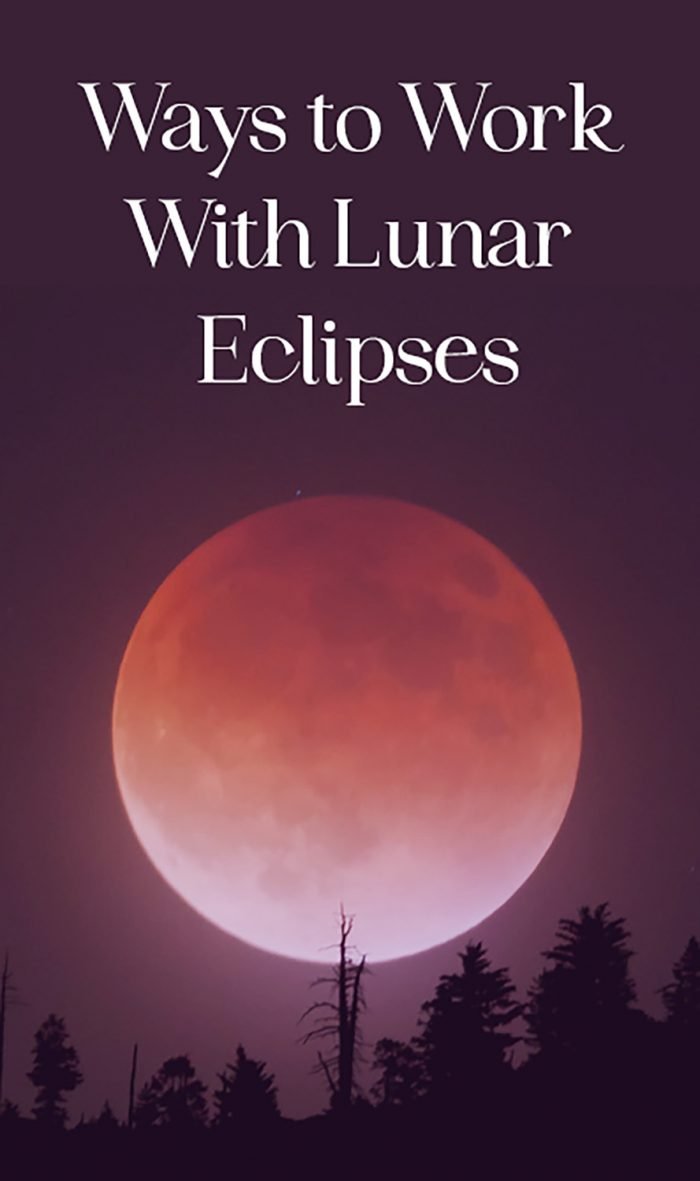
The super blood moon of September 27th, 2015 is silhouetted by the ridgeline near Ontario Peak, California.
How eclipses can affect us
Eclipses bring an amplified and more intense energy that's often palpable. If you're like me and feel a little ungrounded or shaken up from full moons, you'll likely feel that even more from a lunar eclipse. Sleeplessness, exhaustion, extra emotions, and overwhelm can be especially present during eclipse season. I amp up my grounding practices during an eclipse season, especially for lunar eclipses, because I know they shake things up for me. I also expect sleep disturbances and take extra steps to help myself get a good night of rest, or if I can't sleep during these times, I just stay up and roll with it!
Eclipses are a cosmic wild card in a lot of ways. I see them as an opportunity to allow whatever needs to bubble to the surface to arise and be transformed, especially when it comes to lunar eclipses. I often find that some theme emerges amidst eclipse season. The themes that arise will be unique to each of us. Although the sign the eclipses are occurring can certainly color what comes up. Any themes that arise are your opportunity to examine, learn, and possibly transform.
The flavor of how transformations occur will likely feel different during eclipse season. Unlike most lunations, in my experience, when we can be present with the energy of eclipse seasons, they work on us very passively, without much action on your part. For most new or full moons, there's an emphasis on taking specific steps and actions for the desired outcome. I see eclipse season as a road trip where I don't know the destination. But if I decide to take the ride, it will undoubtedly be transformative. You may be less in control of the experience with eclipses, which can no doubt be scary, but the outcome can also be more impactful.
The effects of eclipse season can be long-lasting, as long as six months or even years. Which honestly makes sense. If eclipses are intended to bring big things to the surface to be transformed, they will potentially affect our lives in significant ways. That said, and I'll stress this often, these celestial events aren't something to fear. Like Mercury Retrograde, they're opportunities to witness things that need to arise and allow new themes to arise that can potentially be long-lasting. These are some of the reasons why eclipses are touted as cosmic wildcards!
How will Scorpio affect this lunar eclipse?
Scorpio gets a bad reputation sometimes, but it's honestly one of my favorite signs! That said, I have three planets in Scorpio, if you don't, it might feel like scary energy to work with. Scorpio rules over themes relating to all things taboo like death and sex. Scorpio energy encourages us to go deep and face our shadows. It calls us to examine our fears so we can learn from them and work with them in more liberating ways.
In tarot, Scorpio relates to Death and the King of Cups. The death card in the tarot, unlike the tower, is often a call to willingly embark on a transformation. Unlike the tower card, the death card often surfaces when it's time for us to begin a journey to examine parts of ourselves, often ignored so we can learn from them and transform anew. The King of Cups is a master of their emotions, even the scary ones. This is another theme for watery and emotional Scorpio; they're not afraid to go there, to face their emotions and bring them to the surface so they can be witnessed and allowed to flow.

Death and King of Cups card from Journey Tarot
Scorpio season governs over the season of Samhain. Another nod to its connection with shedding, death, and embarking on transformations. I'm sure you're starting to see a theme arise with all of these corresponding deep energies associated with Scorpio. Perhaps you can also see why these themes paired with a lunar eclipse have such potential.
So, where does this leave you for a full moon eclipse in Scorpio?
Here's how I see it. Full moons are already a time to release, let go, and transform. Bringing Scorpio in is a call to be fully present with EVERYTHING that's coming up, not to look away, and to sit with what's arising even if it feels ick. Scorpio is asking you to allow your emotions to surface so they can be felt and seen. The eclipse is calling them up to be transformed. I see the eclipse as a real gem, a guide of sorts, here to show us what needs to be transformed and help to potentially begin the transformation.
What to do for eclipse moons?
Eclipses can be amazing because if you decide to go for the eclipse ride, they can do a lot of the heavy lifting. I look forward to eclipses. For this reason, it's not the time to be doing a lot of spellwork, ritual, or deep meditative work. It's a time to sit back, allow, and observe—especially an eclipse in Scorpio. There's also a lot you CAN do during an eclipse that can be super supportive. Here are some simple ways to honor this lunar eclipse or any lunar eclipse.
Notice what's coming up
Journal about your emotional state and what's coming up
Meditate with openness and curiosity
Pull some cards, not for divination, but as a mirror to what's going on for you. Find an excellent card spread for eclipse season here!
Engage in activities that make you happy, safe, grounded, and supported
Take a salt bath
Smoke cleanse
Not Generally Recommended Activities for an Eclipse
Manifesting
Releasing or cord-cutting rituals
Candle spells
Making moon water
Spellwork
Deep journey work
Just like Mercury Retrograde, eclipses aren't something to fear. They're an opportunity to be more reflective, inward-focused, and passive. I also see them as a sort of cosmic reset. I often notice that whatever arises for me during eclipse season arises for a reason. It's usually something I've been avoiding. If I answer the call to face it, I often find myself leaving eclipse season with a fresh outlook and renewed energy to approach whatever it is that's surfacing.
I hope these offerings have given you some peace around this lunar eclipse and perhaps a deeper acceptance of the emotional waves often associated with them. If not, it's also a great excuse for a yummy salt bath. Happy full moon!


Full Moon in Libra Harmony Ritual
The full moon in Libra is an invitation to move into more harmony. A cardinal air sign associated with Venus, the planet of love and beauty, Libra inspires you to make space in your internal and external world to find a greater sense of peace and tranquility. Keep reading for more about the energy of this full moon and ways to work with it.

The full moon in Libra is an invitation to move into more harmony. A cardinal air sign associated with Venus, the planet of love and beauty, Libra inspires you to make space in your internal and external world to find a greater sense of peace and tranquility. By honoring the full moon in Libra, you can open yourself to guidance around what needs to go, stay, and be accepted in your life.
Finding harmony in your life isn’t always about getting rid of everything uncomfortable. Perhaps some things in your life are ready to go, or you need to set some boundaries to create more ease in your life. But, sometimes being in harmony means finding acceptance for what is.
Below are some ritual suggestions to find more harmony during this full moon.

Themes For This Full Moon
Themes: Harmony, balance, beauty, peace
Element: Air
Modality: Cardinal
Harmony Finding Ritual for the Full Moon in Libra
These ritual suggestions can help you find harmony, even amid challenging times. The ideal time to perform this ritual is the day before, on, or after the full moon. As always, take what you like, leave what you don’t, and modify as needed!
You’ll need:
15-30 minutes of quiet and uninterrupted time
Pen or pencil and paper
Oracle or tarot card deck of choice
rose quartz (or any other stone that corresponds to the heart)
Optional: pink candle

1. Create sacred space by grounding yourself and connecting with your breath and body. If you’re using a pink candle, hold it in your hands for a couple of breaths while focusing on inviting in more harmony. If casting a circle or calling in the quarters is in your practice, you could do this too.

2. Sit, and begin connecting with your breath. Elongate your inhales and exhales and try to make them equal in length.
3. Close your eyes and go within. Visualize a soft pink light around your heart space. Imagine it growing with each inhale.

4. When you feel connected to your heart space, ask aloud or within your mind, “What does my heart need to be in better harmony?” or “What does my heart want to show me right now?”.
5. Stay in this space connecting with your heart for 5-20 minutes. When you feel ready to end this meditation, thank your heart space for anything it shared with you and open your eyes.
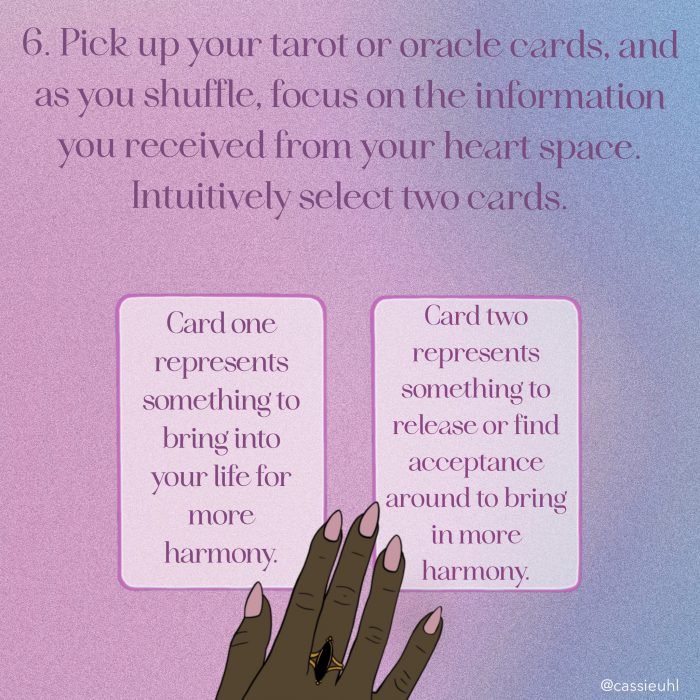
6. Pick up your tarot or oracle cards, and as you shuffle, focus on the information you received from your heart space. Intuitively select two cards. Card one represents something to bring into your life, and card two represents something to release or find acceptance around.
7. Consider displaying the cards you selected in the previous step somewhere you'll see them regularly as reminders.

8. On your paper, write down any insights you received from your meditation or your card spread about feeling more harmonious.

9. Place your paper on a window sill or your altar with the piece of rose quartz on top for a day and night of the full moon. When complete, you can keep your paper somewhere you’ll see it often or turn it over to the earth by burying or recycling it.
This full moon ritual can be adapted or used for any full moon or any full moon in Libra. As always, take what you like and leave the rest. Love & gratitude, Cassie


Full Moon in Cancer Ritual
The full moon in Cancer offers a supportive and nurturing space for you to explore the watery world of your emotions, and initiate healing. Cancer’s planetary correspondence is the moon, so this full moon can feel especially intense, emotional, and intuitive moon. You may feel more sensitive and emotional than usual. This lunation is a call to explore and revel in any feelings and sensitivities that arise rather than pushing them away. Be gentle with yourself and open to rolling with any waves this moon stirs up.
The full moon in Cancer offers a supportive and nurturing space for you to explore the watery world of your emotions, and initiate healing.
Cancer’s planetary correspondence is the moon, so this full moon can feel especially intense, emotional, and intuitive. You may feel more sensitive and emotional than usual. This lunation is a call to explore and revel in any feelings and sensitivities that arise rather than pushing them away. Be gentle with yourself and open to rolling with any waves this moon stirs up.
If you enjoy this ritual, I invite you to share it with someone else who might benefit from it as well.

Themes for this full moon: Nurturing, supportive, family-oriented, intuitive, healing, cleansing
Element: water
The ideal time to perform this ritual is the day before, the day of, or the day after the full moon.

You’ll need:
15-30 minutes of quiet and uninterrupted time
Bath, shower, or body of water
A glass of water or cup of tea
Cozy clothes
Optional: moonstone, any scented oils or herbs that feel nurturing and supportive to add to your bath
1. For this ritual, you’ll be invited to soak in a bath or body of water. If you do not have one, you can perform this ritual in a shower as well. Before you begin the ritual, take a moment to prepare a cup of tea or have a glass of water ready for when your bath or shower is over.
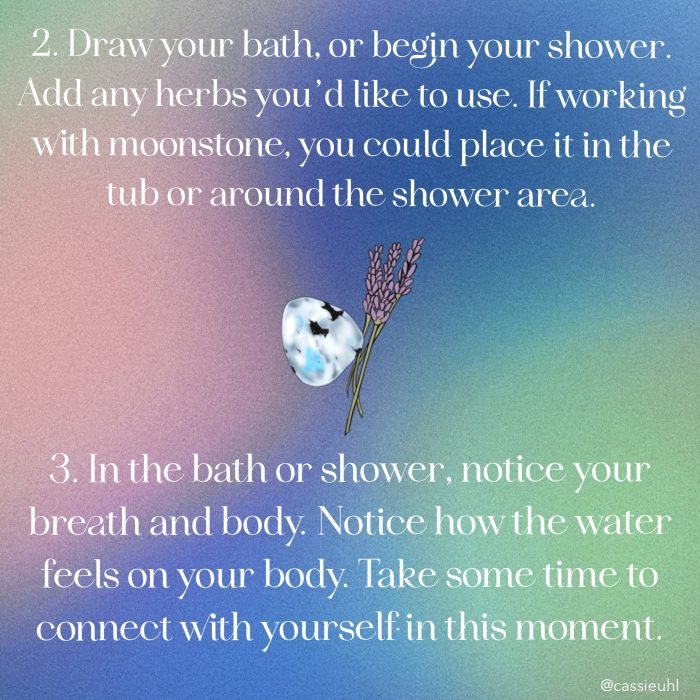
2. Draw your bath, or begin your shower. Add any herbs you’d like to use. If working with moonstone, you could place it in the tub or around the shower area.
3. In the bath or shower, begin connecting with your breath and body to help you root into the moment. Notice your breath and body, how they feel, what feels good, and any aches or pains you may have. Notice how the water feels on your body.

4. Once you feel connected to your body and the water, allow yourself to explore your emotions. Are there any feelings that need to be felt or come out that you haven’t had time to allow? Feel and allow.
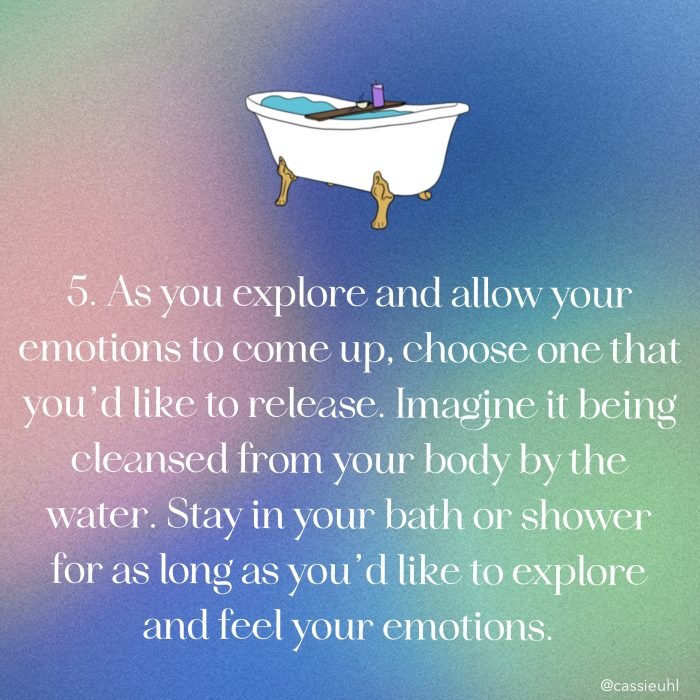
5. As you explore and allow your emotions to come up, choose one that you’d like to release. Imagine it being cleansed from your body by the water. Stay in your bath or shower for as long as you’d like to explore and feel your emotions.

6. When you feel ready to get out of the bath or shower, turn off the shower or unplug the bath, and visualize anything you released going down the drain with the water.
7. Finish up your bath or shower and put on some clothes or pajamas that feel exceptionally comfortable and nurturing. Feel free to add in any additional self-care here, like self-massage with a favorite oil.

8. When you’re ready, take a few moments to connect inward again with your cup of tea or water in hand. Bring to mind something that would make you feel nurtured and at home. Infuse your water or tea with these thoughts.

9. Begin taking drinks of your water or tea and feel your body become filled with this support and care. Consider saving a bit of water or tea to pour into the heart as a sign of gratitude and as a way to share this support with others who may need it too.
10. If you feel called, consider following up with some journaling or a card pull to explore this experience and full moon further.
This full moon ritual can be adapted or used for any full moon or any full moon in Cancer. As always, take what you like and leave the rest. In love & gratitude, Cassie


Full Moon in Gemini Ritual
This Gemini full moon is an opportunity to connect with your spirit to turn your soul whispers into reality, shifting the formless into concrete steps and actions. Mutable Gemini seeks to connect, find truth, and be reciprocal. When we marry these themes with the energy of the full moon, it's a powerful time to transform nudges from spirit into tangible and actionable steps so that you may share them with others.
This Gemini full moon is an opportunity to connect with your spirit to turn your soul whispers into reality, shifting the formless into concrete steps and actions.
Mutable Gemini seeks to connect, find truth, and be reciprocal. When we marry these themes with the energy of the full moon, it's a powerful time to transform nudges from spirit into tangible and actionable steps so that you may share them with others.
So, dear one, what has spirit been nudging you to do? Where are you feeling pulled and called to expand and explore? What are the subtle whispers of your soul that you've yet to breathe life into?
Gemini corresponds with the magician in the tarot, which speaks to the heart of this ritual. The magician has their magickal tools and the four elements swirling within and around them. The magician's task is to alchemize with these tools to create authentic and solid change to improve themselves and the world around them.
This full moon is an opportunity to draw out the whispers from your soul, and use your chosen tools to alchemize, and bring these whispers to life. When your spirit comes knocking, it's an opportunity for you to bring real concrete change to ourselves and the world around us, and a Gemini full moon is a beautiful opportunity to catalyze this process.

For this ritual, you will need:
20-40 minutes of quiet time
Herbal smoke or incense of choice
Pen/pencil and paper
Optional: apatite and quartz

Ritual Steps:
1. Collect your items, so they're nearby. Connect with your breath and body to root into your space by taking a few deep breaths and noticing how your body feels.
2. Create a sacred space in a way that feels good and natural for you. This could be connecting with the earth's energy, casting a circle, or calling on guides or deities you work with in your practice.

3. Using your herbal smoke of choice, cleanse your body with the smoke visualizing it pulling away anything you may be carrying around from others.
4. Ask yourself aloud or in your mind, "What truths does my soul need me to bring forward at this current phase in my life?" (or something similar that feels good to you.) If you're working with apatite, this would be a great time to hold onto it as you meditate.
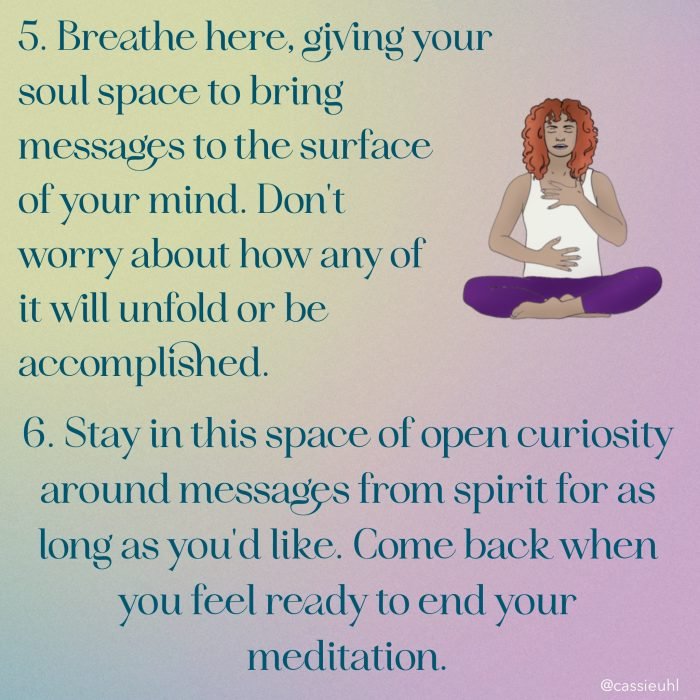
5. Breathe here, giving your soul space to bring messages to the surface of your subconscious mind. Don't worry about how any of it will unfold or be accomplished at this point.
6. Stay in this space of open curiosity around messages from spirit for as long as you'd like. Come back when you feel ready to end your meditation.

7. With your pen and paper, write down any insights that came to you from spirit.
8. Invite spirit to guide by asking aloud or in your mind, "Spirit, please guide me and show me how I can bring these suggestions to life" (or something similar that feels right for you.)

9. Spend some time free-writing, allowing spirit to flow through you onto your paper. At this point, don't worry about grammar, spelling, or whether or not it makes any sense. Write and doodle for as long as you feel comfortable doing so.
10. When you feel ready to stop, begin to look over what you wrote. Pull out a few actionable and concrete steps you can start taking to bring this suggestion from spirit into reality.

11. Write these steps on a new piece of paper. Place the piece of paper on an altar, or somewhere you'll see it regularly. If you're working with the piece of quartz, you can place your piece of quartz on top of it under the light of the full moon to help amplify your actions.
12. In the coming days and weeks, check in with your list to help keep yourself accountable for the actions you and your soul brought to light.
Once you've completed the steps suggested by spirit, you can burn or bury your paper.
As always, take what you like and leave the rest! Don't hesitate to modify this ritual to suit your unique path. Wishing you a beautiful full moon!

New Moon in Scorpio: Exploring Your Depths
The new moon in deep Scorpio offers you an opportunity to explore your deepest desires and be curious about how to bring them into the world, no matter how uncomfortable it may be. A fixed water sign, Scorpio invites you to dive into the depths of your subconscious to help excavate your true purpose for being here. Tune into the depths of this Scorpio new moon energy to explore the parts of yourself you often hide and find ways to bring them out into the open.
The new moon in deep Scorpio offers you an opportunity to explore your deepest desires and be curious about how to bring them into the world, no matter how uncomfortable it may be. A fixed water sign, Scorpio invites you to dive into the depths of your subconscious to help excavate your true purpose for being here.
Tune into the depths of this Scorpio new moon energy to explore the parts of yourself you often hide and find ways to bring them out into the open. There’s more beneath the surface ready to be known.

Ritual Support for the Scorpio New Moon
If you enjoy this ritual, I invite you to share it with someone else who might benefit from it as well. Themes for this full moon: Soul searching, shadow work, fears, desires, finances, death, transformationElement: Water
The ideal time to perform this ritual is the day before the new moon, on the new moon, or the day after the new moon.
You’ll need:
15-30 minutes of quiet and uninterrupted time
Vessel of water
Pen/pencil and paper
Optional: amethyst
1. Create sacred space by grounding yourself and connecting with your breath and body. If casting a circle or calling in the quarters is in your practice, you could do this too.

2. Sit, close your eyes, and begin to connect with your breath and body. If you're using amethyst you can hold it or place it near you to inspire your intuition.

3. In this meditative state, ask aloud or in your mind, “Show me my soul’s deepest desire.” Breathe and allow your mind to take you where it wants to go. Be open to visualizations, messages, or feelings that may arise.

4. After spending some time with the first question, and when you feel ready, ask aloud or in your mind, “Show me my next steps to be in better alignment with my soul’s deepest desires?” Again, breathe and allow your mind to take you where it wants to go. Be open to visualizations, messages, or feelings that may arise. The subconscious mind often works through symbols. Be open and curious about anything that comes through to you, understanding that even though it may not make sense at the moment, it may later.

5. When you feel ready to come out of your meditation, thank any guides who came through to offer guidance, then write down any insights that came to you.

6. Place your paper in your vessel of water to remain there until the moon is full. Check in with your bowl of water with the paper in it each day to refill with water if needed, touch into the feelings you experienced, and as a reminder to take continued action towards your soul’s desires, even when it feels challenging.

7. At the time of the next full moon, bury your paper outside and pour the water on top of it, trusting that you will be guided in your soul’s journey. This new moon ritual can be adapted or used for any new moon or new moon in Scorpio. As always, take what you like and leave the rest.

Full Moon in Aries Ritual: Honoring Your No
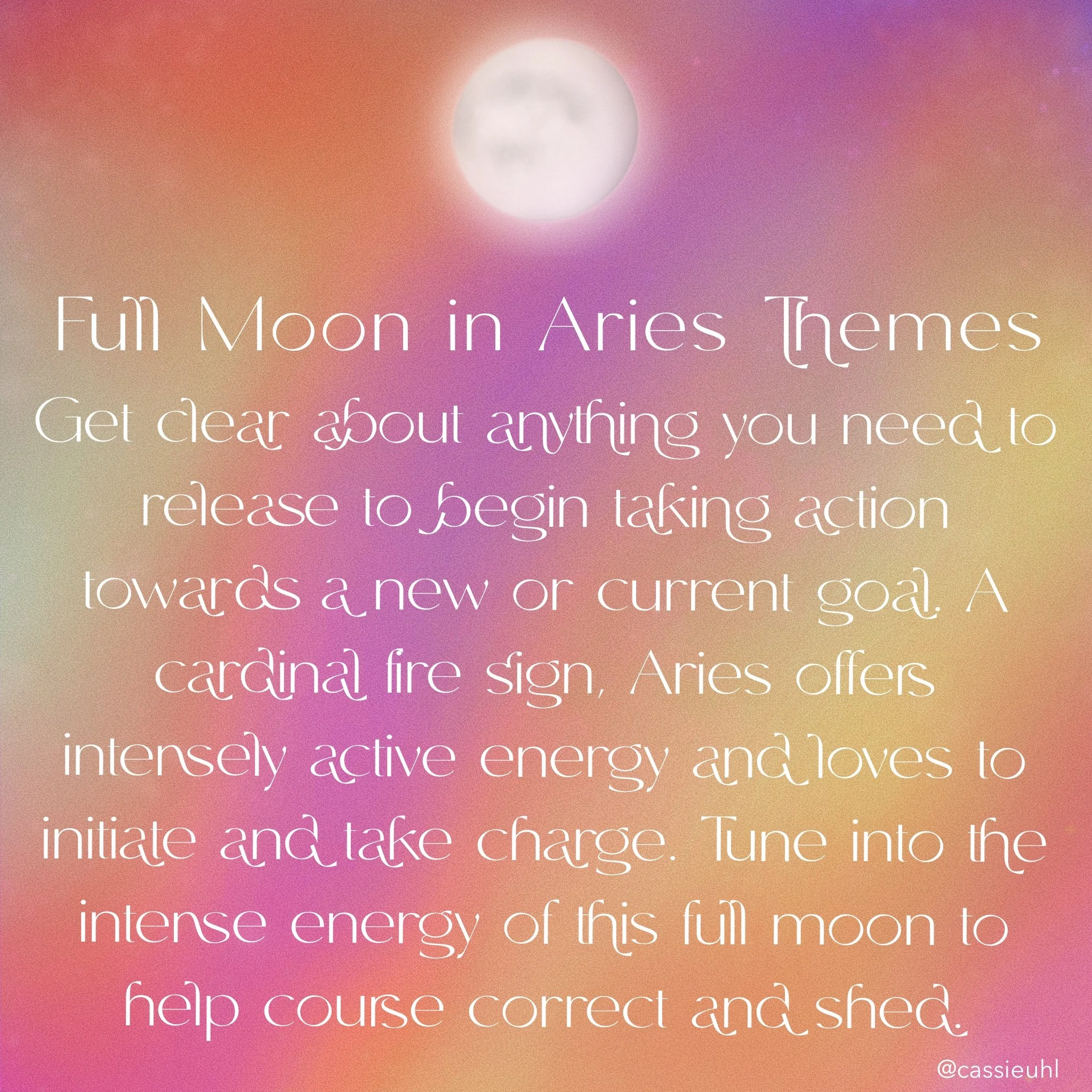
The full moon in fiery Aries offers you an opportunity to get clear about anything you need to shed or release to begin taking action towards a new or current goal. A cardinal fire sign, Aries offers intensely active energy and loves to initiate and take charge. Tune into the intense energy of this full moon to help course correct and shed. If you enjoy this ritual, I invite you to share it with someone else who might benefit from it as well.
The full moon in fiery Aries offers you an opportunity to get clear about anything you need to shed or release to begin taking action towards a new or current goal. It’s a time to take acknowledge and claim your sacred “no”, for yourself, your loved ones, and your community. When you know your “no’s” you can clarify your “yes’s” and move towards them with greater confidence.
A cardinal fire sign, Aries offers intensely active energy and loves to initiate and take charge. Tune into the intense energy of this full moon to help course correct and shed.
Themes for the Full Moon in Aries
Themes: Initiation, action, holding boundaries, intense shedding and releasing, course corrections, change, and transformation
Element: Fire
Planetary Correspondence: Mars
Tarot correspondence: The Emperor
Full Moon in Aries Ritual Support
The ideal time to perform this ritual: This ritual is designed to be performed on the waning side of the full moon, anytime after the peak fullness of the moon to two days after.
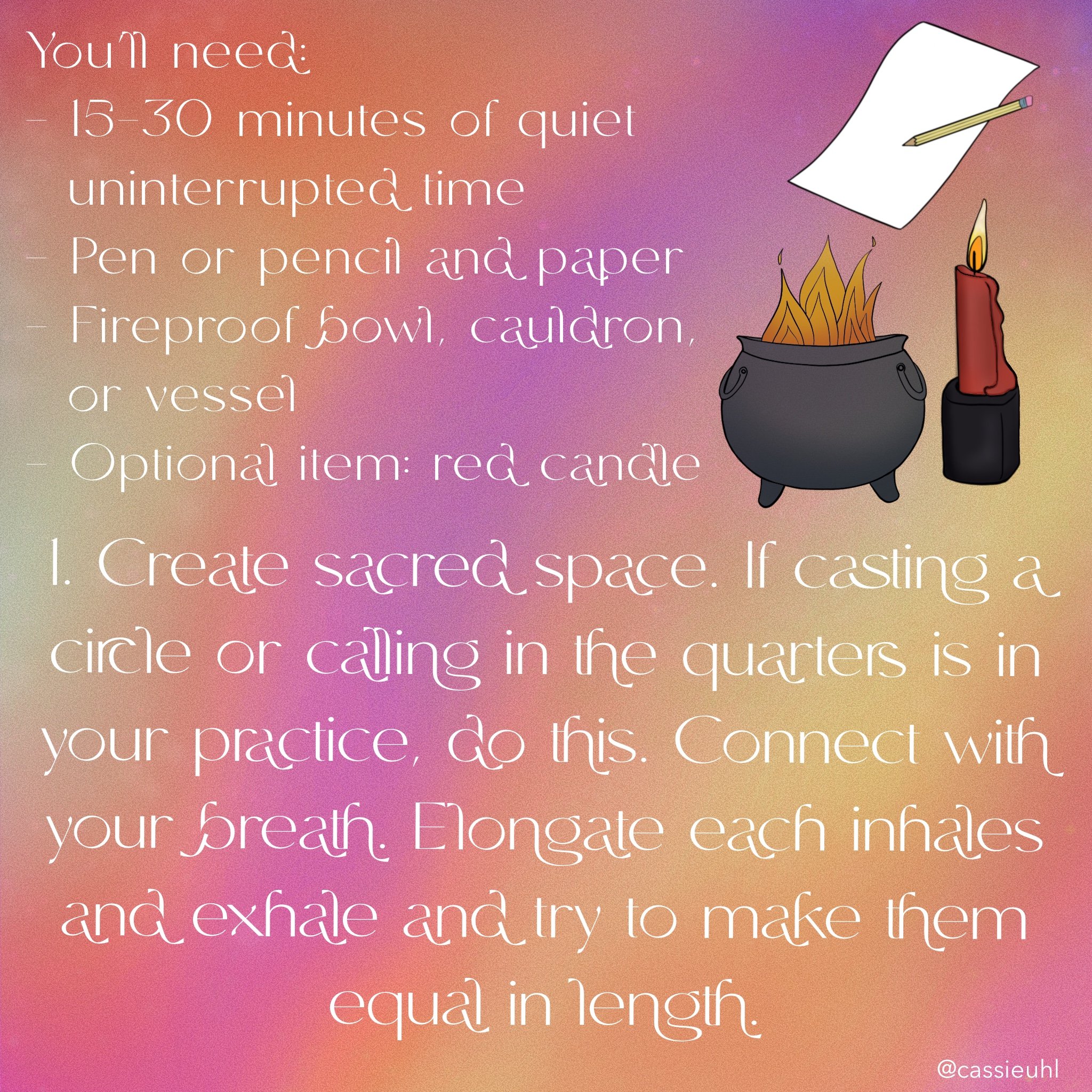
You’ll need:
15-30 minutes of quiet and uninterrupted time
Pen or pencil and paper
Fireproof bowl, cauldron, or vessel
Optional item: red candle
1. Create sacred space by grounding yourself and connecting with your breath and body. If casting a circle or calling in the quarters is in your practice, you could do this too. Sit and begin connecting with your breath. Elongate each inhale and exhale and try to make them equal in length.
2. Ask yourself (aloud or in your mind), “What action, habit, or way of being could I release or say “no” to, to find more ease in attaining my goal (feel free to insert your personal goal here)?”
Optional: If you’re using a red candle, hold it in your hands and bring to mind the situation you’re seeking guidance around.

3. Begin to enter a meditative state by focusing on your breath and body. If you’re using the candle, you can gaze at its flame. If you’re not, you can close your eyes and visualize fire and allow it to share any messages with you. Stay in this space for 5-15 minutes.

4. Once you’ve received guidance around what you need to shed, thank any guides who came through, and exit your meditation. Write down what you’re ready to shed on a piece of paper.

5. In a well-ventilated location, light your paper on fire and place it in your fireproof vessel or cauldron. Stay with it as it burns, and visualize what needs to be released from you being burned up as the paper burns. This can be intense and bring up emotions. I encourage you to let them flow as much as possible.

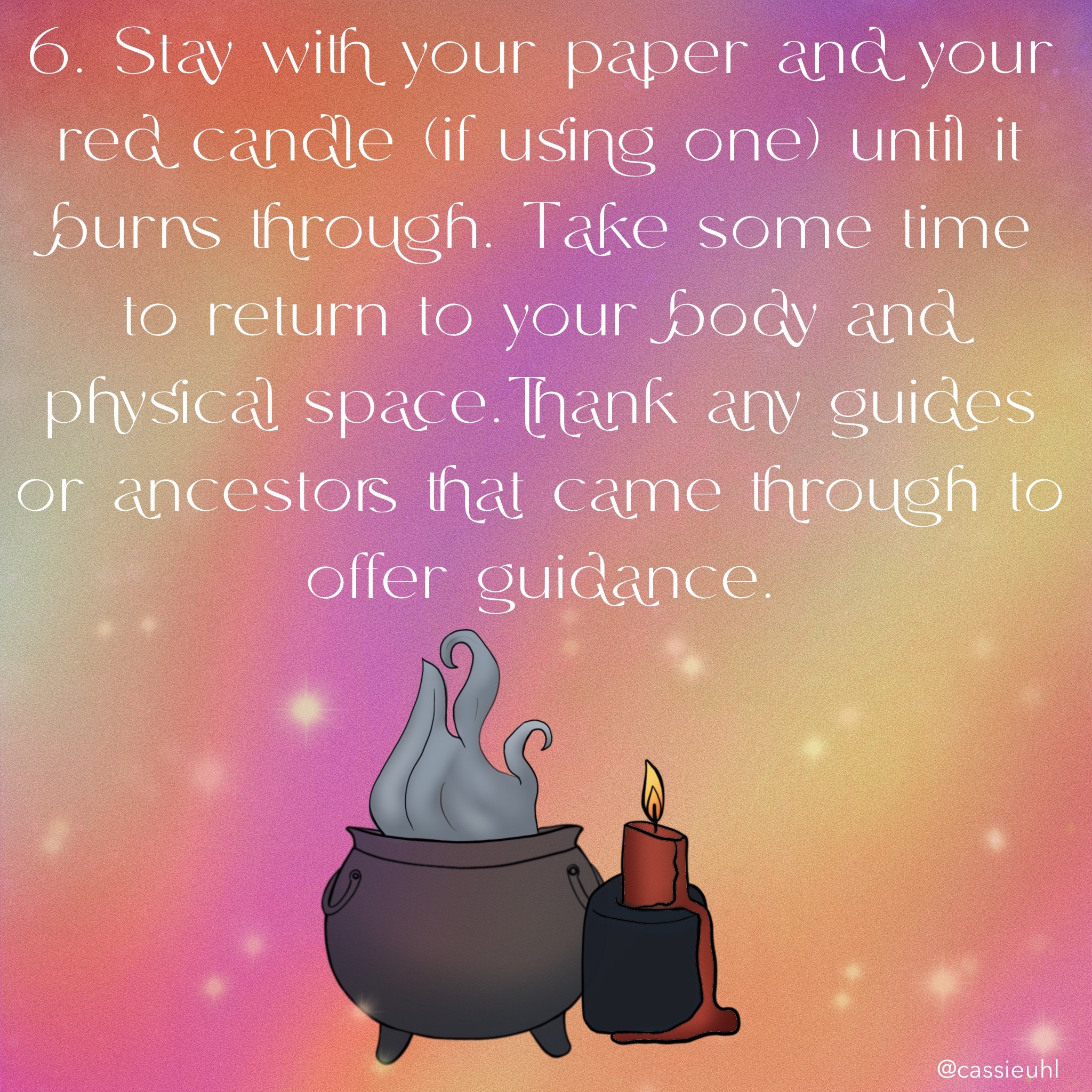
6. Stay with your paper and your red candle (if using one) until it burns through. Take some time to return to your body and physical space. Thank any guides or ancestors that came through to offer guidance.
7. Ritual follow-up: To further the theme of releasing, consider releasing the ashes from your burned paper back into the earth or a body of water to be alchemized into something new.
This full moon ritual can be adapted or used for any full moon or any full moon in Aries. As always, take what you like and leave the rest. All drawings are featured from my "Zenned Out Guides" book series with Quarto Knows. Love & Shadow, Cassie

New Moon in Libra Ritual: Sacred Connection
The new moon in Libra offers you an invitation to be open to bringing more beauty and connection into your world. New moons are always a time for being open to new ideas and ways of being in the world, our cosmic clean slate if you will. As a cardinal air sign, Libra energy is one of balance and initiation. The planetary rulership of this sign is Venus, bringing in the energy of love and beauty.

The new moon in Libra offers you an invitation to be open to bringing more beauty and connection into your world.
New moons are always a time for being open to new ideas and ways of being in the world, our cosmic clean slate if you will. As a cardinal air sign, Libra energy is one of balance and initiation. The planetary rulership of this sign is Venus, bringing in the energy of love and beauty. Learn more about Libra energy here.
The energy of Libra within a new moon calls you to explore themes of beauty, reciprocity, and connection. Here are some questions to focus on for this new moon. What areas of your life are calling out for more beauty? How can you allow in more beauty? In what ways can you be in more sacred and aligned reciprocity with yourself, those around you, and the world at large?

Themes for the New Moon Libra
Themes: Justice, balance, beauty, love, connection, and reciprocity
Planet: Venus
New Moon in Libra Ritual for Sacred Connection
The best time to perform this ritual with the new moon in Libra is the day of or the two days after the new moon.
You’ll need:
15-30 minutes of quiet and uninterrupted time
Piece of rose quartz
Optional: rose scent (incense, dried rose, etc.), guided meditation to connect with your guides (free for newsletter subscribers, click here to receive).

1. Ensure that you have 15-30 minutes of uninterrupted quiet time. Create a sacred space in a way that feels good to you, for example, burning incense or herbs mentioned above, calling in the four directions, or casting a circle. Root into the space by connecting with your breath and body. Notice your body and how it feels. Begin to breathe more intentionally, sending your breath deep into your low belly.
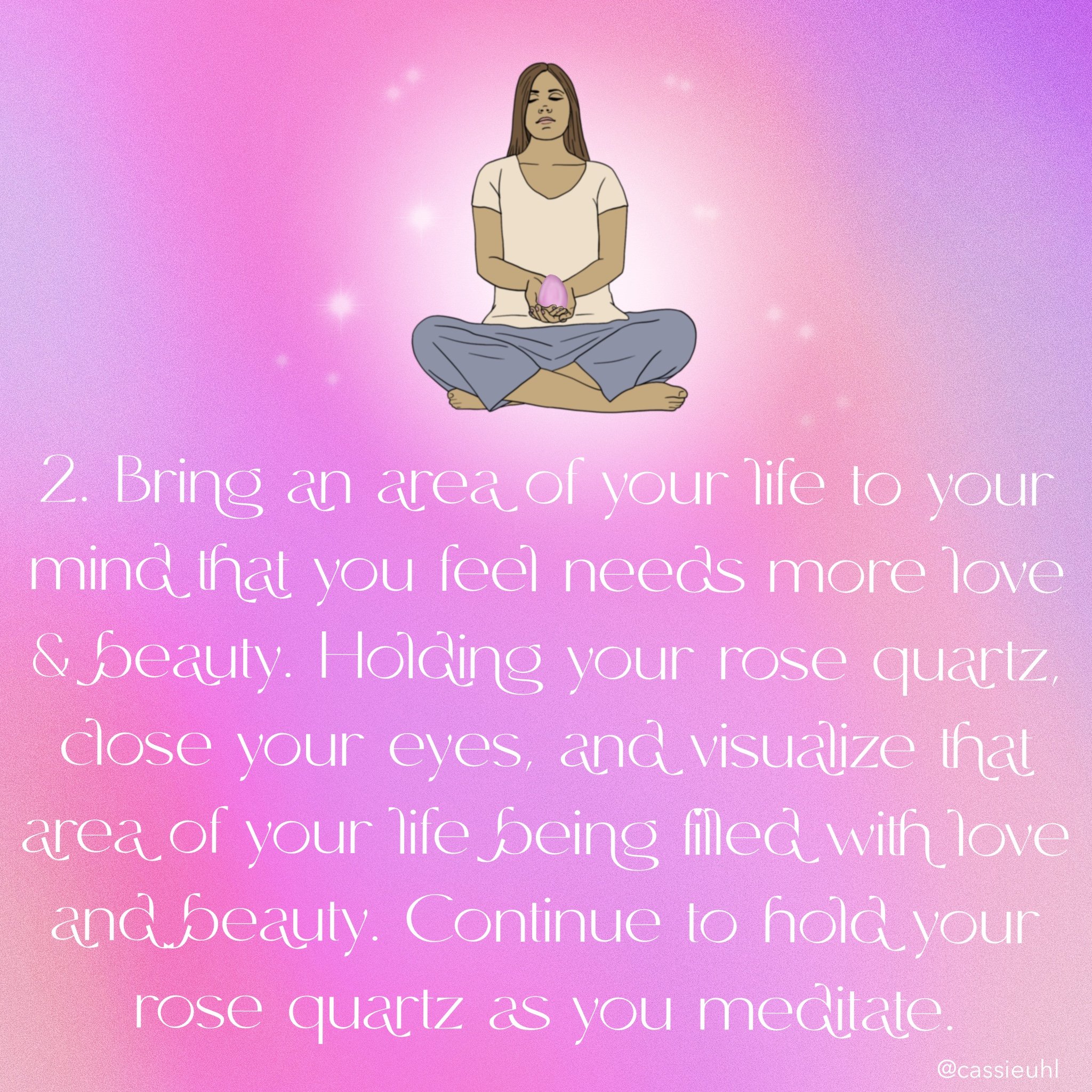
2. Bring an area of your life to your mind that you feel needs more love and beauty. Holding your rose quartz in your hands, close your eyes, and visualize that area of your life being filled with love and beauty. Continue to hold your rose quartz as you meditate.
3. Close your eyes and prepare to journey to meet one of your guides to help you bring more love and beauty into this area of your life. State aloud or in your mind, “I’m ready to receive guidance around __________ and be in sacred reciprocity with a guide, please, make yourself known to me.” Click here to be taken to a free guided meditation to connect with your guides.

4. As you meditate, focus on your breath and your body. If you can visualize a beautiful location in your mind, do this now, as this can create a space to commune with a guide.
5. Be open to guidance, suggestions, and wisdom from spirit. Trust what comes to you.

6. If a spirit guide presents itself to you and offers guidance, ask what you can do to reciprocate the information shared with you.
7. Close your meditation by thanking any guides who came through. Consider writing down anything that came through to help process and remember.
8. If your guide made a request for reciprocity, be sure to act on it. If they did not, consider creating an offering on your altar to show your gratitude for the connection and wisdom shared.

9. Leave your rose quartz out the night of the new moon to carry with you afterward as a reminder of how to bring more love and beauty into your life.

If you enjoyed this ritual, please consider sharing it with someone else who may enjoy it too. New moon blessings!
