
Full Moon in Cancer Ritual
The full moon in Cancer offers a supportive and nurturing space for you to explore the watery world of your emotions, and initiate healing. Cancer’s planetary correspondence is the moon, so this full moon can feel especially intense, emotional, and intuitive moon. You may feel more sensitive and emotional than usual. This lunation is a call to explore and revel in any feelings and sensitivities that arise rather than pushing them away. Be gentle with yourself and open to rolling with any waves this moon stirs up.
The full moon in Cancer offers a supportive and nurturing space for you to explore the watery world of your emotions, and initiate healing.
Cancer’s planetary correspondence is the moon, so this full moon can feel especially intense, emotional, and intuitive. You may feel more sensitive and emotional than usual. This lunation is a call to explore and revel in any feelings and sensitivities that arise rather than pushing them away. Be gentle with yourself and open to rolling with any waves this moon stirs up.
If you enjoy this ritual, I invite you to share it with someone else who might benefit from it as well.

Themes for this full moon: Nurturing, supportive, family-oriented, intuitive, healing, cleansing
Element: water
The ideal time to perform this ritual is the day before, the day of, or the day after the full moon.

You’ll need:
15-30 minutes of quiet and uninterrupted time
Bath, shower, or body of water
A glass of water or cup of tea
Cozy clothes
Optional: moonstone, any scented oils or herbs that feel nurturing and supportive to add to your bath
1. For this ritual, you’ll be invited to soak in a bath or body of water. If you do not have one, you can perform this ritual in a shower as well. Before you begin the ritual, take a moment to prepare a cup of tea or have a glass of water ready for when your bath or shower is over.
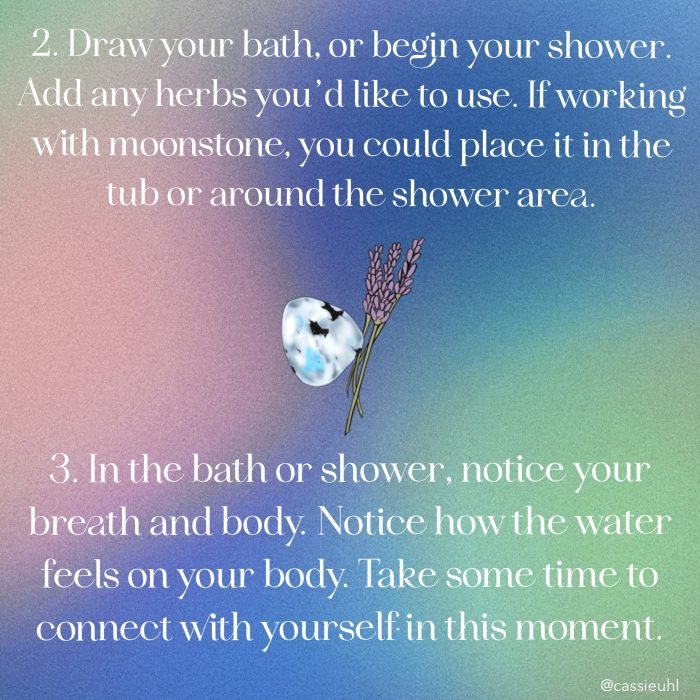
2. Draw your bath, or begin your shower. Add any herbs you’d like to use. If working with moonstone, you could place it in the tub or around the shower area.
3. In the bath or shower, begin connecting with your breath and body to help you root into the moment. Notice your breath and body, how they feel, what feels good, and any aches or pains you may have. Notice how the water feels on your body.

4. Once you feel connected to your body and the water, allow yourself to explore your emotions. Are there any feelings that need to be felt or come out that you haven’t had time to allow? Feel and allow.
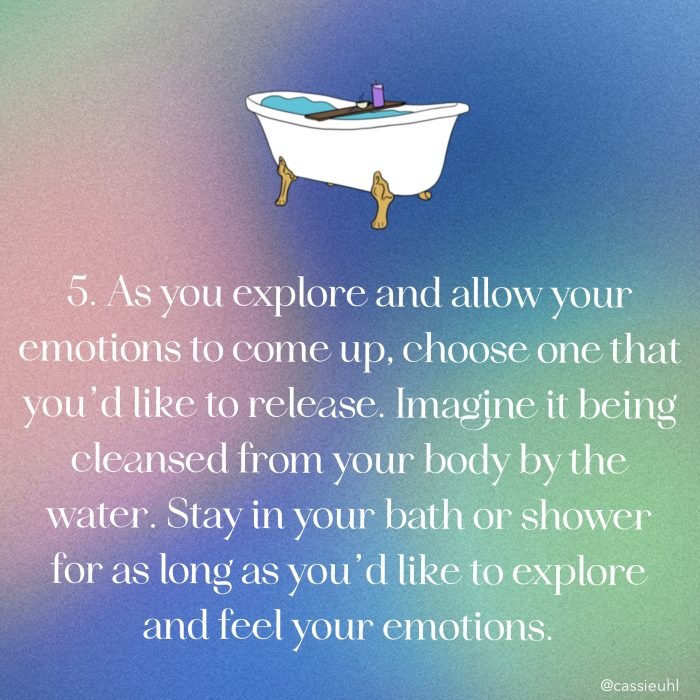
5. As you explore and allow your emotions to come up, choose one that you’d like to release. Imagine it being cleansed from your body by the water. Stay in your bath or shower for as long as you’d like to explore and feel your emotions.
6. When you feel ready to get out of the bath or shower, turn off the shower or unplug the bath, and visualize anything you released going down the drain with the water.
7. Finish up your bath or shower and put on some clothes or pajamas that feel exceptionally comfortable and nurturing. Feel free to add in any additional self-care here, like self-massage with a favorite oil.

8. When you’re ready, take a few moments to connect inward again with your cup of tea or water in hand. Bring to mind something that would make you feel nurtured and at home. Infuse your water or tea with these thoughts.

9. Begin taking drinks of your water or tea and feel your body become filled with this support and care. Consider saving a bit of water or tea to pour into the heart as a sign of gratitude and as a way to share this support with others who may need it too.
10. If you feel called, consider following up with some journaling or a card pull to explore this experience and full moon further.
This full moon ritual can be adapted or used for any full moon or any full moon in Cancer. As always, take what you like and leave the rest. In love & gratitude, Cassie


New Moon in Capricorn Ritual
The new moon in the cardinal sign of Capricorn is an invitation to explore themes of building supportive and nurturing foundations. This timely Capricorn new moon usually falls around the new year on the Gregorian calendar, where you may already be exploring goals or new paths for your year ahead.
The new moon in the cardinal sign of Capricorn is an invitation to explore themes of building supportive and nurturing foundations. This timely Capricorn new moon usually falls around the new year on the Gregorian calendar, where you may already be exploring goals or new paths for your year ahead.
The energy of Capricorn reminds you to pause and reflect on how you may need to nurture and care for yourself to grow in new ways. Because Capricorn is a cardinal sign, it carries an energy of initiation. This doesn’t necessarily mean taking direct action towards your goals but instead pausing to ensure that you have taken the necessary steps to build a structurally sound and sturdy foundation in which you can build upon.

If you enjoy this ritual, I invite you to share it with someone else who might benefit from it as well.
Themes for this full moon: Structure, stability, building foundations, planning necessary steps to begin a new phase, nurturing yourself
Element: Earth
The ideal time to perform this ritual is the day before the new moon, on the new moon, or the day after the new moon.

You’ll need:
20-30 minutes of quiet and uninterrupted time
Comfortable place to sit or lie down
Pen/pencil and paper
Any grounding crystal or stone from outside
1. Create sacred space by grounding yourself and connecting with your breath and body. If casting a circle or calling in the quarters is in your practice, you could do this too.
2. Sit or lie down, close your eyes, and begin to connect with your breath and body. Place your grounding stone in your hands, on your lap, or somewhere on your body.

3. Take a few moments to reflect on something you’d like to initiate in the coming weeks or months. Because this sign calls you to build a strong foundation, this is an ideal time to reflect on something that may feel daunting or big to begin.

4. Once you have something in mind, place your hands on your grounding stone and notice its weight, solidness, and structure. Think about the new adventure you have in mind to initiate and what you would need to feel supported, nurtured, and held as you begin taking action towards it.

5. As ideas come to mind, imagine sending them into your grounding stone upon which your hands are resting. Allow yourself to think of as many supportive and nurturing things to support you in this new endeavor. Don’t worry about how feasible any of them are. Simply allow yourself to feel into this space of being held and supported.

6. When you feel ready, slowly come out of the meditation. Take a few moments to write down suggestions or ideas that came to you around feeling supported and ways to build a strong foundation for any new endeavor.
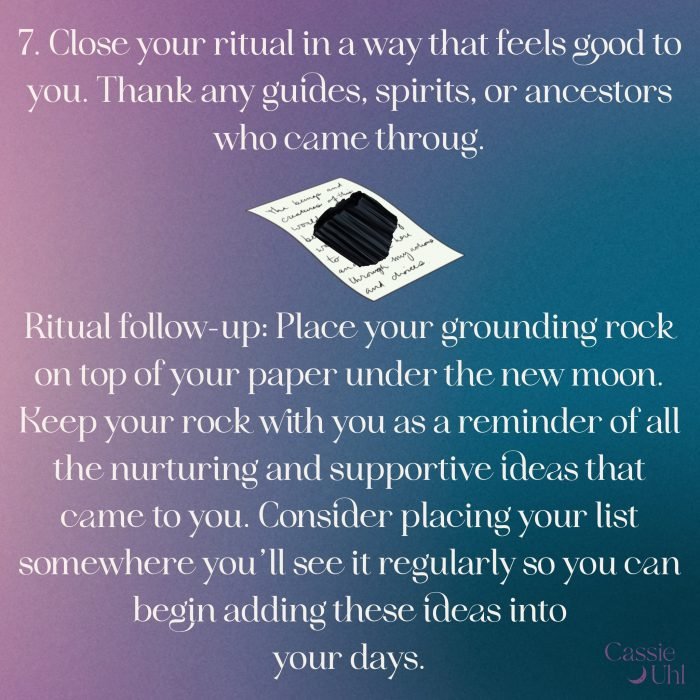
7. Close your ritual in a way that feels good to you. Thank any guides, spirits, or ancestors who came through.
8. Ritual follow-up: Place your grounding rock on top of your paper under the new moon. Keep your rock with you as a reminder of all the nurturing and supportive ideas that came to you. Consider placing your list somewhere you’ll see it regularly so you can begin adding these ideas into your days.
This new moon ritual can be adapted or used for any new moon or new moon in Capricorn. As always, take what you like and leave the rest. xoxo Cassie

Card spread & ritual for Capricorn season
Capricorn, our cardinal Earth sign, invites us to create structure, heal around masculinity, and climb the mountain towards our dreams. In this blog post, I’ll be sharing a card spread and a ritual for Capricorn season. To learn more about Capricorn energy and your personal birth chart’s connection to Capricorn, check out our Understanding the Energy of Capricorn Season blog post.
Capricorn, our cardinal Earth sign, invites us to create structure, heal around masculinity, and climb the mountain towards our dreams.
In this blog post, I’ll be sharing a card spread and a ritual for Capricorn season. To learn more about Capricorn energy and your personal birth chart’s connection to Capricorn, check out our Understanding the Energy of Capricorn Season blog post.

Card Spread for Capricorn Season
We’ll use this card spread to explore the invitations and lessons Capricorn has to teach you this season. Feel free to use a tarot deck or an oracle deck for this spread - whichever resonates with you.
I invite you to create a ritual space for you and your deck to communicate by taking a moment to ground and center yourself however feels good to you. In the spirit of Capricorn season and Earth energy, you might like to ground and center by rooting your feet into the ground or placing your hands somewhere on your body and breathing into them.
When you feel grounded and ready, shuffle your deck and draw a card for each of the following questions:
What is Capricorn season here to teach me?
How can I build my dreams and desires this season?
How to create a structure for my softness this season?
Possibilities Capricorn season is opening up for me?

After you pull your cards, sit with them. Try to take some time to journal or meditate with them to really connect with the full meaning they have to offer you. At the end of the season, you might like to revisit your cards and reflect on how they unfolded throughout the season. How did they show up? What did you learn about yourself, and about the cards through the way they manifested this season?
Capricorn Season Ritual for Holding Your Softness
This is a ritual to support you in holding your softness. This is the Capricorn/Cancer polarity: Capricorn creates the supportive space for you to feel all that you feel. In this ritual, you'll create a sacred space to explore your feelings in a supportive and nurturing space.
You’ll need:
a bowl
water
some stones (they could be any kind of stones — I like using stones I’ve gathered from nature around me!)
the structure card you pulled in the tarot spread above.
Ritual steps:
1. Open your ritual with some kind of grounding and centering that feels good to you. If calling in the directions or casting a circle is in your practice, feel free to do that here.
2. When you feel ready, invite in any energies, plants, ancestors, and/or other beings who embody healthy, liberated, masculine energy and have your highest and best at heart. Gender is a construct and energies go beyond binaries, so don’t limit yourself! If it feels like masculine energy and it feels good to you, go ahead and invite it in. You can do this by speaking aloud or silently offering the invitation. If there are no energies or beings you specifically want to name, you can just cast out a wide invitation.
3. When you feel those energies join, notice how you feel. Let them really be here and let it be an invitation to embody your masculine, too — whatever that means to you. Let it take up residence in your body, unfurl this energy from where it already exists within you. See how it feels and what it brings up as you sit in meditation with these energies. Ask them to support you in holding structure for your softness — perhaps breathing into your ribs, the hard, flexible structure that holds your soft organs underneath as inspiration.
4. When you feel ready, place your tarot card next to your bowl and begin lining it with stones. Notice how the stones feel in your hands as you intentionally build an Earth structure for water to sink into.

5. After your structure feels complete, pour water into your bowl. Let the water represent your softness, your feelings, your heart. See how the bowl and the stones can hold it. If feelings arise, trust that you are held by these energies and soften into them. Let this ritual rewire old stories that it isn’t safe to feel, that there isn’t anyone there to hold you, that you can’t fall apart.
6. Stay here as long as you like, and close with a few deep breaths. Leave your bowl on your altar for a few days if you’d like as a reminder of this Capricorn/Cancer polarity, and how held you are in your softness.
Happy Capricorn season and winter solstice! I hope this card spread and ritual support you - share your spreads and rituals on Instagram and tag us @cassieuhl so we can see them!


What is Awen?
Have you wondered what Awen is? Perhaps it's a word you're familiar with, but I also recognize that my podcast title, Awen Guided by Spirit, may have been your first acquaintance with the word. I feel like I owe you a bit of an explanation about what Awen is and why it's included in the title of my podcast. I also feel like it's important to breathe some life into Awen here in this space.
Have you wondered what Awen is? Perhaps it's a word you're familiar with, but I also recognize that my podcast title, Awen Guided by Spirit, may have been your first acquaintance with the word. I feel like I owe you a bit of an explanation about what Awen is and why it's included in the title of my podcast. I also feel like it's important to breathe some life into Awen here in this space.
In this post, you'll learn what Awen is, where the word came from, how it's used, and my connection to it. Wrapped up in this share, I also want to begin a larger conversation about titles and how we identify ourselves in the spiritual community.
Listen to the full episode here.
How do you identify yourself in the spiritual community?
If you're here, it's possible that, like myself, you feel unsure of what to call yourself. I find myself often simply identifying as "spiritual." Which is so non-specific that I think it has very little meaning, even though I know that the spiritual practices I adhere to are significant, real, and valid, as are yours. Maybe this isn't something you've pondered. If you don't, great, haha! However, I've personally grappled with this throughout my spiritual journey.
Maybe, like me, you've asked yourself, "am I a witch, a pagan, a Druid, a Shamanic practitioner?" I don't fully resonate with any of these terms. In my opinion, most of these words have, to some extent, been misunderstood and misused. My unwillingness to claim these words often gives me a sense of feeling misplaced or apart from rather than a part of. Perhaps, you can relate, or maybe you feel very at home with some of these identifiers. Cultural heritage and where you live play a significant role here too.
For me, there's an energetic weight to some of these identifiers that I don't want to carry. For example, the need I feel to explain what being a witch means to me is something I don't want to untangle for people. The word witch often brings up a vast array of preconceived ideas for people. Yes, it can be empowering to identify as a witch. It can be powerful to reclaim that word. But, that word has also picked up so many correlations that do not fit who and what a witch is, believes, and does. Many people have a very fraught relationship with the word witch.
I practice witchcraft, but I do not claim the title of witch more often than not. I know many of you feel very at home with this word, and that's beautiful. This is a bigger topic that I'm just scratching the surface of here. As always, I'd love to hear your thoughts, so feel free to email or DM me on Instagram. Perhaps, it's my Aquarius Sun, just trying to be different, haha! But, I don't doubt that some of you feel similarly. There's a lot of grey area and nuance to this topic, much of which I won't get into today.
My connection to Awen
Let's get back to the point of this share, which is to discuss Awen. Why then the slight detour? In my ever-evolving quest to find words and titles that I truly resonate with, I came to the word Awenydd in 2019 while reading a book by Elen Sentier. I often wonder if it was a deep soul whispering of a word I once knew and identified with lifetimes ago. Perhaps! Upon reading about the Awenyddion in the British Isles, I began a quest to read and learn all that I could about Awen and Awenyddion.
For me, there's something about the word Awen that feels a little lighter, like it hasn't been subjected to the same weight that the word witch has. Instead, it feels very special, like a secret. Energetically, it feels like the essence of the unique spiritual path that I choose to walk. This is why I named this podcast Awen. I also believed that calling this podcast Awen would allow me to do what I'm doing now, to put this word and its essence on a bit of a pedestal. If it is a new word to you, too, I'll be excited to hear if its meaning rings as true for you as it did for me. Let's explore Awen.
What is Awen?
So, what does Awen mean? Awen is a Welsh and Breton word that loosely translates as "flowing inspiration" or "poetic inspiration." Some describe it as the "holy spirit" of Celtic Spirituality and Druidry. I'll share my understanding of Awen, descriptions from others, and I'll end with a bit of historical context for this word.
I think Awen is something we've all experienced at some point in our lives. Awen is available to everyone from any path. I think many experience Awen and simply call it a different name. Can you remember a time when you became fully consumed with an art project, playing an instrument, performing a ritual, dancing, writing, or simply being in awe of nature? Those moments of feeling wholly absorbed, present, and even experiencing a loss of time are Awen. Awen is something many of us brush up against while engaging with creative acts, but it can also be cultivated.
As an artist and someone who started meditating at a young age, I'm quite familiar with what this sensation feels like. In art school, I remember being in awe of how I'd become fully engrossed in a painting to the point that I didn't feel like it was I who had control over the brush but something outside of myself. I would sometimes spend an entire day engrossed in a painting or drawing, and it felt like no time had passed at all. I can also remember my early meditation experiences, feeling like my body had become one with my surroundings. As I've grown older, this energy of Awen is something I've learned to tap into both through meditation, creativity, and being outside. Today, I recognize that it is through connecting with the energy of Awen I perform energy work, write my books, create my art, and more. It is not I am alone. It is me choosing to be in a relationship with the flowing energy of Awen. It is a co-creative and reciprocal relationship.
Awen is something that anyone can tap into, it’s always here, therefore it’s for everyone.
The word Awen can be used in many ways, it can refer to the essence of creative inspiration or spirit, but it can also be used to describe a person. Someone living in the space of connection with Awen may be referred to as an Awenydd. I'll start by sharing an excerpt from Elen Sentier's book Following The Deer Trods, where she uses the phrase Awenydd.
Awenydd means spirit-keeper and comes from the word awen, which means spirit.
Awenyddion (the plural of awenydd) have served the British tribes for hundreds of thousands of years, as long as there have been humans living in our land. We call this path walking the deer trods ... We still do this work now, in the 21st century, for everything that lives on the Earth and the Earth herself, the seen and unseen, the human and not-human. We journey to bring wisdom and enable healing for creatures, people, plants and the land herself.
We awenyddion honour the spirit of the Earth and work with the spirit of the land. For me, this involves all sorts of things from growing my own veg to politics as well as spirit walking, journeying and healing. For each awenydd the form of the path is different, but the purpose is always the same … working for Mother Earth and all the life that lives and breathes and has its movement therein.
Elen Sentier, Following The Deer Trods
One of my favorite books on the topic is The Awen Alone by Joanna Van Der Hoeven. Here's an excerpt from this book that I adore and find that she beautifully captures Awen's essence.
For awen to exist, there must be relationship. We cannot be inspired unless we are open, and we cannot be open unless we have established a relationship, whether that is with the thunder, the blackbird or a god. Awen is cyclical in nature; we open and give ourselves and in doing so we receive in a continuous cycle. Letting go, releasing ourselves into the flow of awen allows it to flow ever more freely. We find ourselves inspired not only in the fits and bursts of enlightenment or inspiration, but at all times, carrying that essence of connection and wonder with us in our everyday lives.
But just what is awen? It is an awareness, not just on a physical and mental level, but also on a soul-deep level of the entirety of existence, of life itself. It is seeing the threads that connect us all. It is the deep well of inspiration that we drink from, to nurture our souls and our world and to give back in joy, in reverence, in a wild abandon, and in solemn ceremony.
Joanna Van Der Hoeven, The Awen Alone
Finally, I'll share an excerpt from the book, The Path of Druidry by Penny Billington. The word Awen is often associated with Druidry. However, those working outside of Druidry also use this word, as depicted above by Elen Sentier.
As with the walks that put Druids in the way of the magical current so becoming absorbed in the moment—whatever the activity—and engaging fully with what is happening puts us in the way of creative flow. That mysterious, elusive thread of our magical current, inspiration, is the key to creativity. Artists who experience a creative block suffer greatly—and this means all of us. We were born to be creative, and finding how to express that is our bardic challenge…
Druids have a word for this spirit of inspiration. We call it Awen.
Penny Billington, The Path of Druidry
I love how Penny Billington refers to Awen as a "magical current" and think it rings so true to the feeling of being in flow with Awen.
As you can see from each of these excerpts, and my offering, what Awen means to people has subtle fluctuations. Just as the literal translation Awen suggests, Awen is fluid and not something we will be able to "nail down" or define perfectly. There's a certain amount of mystery to the word, which I believe makes it more alluring.
Now for a bit of history.
History of the word Awen
The first written use of this word comes from Historia Brittonum in approximately 828. There's also mention of Awenyddions in the Description of Wales by Gerald of Wales in 1194. He compares them to soothsayers (aka diviners) and talks about their ecstatic poetry that appears to pour forth from a trans-like state. Here's a funny little excerpt from Description of Wales by Gerald of Wales.
There are certain persons in Cambria, whom you will find nowhere else, called Awenyddion, or people inspired; when consulted upon any doubtful event, they roar out violently, are rendered beside themselves,and become, as it were, possessed by a spirit. They do not deliver the answer to what is required in a connected manner; but the person who skilfully observes them, will find, after many preambles, and many nugatory and incoherent, though ornamented speeches, the desired explanation conveyed in some turn of a word: they are then roused from their ecstasy, as from a deep sleep,
Gerald of Wales, Description of Wales
There's also a beautiful reference to Awen concerning spirit and inspiration that lives in the Book of Taliesin. The Book of Taliesin debuted in the early 14th century. However, like so many things in this sphere, many of the stories with the Book of Taliesin were likely orally passed down much earlier. There's still much debate about when the stories within the Book of Taliesin were written and who wrote them.
One of the most striking lines about Awen from the Book of Taliesin translates to,
“The three elements of inspiration (Awen) that came, splendid, out of the cauldron.”
The book of taliesin
I love that this early written reference of Awen mentions the cauldron and the three rays, which connect with the modern-day symbol associated with Awen.
The symbol for Awen was created in the 18th century by a Welsh poet named Iolo Morganwg. Within a circle, it depicts three dots with three rays radiating outward below the three dots.
Though I found this word to resonate with me in profound ways, it is a relatively new word to me. Upon writing this, it's only been about three years, which is a tiny amount of time. If it resonates with you too, I encourage you to do your own explorations into Awen and the Awenyddion. I'm learning just as you are, and even on topics I have been studying for longer, ultimately, you are your own sounding board. Until next time, I hope you feel the flow of Awen within you, around you, and through you.
In love and gratitude, Cassie

Card Spread and Liberation Ritual for Sagittarius Season
Sagittarius, our mutable fire sign, invites us into expansion, aliveness, open-mindedness, liberation, and adventure. In this blog post, I’ll be sharing a card spread and a ritual for Sagittarius season. To learn more about Sagittarius energy and your personal birth chart’s connection to Sagittarius, check out our Understanding the Energy of Sagittarius Season blog post.
Sagittarius, our mutable fire sign, invites us into expansion, aliveness, open-mindedness, liberation, and adventure.
In this blog post, I’ll be sharing a card spread and a ritual for Sagittarius season. To learn more about Sagittarius energy and your personal birth chart’s connection to Sagittarius, check out our Understanding the Energy of Sagittarius Season blog post.
Card Spread for Sagittarius Season
We’ll use this card spread to explore the invitations and lessons Sagittarius has to teach you this season. Feel free to use a tarot deck or an oracle deck for this spread - whichever resonates with you.
I invite you to create a ritual space for you and your deck to communicate by taking a moment to ground and center yourself however feels good to you. In the spirit of Sagittarius season and fire energy, you might like to ground and center by fire gazing or rubbing your hands together to create heat, then resting them on your heart and breathing into the sensations.
When you feel grounded and ready, shuffle your deck and draw a card for each of the following questions:
What is Sagittarius season here to teach me?
What is my invitation for expansion this season?
How to move towards liberation this season
Possibilities Sagittarius season is opening up for us

Tarot cards associated with Sagittarius, The Wheel of Fortune, and Temperance. Cards are from Journey Tarot.
After you pull your cards, sit with them. Try to take some time to journal or meditate with them to really connect with the full meaning they have to offer you. At the end of Sagittarius season, you might like to revisit your cards and reflect on how they unfolded throughout the season. How did they show up? What did you learn about yourself, and about the cards through the way they manifested this season?
Sagittarius Season Ritual for Liberation
This is a ritual to embody your own liberation and call forth collective liberation. All you’ll need is two candles and a quiet space.
Open your ritual with some kind of grounding and centering that feels good to you. If calling in the directions or casting a circle is in your practice, feel free to do that here.
When you feel ready, invite in any energies, plants, ancestors, and/or other beings who embody liberation and have our collective highest and best at heart. You can do this by speaking aloud or silently offering the invitation. Let your heart open and let them join you. You can name specific beings and energies, or just cast out that wide invitation. It’s okay if you don’t know who specifically is with you, you can trust that extending that invitation has brought you who you need.
When you feel them join, sit in their presence and drop into meditation. Notice their presence feels in your body. Dream into your visions of liberation for yourself and for the collective and let them hold space and witness you. Ask them how you can move towards liberation for all. Ask them to light a fire for liberation within you. Ask them to change you, move you, make you brave.
When you feel ready, light your first candle. This candle represents the ways you are committed to getting free. Speak them aloud. Speak aloud your dream for your own liberation as your light this candle. Then, using the already lit candle, light the second candle. This candle represents our collective freedom. Speak aloud the ways you are committed to helping us all get free. Speak aloud your dream for our liberation. Call it forth with your words and let the candle flames carry your intention out into the universe.

Take your time here, breathing and feeling and speaking as the candles burn down. If you feel inspired to move more energy in some way, feel free to do so here - perhaps with dance, breath or fire, or humming.
As your candles burn down, ground your ritual with a tangible action for our collective liberation - perhaps having a necessary conversation, giving to a mutual aid fund, journaling about a harmful belief you hold that you want to unpack and release for all of us, sending a text to offer to babysit your friend’s kid or cook them a meal, or anything else that moves you.
Happy Sagittarius season! I hope you find this card spread and ritual supportive for this season.

Understanding the 4 Elements & Using them to Shift Your Energy
The four elements, earth, air, fire, and water, are physical materials and energies that comprise the world around us. If you don't already work with the four elements in your practice, you've likely heard of them because they're rather tricky to avoid as so many spiritual practices refer to them in some way.
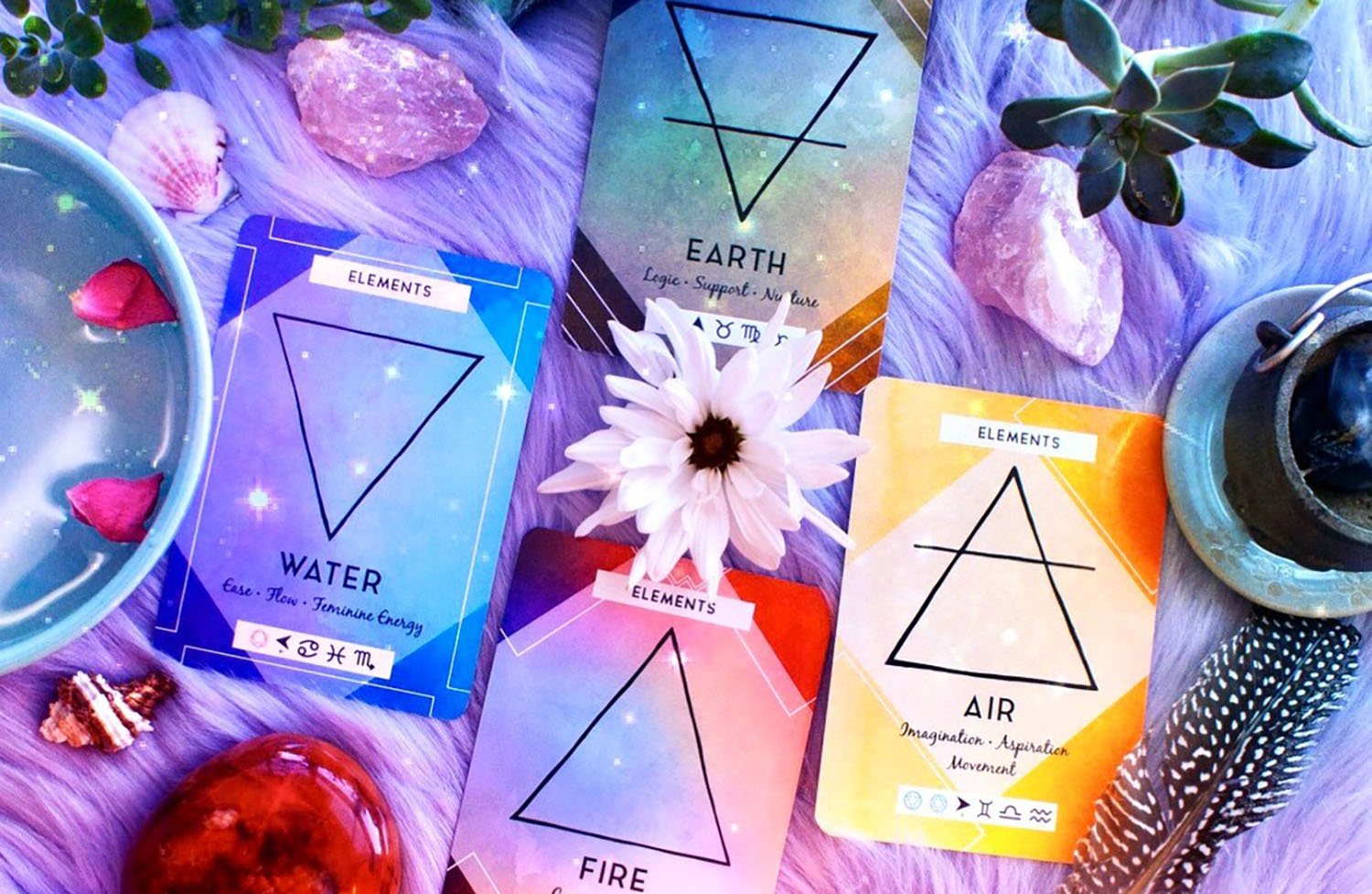
The four elements, earth, air, fire, and water, are physical materials and energies that comprise the world around us. If you don't already work with the four elements in your practice, you've likely heard of them because they're rather tricky to avoid as so many spiritual practices refer to them in some way.
There are countless ways to deepen your relationship with the four elements and bring them into your practice. In this post, you'll learn a bit about the history of the four elements, common correspondences for them, how to work with them physically and energetically, calling them in for protection, and using them in your home or on your altar.
I want to quickly touch on the element of Spirit because I'm sure some of you may be wondering if I'll discuss it as well! I will touch on the fifth element, often referred to as Spirit, aether, or Akasha, especially in the history section. However, I will save a deeper dive into the fifth element of Spirit for a post of its own. Much of this share will be dedicated to the four elements as I see them as slightly separate from Spirit and very foundational.
Listen to this post on my podcast, Rooting into Wholeness here.
A brief view of history and the four elements
As usual, I do like to cover some history. I think it's an essential part of having a complete view of different spiritual practices. That said, I always research with an understanding that this history is rarely the whole picture, but rather one piece. This is especially true when you're reconstructing a spiritual path that's not clearly recorded, was attempted to be eradicated, or if you hold multiple cultural heritages (like many of us do!).
The deeper I dive into my spiritual roots, the clearer it becomes that building a meaningful practice combines historical facts, inference, oral traditions passed down, and personal experience. Each of these pieces, in my opinion, serves a useful purpose while building a spiritual practice. Here's a very brief history of some of the earliest mentions of the four elements.
One of the first written examples of the four elements comes from the Greek philosopher Empedocles in the fifth century BCE. Empedocles refers to them as the four roots and assigns each element or "root" to a Greek God or Goddess as follows, Hera with earth, Zeus with air, Aidoneus with fire, and Nestis with water (though there is some debate over this, this is the consensus.) The Gods and Goddesses Empedocles associated with each element is less important (to me) than the fact that he did associate them with Gods and Goddesses. Because Empedocles gave these elements spiritual significance by corresponding each with a God or Goddess, it indicates that he viewed them as having a deeper meaning than mere elements on a periodic table.
In Buddhist practices, we see the first written mention of the four (sometimes five) elements in the Pali Canon in 29 BCE. However, these were recorded based on oral history that had been previously passed down for possibly hundreds of years. We also have Vedic texts that speak to the five elements, or Pancha Bhootas, in Hinduism. These were first recorded in the Taittirīya Upanishad is unknown, but some think it could have been even earlier than Empedocles and predate Buddhist practices at around 500-600 BCE. If you've studied practices that have become more commonplace in the West, like Yoga or Ayurveda, these are the elements referred to in these practices.
In all of these cases, I'm simply talking about the written records. I believe, as do others, that the four elements have been worked with and used by many pagan and indigenous practices long before the written evidence was created.
As far as Celtic practices, the four elements were likely not a part of their practice. The number three was sacred to the Celts, so the elements they honored were the land, sea, and sky, or earth, water, and air. In witchcraft and other earth-based practices, the four elements became much more commonplace with the introduction of Wicca in the 1970s, which relies heavily on the four elements (sometimes five.)

Explore The Soul Discovery Journal for more on the elements
There's certainly reference to working with the four elements in pagan, shamanic, and indigenous practices worldwide. However, many of these practices have been passed down orally.
Elen Sentier teaches and practices British Shamanism, or the "old ways," as she calls it, shares about the four elements concerning the world tree. She explains this below, in this excerpt from her book, Following the Deer Trods.
"The World Tree holds the vertical axis on which the three worlds spin (Upperworld, Middleworld, and Lowerworld.) The vertical axis is like the warp-threads in weaving; these are threads on which the pattern is woven. Middleworld holds the horizontal axis of the four elements. These are the weft threads that weave the pattern of life.
The four elements - earth, air, fire, water - are the weft-threads.
These two, the warp and the weft, are the basis of the duality which enables life to be."
This explanation from Elen Sentier is hardly the only reference to the four elements in earth-based spiritual practices. I'm confident that wherever your cultural roots lie, you will be able to find reference to three, four, or five elements there as well. This is where inference and personal experience come in. When we examine the written history, we have one piece of the puzzle; however, when we explore the personal experiences from those who've lived and experienced lines of knowledge passed down, we receive a different part of the puzzle. For example, even though I walk a Celtic and British path primarily, I choose to work with the four elements because they have been an integral part of my practice, through my introduction to them with Yogic philosophy but in my witchcraft and shamanic work as well.
As always, work with what speaks to you, your experiences, and your heritage. Perhaps you prefer to work with three, four, or five elements. There are seeds of truth and wisdom in all of them.
For this post, I will be focusing on the four elements through my unique lens of witchcraft and British earth-based spiritual practices. However, my introduction to the four elements was through my Yoga teacher training in 2012, which will color my unique lens.
The elements and correspondences
Each element has a unique essence, which carries both positive and shadow attributes. No element is positive or negative, but rather a conglomerate of different energies. For example, we can see the soft and gentle flame of a candle or a roaring forest fire. Each has value and purpose. Each element also relates to a host of other energies and objects, called correspondences. Correspondences are energies that match and play well together.
Once you understand how the four elements relate to other energies, it creates a strong foundation for understanding magical correspondences on a broader level. Explore an in depth exploration of the four directions and elements by journeying to them here.
Keep in mind. These are my beliefs based on my research and experiences. If something I share about an element doesn't fit into your practice or even goes directly against your practice, no worries, just leave it. As we already discussed in the history section, spiritual practices using the four elements span the globe, so differing opinions are bound to come about.
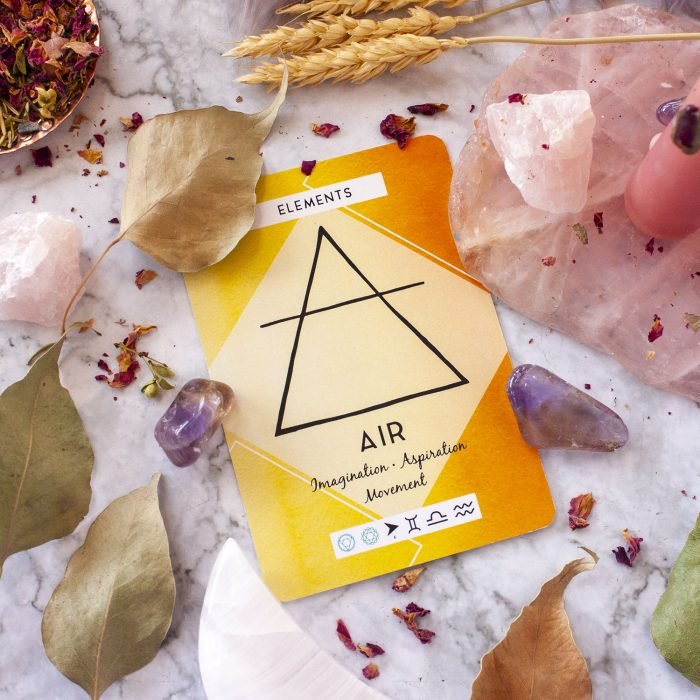
Air card from The Ritual Deck.
Let's go through each element and discuss some of the most common meanings and correspondences for them.
Air relates to intellect, ideas, inspiration, and the mind. It corresponds with the East, the color yellow, the suit of swords in the tarot, the throat and heart space, wind, sound, smoke, smells, feathers, birds, and unseeable forces that influence our minds. In astrology, the three air signs are Gemini, Libra, and Aquarius.
Fire relates to transformation, action, power, and the ego. It corresponds with the South, the color red, the suit of wands in the tarot, the solar plexus area, flames, heat, candles, the phoenix, dance, and the destructive forces that ultimately encourage new growth. In astrology, the three fire signs are Aries, Leo, and Sagittarius.
Water relates to emotions, intuition, feelings, and the subconscious mind. It corresponds with the West, the color blue, the suit of cups in the tarot, the sacral area, springs, the ocean, tears, shells, aquatic animals, things in a liquid state like melting wax, and the forces that move us to feel so we can cleanse and heal. In astrology, the three water signs are Cancer, Scorpio, and Pisces.
Earth relates to safety, protection, the material world, and the physical body. It corresponds with the North, the color green, the root space, dirt, trees, rocks, food, bones, ancestral wisdom, and the physical energies that support and sustain us. In astrology, the three earth signs are Taurus, Virgo, and Capricorn.
I discuss this a lot in my Tarot Correspondences course and my new book, Understanding Tarot. As you can see, once you have a firm understanding of each of the elements, it will help you better understand Astrology, Tarot, and a host of other magickal practices.
This is a peek into each element. We'll go deeper into each of these, their positive and shadow sides, different tools to connect with them, and wisdom from each in the following posts:
Let's move on to some ways to begin working with the four elements collectively.
Connecting with the elements in the physical and energy body
As Elen Sentier stated in the excerpt from her book above, the four elements are the "weft threads that weave the pattern of life." The four elements affect each of us physically and energetically here in physical form. We can feel them in the body and connect with them in the subtle body.
If you want to form a deeper relationship with the four elements, this is where I'd invite you to begin, connecting with them within your body. There are many ways to start doing this, and it will be an ongoing practice because our relationship with the elements is not fixed and is constantly evolving and growing.
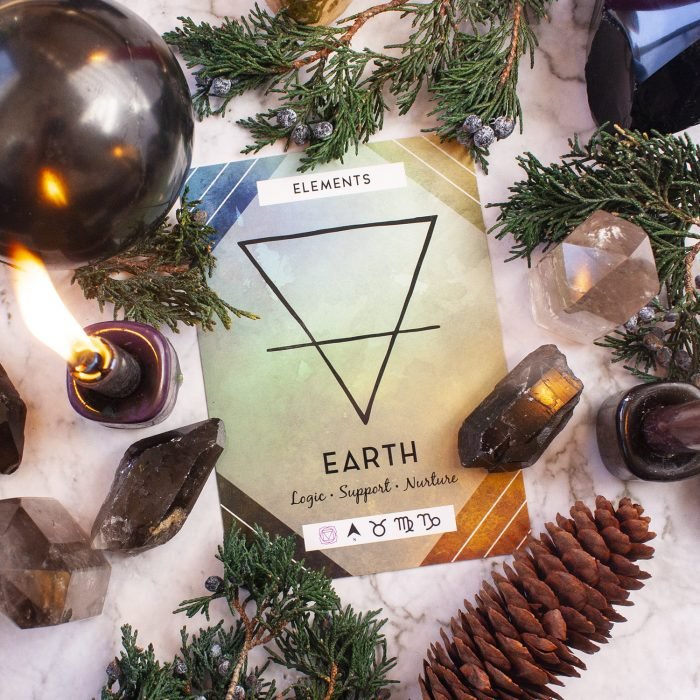
Earth card from The Ritual Deck.
Here are three ways I've learned to deepen my relationship with the four elements.
1. Notice the elements in the natural world and when you do, notice how they make you feel. For example, When I go on my regular walking meditations outside, this is one way that I tune in to the environment and the elements. I notice how the sun's heat feels on my skin. I notice the wind and any sounds it may be creating in the trees. I notice any water (which here in the desert is usually just the dew on the grass leftover from sprinklers). I notice the supportive earth beneath my feet. You can even imagine this in your mind right now. What feelings come up within you when you think about a stream vs. a fire? Each brings a different energy that is palpable within my mind's eye.
2. Notice how the four elements come up within your physical body. When you experience different sensations in your body, can you associate them with a specific element? For example, I'm someone who becomes ungrounded and anxious easily. I know what anxiety and dysregulation in my nervous system feel like. My mind races, I get a tingling sensation in my neck, my hands and feet sometimes get tingly, and my breath becomes shorter and moves to the chest. These sensations can come up due to an event outside of me or me merely not making time to care for my body, mind, and Spirit.
For me, I recognize this as an overabundance of air. Air corresponds with the thinking mind, intellect, and ideas. When I'm stuck in my head, and it's literally pulling me out of my body, I know I need to ground and bring in more earth. If I find myself in this place, I make sure to do things that bring in more of the earth element, like getting outside and feeling the support of the earth below my feet, or perhaps I meditate and visualize a connection to the earth. This is why my regular walking meditation practice is so imperative for me. Of course, this is not a cure-all nor an excuse to not seek out professional help. I've also relied on therapy and medication for my anxiety at different times in my life, but I find that a daily practice such as this helps support me in different ways.
Can you bring to mind some common emotions or sensations in your body? Perhaps you lean towards too much earth and often feel sluggish, tired, or heavy? Or, too much water, and you find yourself overly emotional and often in a puddle of tears. Or too much fire, which could feel like a need to be forceful or constantly doing. As I mentioned, each element is neither good nor bad. They each have both positive and shadow sides to work with and recognize. It's in finding a balance between them that we can move towards more equilibrium.
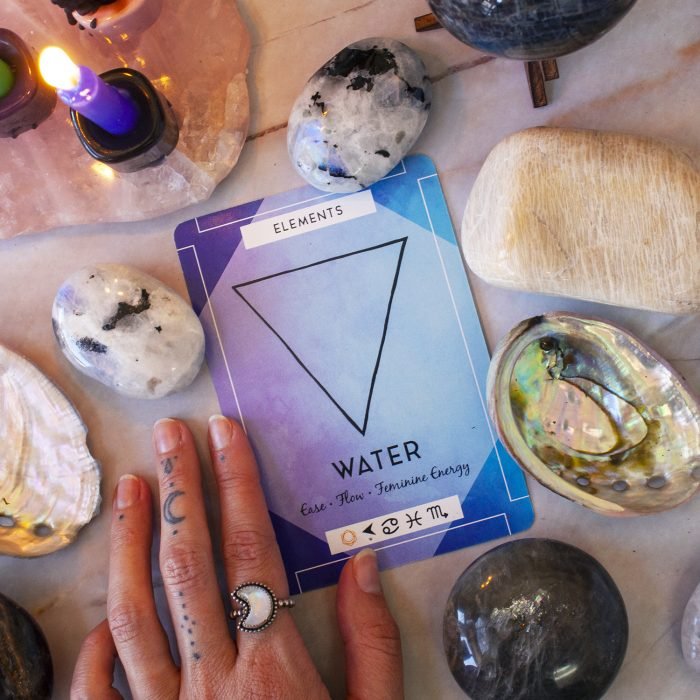
Water card from The Ritual Deck.
3. There are also ways to work with the elements on an energetic level. This is great if you don't have access to elements you want to work with or do some healing work during meditation or journeying.
I rely heavily on the four elements while working alongside clients for energy work. I see each element as an ally or helping Spirit to aid in giving each client what they need for healing. Of course, there are so many ways to do this for yourself as well. Here are some ways that I've learned over the years to work with each element energetically.
For earth, one of my favorite grounding techniques is to imagine that beam of energy or even a root coming from the base of your spine and connecting with the energy of earth (you can do this outside for extra potent earth energy!) In energy work, I will often pull in earth and mud (energetically within my altered state of performing energy work) to place on top of people if their energy feels dysregulated or "buzzy."
For air, I visualize air blowing around me and through my body. When performing energy work, I will sometimes blow air into certain parts of the body to clear or bring in more air. I also work with feathers similarly.
For water, I love to visit and visualize sacred springs and work with the water for healing for myself or with my clients. Spring waters are one of the most common tools, next to earth, that I pour into parts of people's bodies to bring cleansing and healing.
For fire, I love dance, either physically or even visualizing it. I'll imagine certain issues or things being burned up within me. I'm cautious with fire for energy work as it's so intense, so it's something I don't often use unless someone is very low energy.
I encourage you to explore your relationship with each element through meditation or journey work to find ways to work with them that work for you.
I hope this gives you some guidance to begin working with the elements both physically and energetically. As I mentioned, I will dedicate a post to each of these elements to explore each one on a deeper level.
Spellwork and Protection with the Elements
The four elements are often used in both spellwork and protection. Let's discuss some ways to work with them in these ways. As we discussed, each element carries specific energy, and you can call upon those energies through the elements to better facilitate particular outcomes in spellwork.
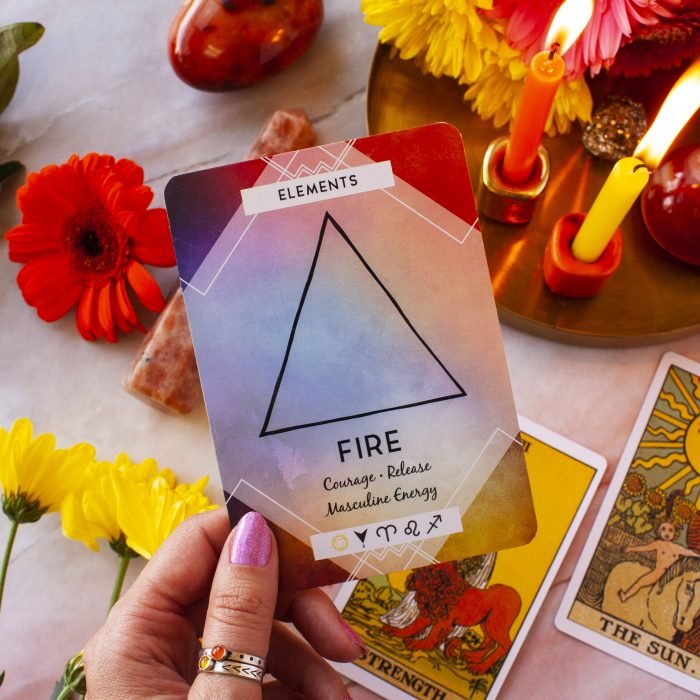
Fire card from The Ritual Deck.
Here are examples for each element. If you are conducting a spell to bring in mental clarity, the element of air would be appropriate, and you may want to incorporate feathers or plants that blow in the wind to honor air. Fire is your friend, and candle spellwork would be ideal if you are conducting a spell to energize you or facilitate a transformation. If you are performing spellwork to connect with your intuitive mind, bring some water into your spell by implementing water, shells, or aquatic materials. If you're working on manifesting something physical into your life, call upon the element of earth by working with stones, crystals, or earth objects to help bring about material possession.
There are so many different items that correspond with each element, so you truly have a bounty of various tools when it comes to representing the elements in your spellwork. You could rely on different tarot cards, plants, crystals, Gods, Goddesses, etc., to bring in an element. If you're learning the correspondences for the elements, I designed my oracle card deck, The Ritual Deck, to be a learning tool specifically for this! Each card has a correspondence bar at the bottom that shows the corresponding element for each card/symbol. Beyond this deck, I also love "Llewellyn's Complete Correspondence Guide." It's a big book but one I think any witch or person who dabbles in spellwork should have!
When it comes to protection, I love working with the four elements! If you've ever had a session with me, you know that I begin each session with some drumming and invoke each of the four elements to create a sacred container for our work. I also do this mentally whenever I journey. In Wicca, this is often referred to as "Calling the Quarters." But, you certainly do not need to consider yourself a Wiccan to work with the elements in this way. Working with the elements in this way for protection is something we see in many earth-based and shamanic practices.
To work with the elements in this way for protection, you can call in each element aloud or in your mind. It's common to start at the East with air, and move clockwise around the directions, Fire of the South, Water of the West, and Earth of the North. I like to visualize each element swooping in to create a barrier around me as I work. You could also place a physical representation of each element around you in this same order.
In witchcraft, this is often referred to as casting a circle. However, there are many other ways to cast a circle, and you do not have to consider yourself a witch to use the elements in this way. The next time you feel like you need extra protection for spellwork, meditating, journeying, etc. I encourage you to try either of these techniques and notice how you feel.
Using the four elements on altars and living spaces
One of the most common ways people work the elements into their practice is through an altar. This is another tool that we can see across cultures and traditions. It's a widespread practice to represent all four elements present on an altar for balance, protection and to show gratitude for each of the elements. We've touched on this a bit, but I'll share here some suggestions for ways to represent each element on your altar.

Air: Feathers, images or sculptures of birds or flying insects, smoke, fans, herbs or plants that blow in the wind, any cards from the suit of swords in the tarot, the color yellow, labradorite, amethyst, musical instruments like singing bowls, chimes, rattles, drums, etc.
Fire: Candles, burning charcoal, burning herbs, incense, lava rocks, obsidian, yellow jasper, any cards from the suit of wands in the tarot, a wand, phallic symbols, symbols, or images of the God (could be any God you're comfortable with.)
Water: water, shells, images or sculptures of any aquatic animals, opal, moonstone, aquamarine, any cards from the suit of cups in the tarot, chalices, cauldrons, symbols of the Goddess (could be any Goddess you're comfortable with.)
Earth: stones, wood, plant material, living plants, herbs, symbols or sculptures of trees, petrified wood, the Greenman, Gaia (or any earth God or Goddess in your practice), any card from the suit of pentacles in the tarot, money, different metals.
Some unique items can serve as all four (or five) of the elements.
Smoke cleansing with a shell or chalice-shaped bowl can serve as a representation of all four elements. The shell or chalice shape represents water, the plant material represents earth, the burning herbs represent fire, and the smoke represents air.
Candles are another one. The flame represents fire, the smoke represents air, the wick represents earth, and the melting wax represents water. I'm sure there are others that I'm not aware of or familiar with!
You can modify these same suggestions for your altar to help balance the energy of your living space. For example, if you're going through a transition as a family unit, you may find it helpful to bring in some grounding elements to your home to offer you and your family a greater sense of safety and support. Alternatively, suppose you recently had a visitor in your home who left some unwelcome residual energy. In that case, you might benefit from bringing more of the air element through smoke cleansing, or simply opening the windows, to bring in an energetic fresh breeze, if you will.
As you can see, there are so many meaningful and important ways to work with the four elements in your spiritual practice!
I'd like to note one last thing, especially when discussing using items from the natural world, both physically and energetically, is to be reciprocal with these elemental energies. When you call on them, thank them for their assistance by taking a few quiet breaths and offering your thanks and gratitude. If you take items from nature, consider leaving an offering as a token of your appreciation. This can be simple, but it's important and can genuinely help you form a much deeper relationship with the elements and nature.
If you enjoyed this share, I invite you to share it with someone else who may enjoy it as well. I'm excited to do deep dives into each of the elements soon!
In love and gratitude, Cassie


Card Spread and Transformation Ritual for Scorpio Season
Scorpio, our fixed water sign, invites us into transformation, shadow work, and exploration of your relationship to power and cycles of death and rebirth.In this blog post, I’ll be sharing a card spread and a ritual for Scorpio season. Check out our Understanding the Energy of Scorpio Season blog post to learn more about Scorpio energy and your personal birth chart’s connection to Scorpio.
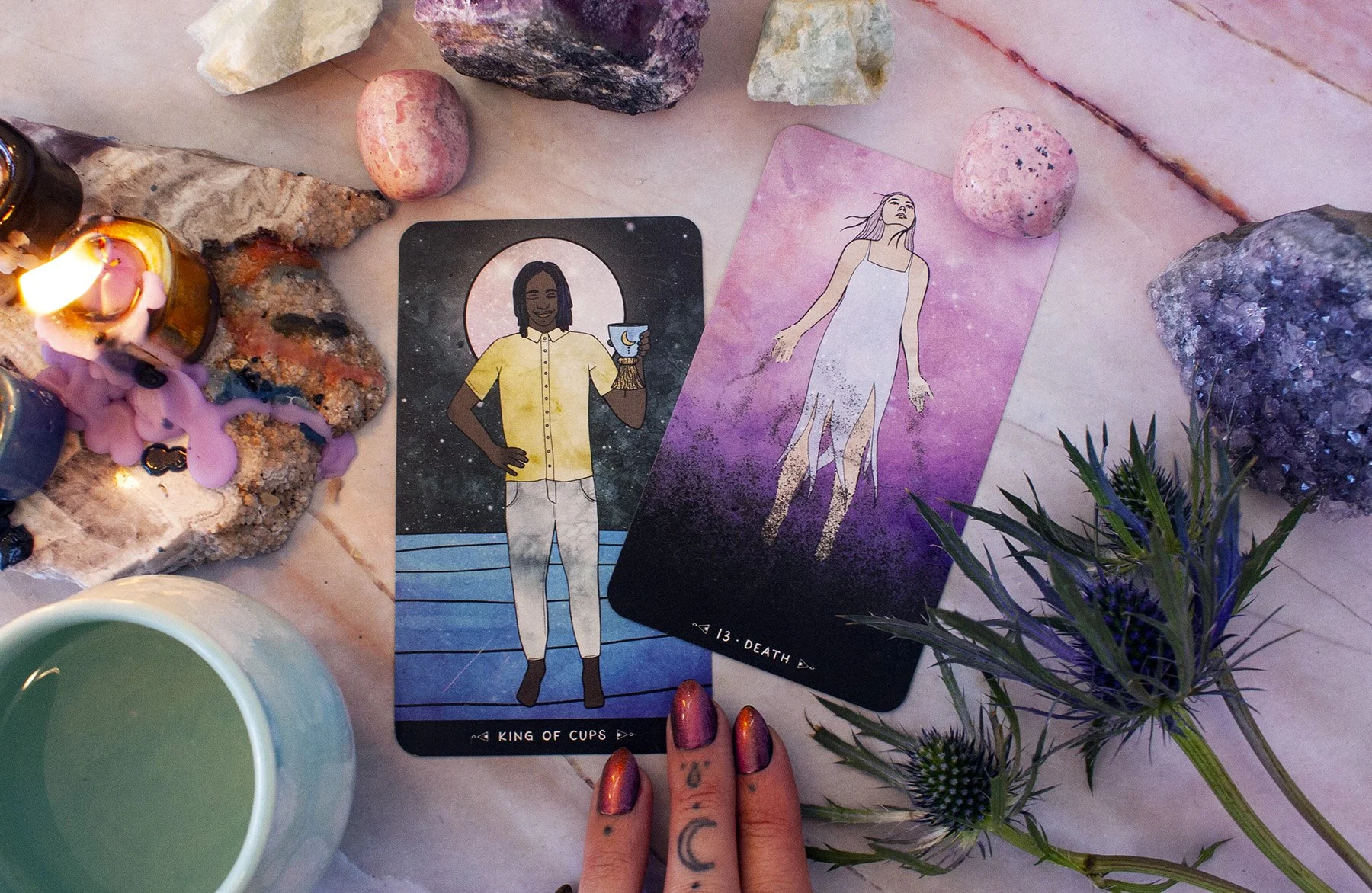
Scorpio, our fixed water sign, invites us into transformation, shadow work, and exploration of your relationship to power and cycles of death and rebirth.
In this blog post, I’ll be sharing a card spread and a ritual for Scorpio season. Check out our Understanding the Energy of Scorpio Season blog post to learn more about Scorpio energy and your personal birth chart’s connection to Scorpio.
Card Spread for Scorpio Season
We’ll use this card spread to explore the invitations and lessons Scorpio has to teach you this season. Feel free to use a tarot deck or an oracle deck for this spread - whichever resonates with you. I invite you to create a ritual space for you and your deck to communicate by taking a moment to ground and center yourself however feels good to you. In the spirit of Scorpio season and water energy, you might like to ground and center by taking a few sips of water and sinking into the sensation of the water moving through your body.When you feel grounded and ready, shuffle your deck and draw a card for each of the following questions:
What is Scorpio season here to teach me?
What is dying and being reborn this season?
What shadow material is coming up for me to work with this season?
Possibilities Scorpio season is opening up for me
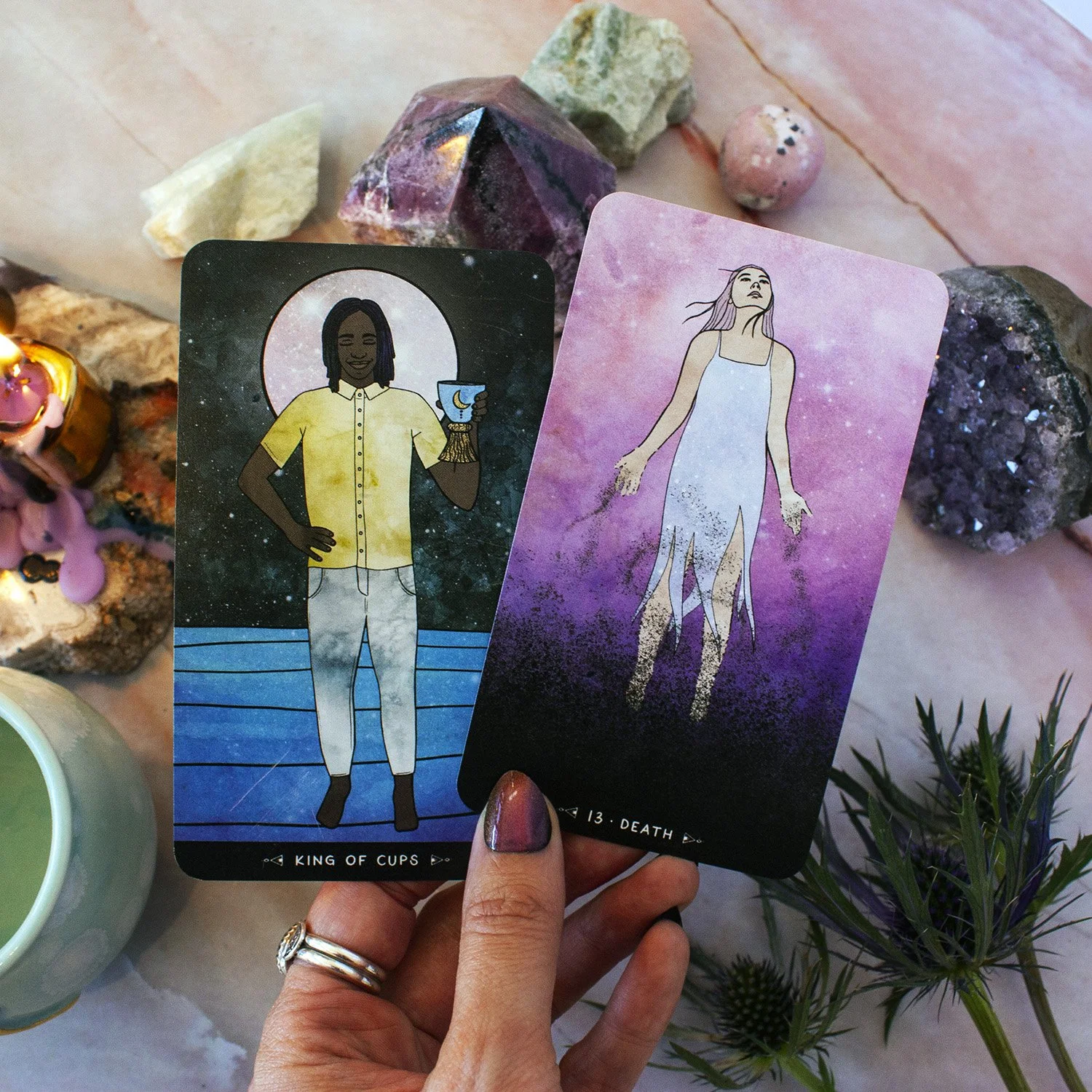
After you pull your cards, sit with them. Try to take some time to journal or meditate with them to really connect with the full meaning they have to offer you. At the end of Scorpio season, you might like to revisit your cards and reflect on how they unfolded throughout the season. How did they show up? What did you learn about yourself and about the cards through the way they manifested this season?
Scorpio Season Ritual for Transformation
This is a ritual to honor how you are transforming, to honor the parts of you that are dying and being reborn.All you’ll need are herbs to sprinkle in your bathtub and candles to light while you soak. Both optional!
Open your ritual with some kind of grounding and centering that feels good to you. If calling in the directions or casting a circle is in your practice, feel free to do that here.
Spend some time meditating, journaling, or pulling cards to reflect on this question: what part of me is dying and being reborn? You might take time to connect with this part of you, ask it questions, notice the bodily sensations that come up around this and soften into the edges of this part of you. And if you don’t have a clear definition for the part of you that is being transformed or how you are being transformed, that’s okay! Magic doesn’t have to be crystal clear. You can trust the sensations and feelings, too.
When you feel ready, draw a bath. Feel free to light candles around the tub or sprinkle herbs in the water. Set the intention that as you step into the tub, you are supporting your transformation process. While you soak, reflect on what you are leaving behind and notice feelings that arise around this process. When you rise from the tub, you are supporting your rebirth.
Happy Scorpio season! I hope you find some support for this season in this card spread and ritual.


Connecting With the Archetype of Death for Samhain
Samhain ushers in the third and final harvest and shifts us into the darker half of the year. Samhain is situated in between the Autumn Equinox and the Winter Solstice. This season is our annual invitation to explore and honor not only the need for death and decay but acceptance of death and decay.

Samhain ushers in the third and final harvest and shifts us into the darker half of the year. Samhain is situated in between the Autumn Equinox and the Winter Solstice. This season is our annual invitation to explore and honor not only the need for death and decay but acceptance of death and decay.
As we embark on the season of the dead, the crone, and returning to the cauldron to be transformed, we're faced with the fact that no person, animal, or plant can depart from the inevitability of the death and rebirth cycle. We see the flow of this cycle in the seasons and nature, yet so often, our human minds recoil when we think about the death phase of the cycle of life.
In this post, we'll be exploring the archetype of death in relation to the witch's new year, also known as Samhain. I'll offer some insights around why Samhain is considered the witch's new year, the importance of honoring the dead and death this season, and some ways to tune into this season through ritual and common correspondences.
Content warning, I will be discussing death and themes of death within this post, so if you are actively grieving or recently lost someone, this is a gentle notice to proceed with caution.
Listen to this article on my podcast, Rooting into Wholeness, here.
Why is Samhain the Witch's New Year?
Early in my practice working with the Wheel of the year and the seasons, It confused me that Samhain was considered the new year. Here in the states and many other places around the world, there's a hyper-focus on the new year being a time of celebration and newness. Why then does Samhain, our descent into darkness, mark the new year for those honoring nature-based spiritual practices?
Samhain is the ever-important gestational period before the return of the light. It is the part that's so often overlooked in the patriarchal and linear-driven society we currently live in, just like as the fetus transforms in the womb, the natural world retreats into decay and death during this time. We are also given the same opportunity to withdraw, allow parts to fall away, and alchemize from within.

Nature-based spiritual practices are rooted in neverending cycles, not starting points and finish lines. The witch, and anyone living alongside the seasons, not only understands but welcomes the need for decay and death. At the time of Samhain, the season calls us inward to begin this process of rest, death, and alchemy.
One of the greatest gifts of this season is the opportunity to face and learn from our relationship with death and decay, which is what we'll explore here.
Connecting with the Archetype of Death for Samhain
How do you feel in your body when you hear the words death and decay? Do you embrace these words, do they roll off of you with ease, or does something within you want to disassociate with these words?
It's easy to see how disconnected we are from death, especially in the West. We see celebrities that refuse to age, food with signs of decay thrown out, and many of our wise elders placed in homes outside of the family unit. Samhain is an opportunity to feel into all of this and become more comfortable accepting death and decay. It's an opportunity to heal our wounds around death to be more accepting of it when faced with it, whether in your own life or the life of a loved one.
If you're willing to meet this season where it is, in decay and death, it has so much to teach you, so much to teach all of us. Learning how to be in this world with more acceptance around death and even aging are some of the most freeing and empowering feelings we can cultivate. Here are common ways our ancestors connected to death and a few ways I like to connect with the archetype of death during this season.
1. Honoring loved ones and ancestors in spirit.
One of the most common themes of this season is honoring loved ones who've crossed into the spirit realm. Samhain is a time in which the veil between the physical and spirit realm is thin. If you've lost loved ones, it's an ideal time to honor and connect with them. It's also a time to connect with your ancestors. We do this at Samhain to acknowledge the lives our loved ones lived, and continue to live in spirit. Honoring deceased loved ones and ancestors can also help you tune into the archetype of death within yourself.
As someone who's lost a lot of family members, I've found that fear of death can make it challenging to connect with loved ones who've crossed over. Facing the fact that loved ones are no longer here, in physical form, brings forth an undeniable recognition of death, which can be hard.
It's important to note that everyone's grief process is unique and that denial is a natural part of grieving. I went through a long phase where I could not even look at pictures of my father and grandmother early in my grief process. If you have experienced deaths in your life, what I'm encouraging here is a curiosity around your relationship with honoring loved ones who've crossed over. How does it feel when you take time to sit and think about the people in your life who've died? Perhaps you're not ready to do that, and that's okay, but maybe it's something you are ready to do, but the fear of facing death has prevented you from such activities. If you've experienced deaths in your life, I invite you to be open and curious about where you are with this.
Some common ways to honor loved ones who've transitioned into spirit are to create an altar for them with pictures, offerings of foods and treats, and items they loved. Doing this creates a sacred portal of honor, remembrance, and connection with your loved ones in spirit. A silent or dumb supper is another way to connect with loved ones in spirit. On the night of Samhain, consider creating a meal in honor of deceased loved ones, then create place settings for them to honor them and invite them in for this season. Lastly, and especially if you dabble in psychic work, Samhain is a great time to connect with your loved ones in spirit. You could do this through any number of ways that could include tuning in psychically, tarot or oracle cards, scrying, pendulums, or any other divination tool you prefer.
Of course, this work can go far beyond that of deceased friends or immediate familial connections and can extend to your ancestors as well. If information about your cultural heritage and ancestral past is available to you, consider placing some items on your altar in honor of them as well. There's also a great past blog post from Eryn Johnson on my blog with suggestions for a guided meditation to help you connect with your ancestors for Samhain here.
2. Connecting with symbols and imagery of Death
Samhain is an opportunity to cultivate more acceptance and reverence for death. Here are some different ways to connect with the archetype of death in this way. This can be deep work. Trust that whatever suggestions you do feel called to are perfect for you at this moment.
Explore the death card in the tarot. Dig deep into the symbology and imagery of this card. Any deck you feel called to or have handy will do. Read different interpretations of the death card. Consider journaling on the card, notice what comes up naturally, how it makes you feel, etc.?
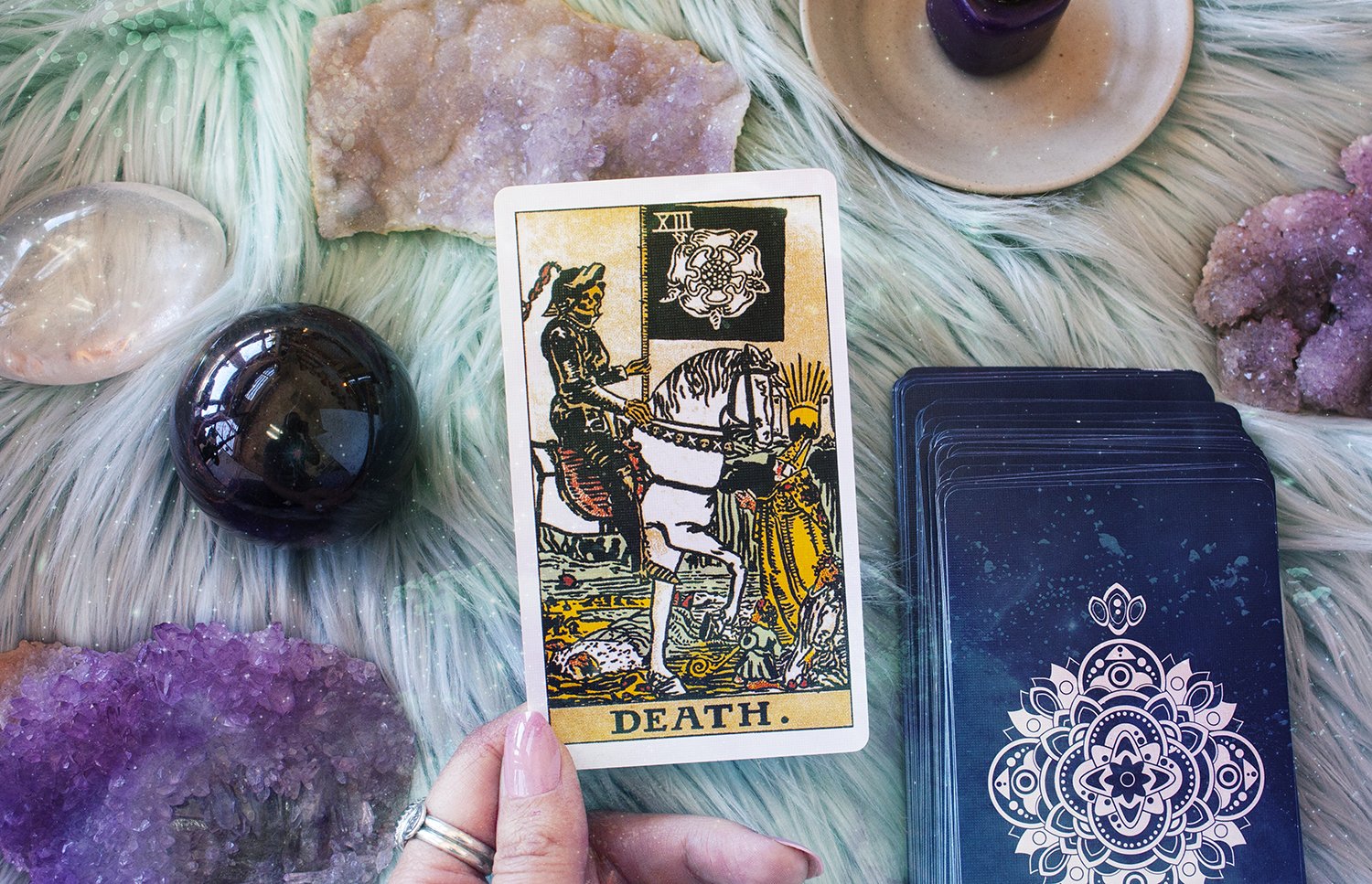
Connect with items or symbols associated with death and decay. Some options are crystal skulls, animal bones, snake sheds, or animals often associated with death like owls, crows, moths, etc. There are so many ways to connect with these items and their inherent connection to death and decay. You could simply place any of them on your altar and notice how you feel as you engage with them regularly. You could also consider meditating with them, or if journeying is a part of your practice, you could journey to them in spirit to learn from them.
Lastly, I invite you to be more open and curious about death and decay. When you interact with an elder or see an elderly person in public, what comes up for you, and how do they make you feel? When you come across fruits or vegetables in the grocery store with signs of decay, how does it make you feel, and do you pass over it for an item that appears more pristine? What comes up for you when you think about your death and the deaths of your loved ones?
Though these can be difficult questions to grapple with, they each hold seeds of wisdom and ultimately growth. If you feel the call to explore death more deeply, this is an ideal season to do so.
3. Explore and Reclaim your relationship with the dark
Even our modern interpretations of Samhain with Halloween have held onto cozying up to the dark. However, it wasn't until our early departure from Goddess-based and cyclical practices that we started to attach negative associations to darkness and death. The dark and death have not always been feared and associated with evil. It was the influx of linear patriarchal thinking, God-based religions, and white supremacy that have each deeply affected our relationship with the dark and death in harmful ways. Demetra George talks about this in her book Mysteries of the Dark Moon, which I highly recommend.
The Wheel of the Year itself is broken into a dark and light half. The dark half of the year and Winter begins with Samhain, and the light half and Summer begins with Beltaine. Even though the Wheel itself is a relatively modern interpretation of how our ancestors celebrated, we can see in the Coligny calendar of the Celts that there was deep and equal reverence for both the light and the dark.
I encourage you to notice what feelings arise when you think about the dark, whether it be the literal absence of light or black objects. You might even find it helpful to spend more time in the dark, outside or inside, simply to notice how it makes you feel and what it brings up within you. Once you start digging, it's hard to unsee all of the ways we've been trained to associate the dark with negativity. I don't offer these invitations to say that the light is bad, but it's our often dysfunctional relationship with the dark that cuts us off from the wisdom of death.
Shadow work can be a great place to start when exploring your relationship with the dark, and this season is a great time to dig into some shadow work! I've got a few past blog posts all about shadow work that you can check out here.
Common correspondences for Samhain
Here are some of my favorite common correspondences for Samhain. Most of these come from my new book, Understanding the Wheel of the Year

Themes: Ancestral connections, releasing, cleansing, death, divination, protection, the underworld
Moon Phase: Waning Crescent Crystals: Amethyst, labradorite, obsidian, onyx, hematite
Colors: Purple, black, silver, orange
Tools: Besom (broom), cauldron, skulls shapes, bones, any items that remind you of death, salt, divination tools (pendulums, tarot cards, scrying mirrors, etc.)
Plants and Scents: Mugwort, cinnamon, clove, patchouli, mullein, garlic
Foods: Apples, pomegranate, pumpkins, squash, nuts, seeds, meat
Runes: Algiz (protection, especially in the psychic realm), Ansuz (receiving wisdom), Perthro (hidden secrets and mystery), Othalo (ancestry), Isa (halt or freeze action)
Zodiac: Scorpio
Goddesses: Cailleach, Cerridwen, Hecate, Lilith, Persephone
Tarot card: Death, Wheel of Fortune
If you're looking for some less grim rituals than what I've offered here, haha, I have you covered too! This is indeed a season to celebrate, even if it centers around death. One of my favorite activities at Samhain is to do a thorough house cleansing and to add some extra protective layers to my space. I have an in-depth past blog post all about this that you can check out here. It's also a great time to perform psychic work of all kinds, which I touched on with connecting with your ancestors, but any kind of psychic work for any purpose can be incredibly potent during this season. Find more rituals for Samhain here.
Wishing you a magical and blessed Samhain! xoxo Cassie
