

6 Tips to Learn the Tarot Card Meanings Quickly
So you got your first tarot deck, did a couple of solo readings, and then never picked it up again? Or, you work with tarot regularly but find yourself frustrated with being so reliant on the guidebook? One of the biggest hurdles people face when getting started with tarot is learning the card meanings. This kept me from diving deep into the tarot for years, too; I get it!There are much easier techniques to learning the meanings of all of the cards besides memorizing a guidebook word for word for 78 different cards.

So you got your first tarot deck, did a couple of solo readings, and then never picked it up again? Or, you work with tarot regularly but find yourself frustrated with being so reliant on the guidebook? One of the biggest hurdles people face when getting started with tarot is learning the card meanings. This kept me from diving deep into the tarot for years, too; I get it!
There are much easier techniques to learning the meanings of all of the cards besides memorizing a guidebook word for word for 78 different cards. Not only is memorizing a guidebook of 78-card meanings not very feasible, but it’s also an intuitive disservice in working with the tarot.
What if I told you that you could have a robust knowledge of all 78 cards by learning only 36 correspondences? I know 36 is nothing to sneeze at, but here’s the thing, the 36 correspondences I’ll layout in this post will not only help you understand the energy of each tarot card but will also help you in nearly all other facets of spellwork and magick.

What are correspondences?
Correspondences are simply energies that play well together or match. Each card of the tarot has at least a couple of correspondences, and when you better understand each card's correspondences, you’ll also understand the energy of each card. The correspondences associated with tarot are not unique to tarot and relate to numerology, astrology, witchcraft, and more. Plus, there’s a good chance that you’re already familiar with some of the correspondences that I’m going to outline in this post. If you are, that’s great! You’re already a step ahead.
Before you dive in, correspondences and their meanings can be rich and deep. They can also vary somewhat from person to person. What I share here is enough to get you started to build a strong foundation, but I recommend digging deeper into the ones you’re less familiar with.
Dive deeper into tarot correspondences in my book, Understanding Tarot. You might also find that reading an introductory book on numerology or astrology will really deepen your understanding of those specific correspondences. You can also read up on numerology and the four elements right here on the blog! Click here for more on the elements and here for more on numerology.
Let’s dive in. Here are 6 tips to help you learn the tarot card meanings quickly.
1. Understand your learning style!
Before we jump into understanding the correspondences of tarot, you need to get super clear about how you learn and use that method as we dive into the correspondences. If you’re a visual learner, get a journal and start drawing and writing down what the correspondences below mean. If you’re an auditory learner, consider listening to an audiobook about the correspondences listed below. If you learn by doing, continue working with your tarot deck to weave this knowledge into your readings. Not sure how you learn best? Try a few different ways listed above and see what sticks.
2. Understand Basic Numerological Meanings
The largest part of a tarot deck, and for many, the trickiest cards to learn, are the numbered suit cards of the Minor Arcana (think 2 of cups and 4 of wands, etc.) Understanding the basic numerological meanings will make you feel MUCH more confident with these cards. There are ways to use numerology in the Major Arcana too, which you’ll be able to learn more about in my new book. For the minor arcana, use these numerological meanings to give you clues about what each card means.

New beginnings
Balance
Creativity
Foundations
Change
Partnership
Intellect
Mastery
Endings
This one is kind of unique to tarot because, in traditional numerology, you always reduce down to a single-digit between 1-9. Fortunately, the meaning often in regards to the tarot is pretty obvious. It points to an end of a cycle and transitioning to a new phase. It has a slightly different feel than 9 in that it signals a willingness to move on.
3. Understand the 4 Elements
Earth, air, water, and fire are, in my opinion, foundational in any magickal or divination practice. The elements are the energies that we’re made of and can be utilized in nearly all facets of a spiritual and magickal practice! Each of the four elements corresponds with a suit of the minor arcana, shown here.
Cups- Water
Pentacles- Earth
Swords- Air
Wands- Fire
Now that you know more about the meanings associated with the numbered cards of the minor arcana, you can also apply the corresponding element. Now you have two things to go off of to understand the energy of each card better. Here’s a list of how the energy of the elements express themselves.

There are ways to apply your understanding of the elements to both the minor arcana's court cards and the major arcana. I discuss these more in my book, but this is a great place to start!
4. Understand Zodiac and Planetary Meanings
We’ll begin to transition more to the major arcana for this one. Each of the major arcana cards corresponds with either a planet or a zodiac sign, giving it a unique energy.
The Fool - Uranus
The Magician - Mercury
The High Priestess - The Moon
The Empress - Venus
The Emperor - Aries
The Hierophant - Taurus
The Lovers - Gemini
The Chariot - Cancer
Strength - Leo
The Hermit - Virgo
Wheel of Fortune - Jupiter
Justice - Libra
The Hanged One - Neptune
Death - Scorpio
Temperance - Sagittarius
The Devil - Capricorn
The Tower - Mars
The Star - Aquarius
The Moon - Pisces
The Sun - The Sun
Judgment - Pluto
The World - Saturn
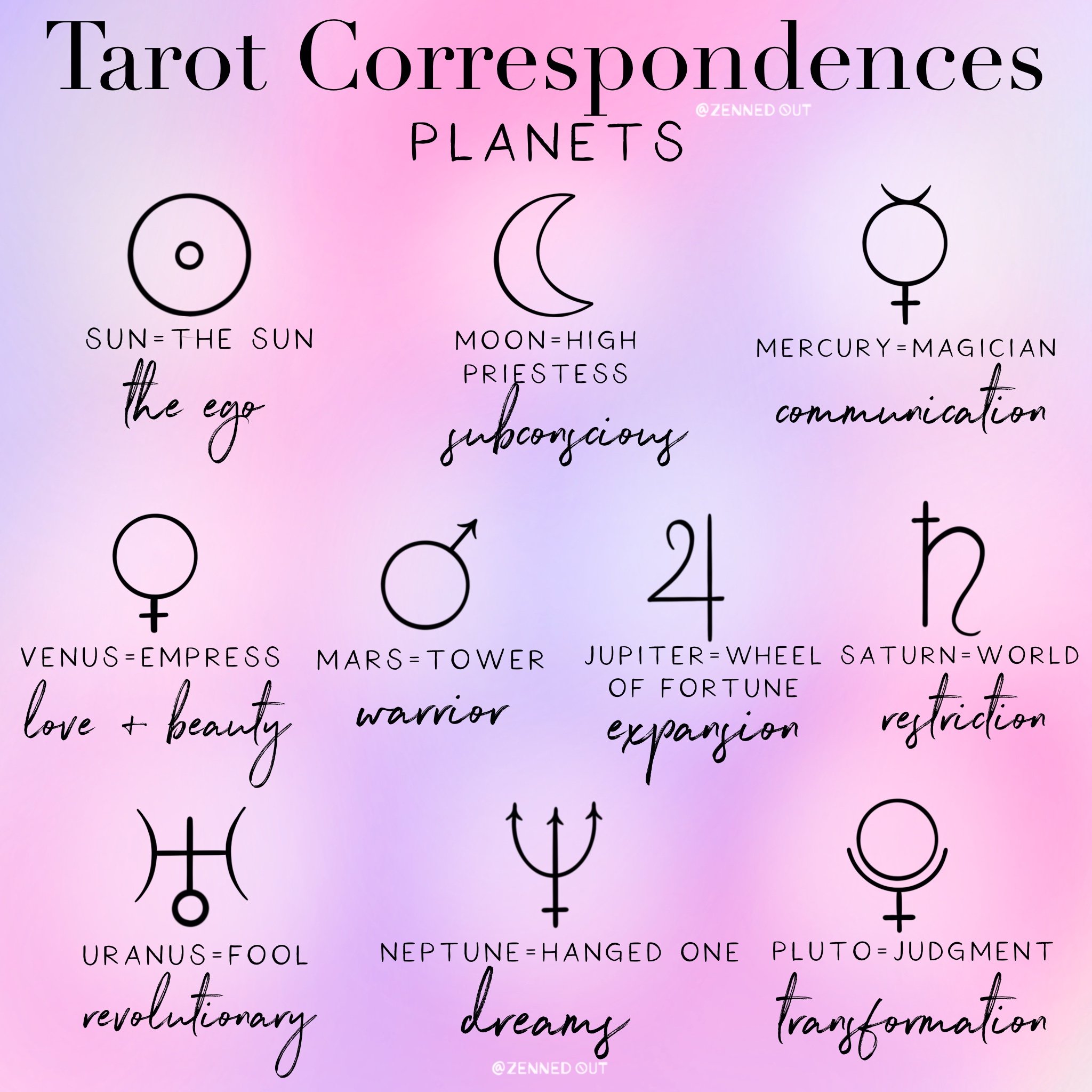
Here are examples of how these energies express themselves. Zodiac Signs

Planetary Meanings
Sun - Ego
Moon - Subconscious
Mercury - Communication
Venus - Love
Mars - Warrior
Jupiter - Expansion
Saturn - Restriction
Uranus - Revolutionary
Neptune - Dreams
Pluto - Transformation
5. Learn how Astrological Energies Correspond with the Elements
I imagine correspondences as a web of intersecting energies that play off of each other. When you understand how these different energies match up or repel each other, it will take your understanding of the tarot cards' meanings to a deeper level.
Each of the zodiac signs and planets corresponds to an element. Now, with your understanding of the elements and basic astrology, you can weave these meanings together. Here’s a list of how the planets, zodiacs, and elements correspond with one another.
Aries - Mars - Fire
Taurus - Venus - Earth + Water
Gemini - Mercury - Air
Cancer - Moon - Water
Leo - Sun - Fire
Virgo - Mercury - Earth + Air
Libra - Venus - Air + Water
Scorpio - Pluto - Water
Sagittarius - Jupiter - Fire
Capricorn - Saturn - Earth
Aquarius - Uranus - Air
Pisces - Neptune - Water
With this information combined, we can see that the Empress corresponds to Venus, the earth element, and Taurus. Therefore the Empress card relates to love, beauty, and creation from an earthly and material perspective.
6. Pair this Knowledge with your Intuition
Think of all of this correspondence knowledge as a way to bolster your intuition. They’re not the end all be all of learning the tarot, but they go a LONG way! The more comfortable and confident you become in understanding these correspondences, the easier it will be for you to intuit the card meanings for yourself and others without a guidebook. The correspondences are better than a guidebook because they give you nudges and insights about what the cards have to tell you, rather than a definitive answer.
Learn more about building up your intuitive muscles here in this previous post.
Now it’s time for you to put these tools into practice. Find a way to learn them that works for you, and watch your ability to understand the tarot card meanings flourish!


Dreamwork 101 // What is Dreamwork and How to Get Started in 5 Steps
Dreamwork is the practice of tending to our relationship with our dreams. We’re dreaming every night, but many of us barely remember our dreams, or if we do, don’t spend much time thinking about them or working with them.(How often have you dismissed a dream as, “oh, it was just a dream?”)

Dreamwork is the practice of tending to our relationship with our dreams. We’re dreaming every night, but many of us barely remember our dreams, or if we do, don’t spend much time thinking about them or working with them.
(How often have you dismissed a dream as, “oh, it was just a dream?”)
But dreams can have a lot to teach us and offer us when we enter into a deeper relationship with them. The dreamworld is rich with feelings, desires, needs, and possibilities. Our understanding of what the dreamworld evokes and presents can support our physical lives and our connections to ourselves.
In this blog post, I’ll share a bit about how to start a dreamwork practice of your own.
Dreamwork Lineage
First, I’d like to share my dreamwork lineage. What I know about dreamwork comes from the work of these folks in particular, as well as my own intuition and my ancestors:
These are wonderful people to go deeper into dreamwork with if you feel so called.
1. Support Dream Recall + Sleep
The simplest of ways to begin supporting your dreaming is by supporting sleep and dream recall. It’s difficult to consciously work with our dreams if we’re not sleeping well or can’t remember our dreams when we wake up. Everyone is different, but here are some things you might like to explore to support your sleep:
Set screen time boundaries for a certain amount of time before bed
Drink a tea to support your sleep, like chamomile (always do your own research and check with a professional before ingesting herbs)
Create your own sleep ritual that helps you shift into rest mode
Meditate and/or do a gentle, restorative yoga practice
Take a few minutes to journal brain-dump style to help clear your mind.
To support your dream recall, there are a few things I find helpful:
Set an intention to dream and to remember your dream(s) before you go to sleep (you can write this down, say it out loud, or just tell it to yourself silently)
Take a few minutes in bed in the morning before you get out of bed (or look at your phone) to give yourself space to remember your dream.
Create a dream altar and meditate at it before bed to welcome your dreams to come
Pay attention to the dreams you do receive by tending them (more on that below!)

2. Start a Dream Journal
This is probably the number one tip anyone you ask about dreamwork will give you, and with good reason! A dream journal creates a container for tending your dreams, helps solidify your intention to connect with your dreams, and helps you understand your dreams.
I recommend choosing a dedicated journal for your dreamwork and placing it on your dream altar when you’re not using it if you have one. As soon as you wake up (definitely before you look at any devices), put pen to paper and record your dream. Try recording your dreams in the present tense to honor its aliveness (for example, instead of "I was walking by a river,” try “I’m walking by a river).
If it feels available to you, you might like to marinate in the dream in bed for a few minutes before actually getting up and reaching for your journal to record.
3. Explore Dream Feelings & Textures
After you record your dream, there are many ways to work with it more deeply and explore the messages it might have for you.
I like to explore the dream textures: what are the textures, sights, smells, tastes, sounds of the dream? What do those senses mean for you and evoke for you? How do they make you feel? How does the dream, in general, make you feel?
4. Understand Dream Associations
As you work with the dream you’ve recorded, notice what stands out to you. Maybe your red dress feels particularly alive, or the hawk sparks something for you, or you feel curious about a figure in your dream.
Whatever you feel curious about, do a bit of freewriting about it. List out: what does this thing make you think of? How does it make you feel?
For example, some associations that come up with hawks for me:
Hawk feather
Maggie Smith’s poetry book Good Bones
Mothers
Protecting your children
Imagination
Play
Notice how I’m not so focused on the hawk itself, but I follow the threads of what each thing is associated with! Now I have something interesting to work with and can ask myself questions like, "what’s my relationship with play right now?"
Some of the associations you make might really surprise you and can offer deeper insight into your dream.
5. Assign Dream Correspondences
As you continue to work with your dreams, you start to develop some personal symbols and correspondences.
Like you saw above in my example with the hawk, I could make a section in my journal where I note that hawk led me to mothers and children and play. When I see a hawk again in my dream, I have that reference and can ask myself if/how it applies to this dream.
Over time, you can deepen your understanding of your own personal dream symbols and correspondences. I love this practice so much because, to me, it’s not about what a certain symbol means but about what it means to you, how it feels in your body, how it resonates with your ancestry. That’s what feels potent and powerful!
Dreams Aren’t Your Personal Vending Machine
It feels important to state that working with dreams isn’t just asking a question and receiving an answer. Generally, it’s not a simple or linear way of working. There isn’t one true or hidden meaning that we need to uncover.
In my eyes, dreams and the dreamworld are alive. So it truly is a practice of engaging in relationship with, of exploring. You might like to ask yourself, "how can I be in equal exchange with my dreams?" How can I honor the dream world and not just extract from it?
Dreams have such potential to expand us out of binary thinking and into visionary possibilities, especially if we acknowledge that power and allow them to take us there!
Going Deeper with Your Dreams
Another way to explore dream tending and go a bit deeper is by asking for a dream. I share how to do this in the dreamwork ritual I shared for Pisces season, which you can find here.
Feel free to contact us and share: how is your dream practice going? How is your relationship with your dreams evolving?


3 Daily Actions to Improve Your Intuition
You’ve probably heard the phrase that “intuition is a muscle.” If this phrase is new to you, guess what? Your intuition is a muscle that can be strengthened and honed! Some come into this world with extremely active intuitive gifts, just like some people come into this world with a knack for certain instruments or sports. But for most people, intuition is something that takes some practice.

You’ve probably heard the phrase that “intuition is a muscle.” If this phrase is new to you, guess what? Your intuition is a muscle that can be strengthened and honed! Some come into this world with extremely active intuitive gifts, just like some people come into this world with a knack for certain instruments or sports. But for most people, intuition is something that takes some practice.
So, if your intuition is a muscle, you might be wondering, “What should I be doing to take my intuition to the metaphorical gym?” As a naturally intuitive person, I’ve spent years working with and refining my intuition and psychic abilities (think of psychic abilities as a super fine-tuned intuition.) There are a few things that I’ve found are key in keeping my intuitive abilities strong and progressing my intuitive abilities into the psychic realm.
Before we jump in, I’d like to point out that we all experience intuitive and psychic information differently. If you’re not familiar with all of the “clairs,” I’m going to break them down for you here quickly. If you’d like to dive deeper into learning about the clairs, check out this past post here.
Clairvoyant: Sees visions, spirits, auras, and energy in the mind's eye or physically. Even though being clairvoyant is the most commonly referenced clair, it is by no means the most common!
Clairsentient: A common trait of empaths. Clairsentients can tap into people's energy fields, places, and things and sense information about them.
Clairaudient: May hear specific sounds for different kinds of energy or hear messages from spirit either aloud or within the mind. ⠀⠀⠀⠀⠀⠀⠀⠀⠀⠀⠀⠀⠀⠀⠀⠀⠀⠀
Claircognizant: Intuition on hyperdrive! The claircognizant knows things without provocation. Claircognizant information may appear in dreams or as a sudden gut instinct. ⠀⠀⠀⠀⠀⠀⠀⠀⠀⠀⠀⠀⠀⠀
Clairtangent: Another word used to explain this is psychometry, or the ability to know things by holding an object. However, clairtangency is not limited to holding inanimate objects and may receive information by placing their hands on people or animals.⠀⠀⠀⠀
Understanding the different ways intuitive information may come through will make understanding your intuition much easier.
Here are 3 Daily Activities to Strengthen Your Intuition. I suggest practicing these in this order, every day for at least a week, to see results.
1. Meditate Every Day For 10-20 Minutes
Regular meditation will get you in the habit of quieting your mind and tuning in to your intuition. Before you run off and say you don’t have time or can’t meditate, I want you to know that this doesn’t have to be 30-60 minutes of quiet meditation. My daily meditation practice usually ranges from 10-20 minutes, with rare longer meditations for special occasions.

Even if you need to start at five minutes a day, you will notice a difference in your ability to tune into your intuition. Our modern world comes with many distractions, so it’s important to get in the habit of quieting your mind regularly. Learn more about creating a daily meditation practice in another post I shared here.
If sitting in meditation doesn’t work for you, I invite you to try different forms of mindfulness, like walking meditation, breathwork, or even becoming more aware of the present moment while doing daily chores and tasks.
Check out guided meditations and journeys here.
2. Select One Intuitive Tool to Work With Daily
Select one intuitive tool to work with daily. Yes, the same one. Working with the same tool consistently will take out some of the variables for strengthening your intuition and better learning how it presents. Spending daily time with a single intuitive tool will also help you gain confidence with that specific tool. This step is ideal to do right after your daily meditation. Try to work with your intuitive tool for 10-20 minutes.

Once you select your tool, you’ll want to develop a system to use daily that doesn’t take very long (unless you have the time, in which case, take as much time as you’d like!) I’ve found that it’s easier to stick with new practices if I make them short and easy to work into my routine. For example, if you’re working with tarot or oracle cards, ask for daily guidance and pull 1-3 cards. Alternatively, if you want to try a daily scrying practice, I suggest setting a timer for an amount of time you can commit to the practice daily.
Here’s a list of common tools. I’ve also linked them to previous blog posts if you’d like to learn more about them.
Oracle cards (get a free printable mini oracle card deck)
Runes (get a set of free printable rune tiles)
If there’s a different intuitive tool within your practice that isn’t listed here, that’s great too. Pick something that works for you and that you’ll be able to commit to using daily.
3. Connect with Intuition in Your Body
Last, and in my opinion, most important, tune into your physical body often while doing your intuitive practice. This is where the real muscle toning comes in to build your intuition. Learning how to connect your intuition into your body is important for a couple of reasons. First, you must have the ability to root into the physical body to expand into the spirit realm. Second, intuition will always show up in the physical body somehow, subtly as it may be. Learning how to sense how and where your intuition presents in your physical body is where the fine-tuning comes in.
Your intuition may show up as a sensation in the gut (there’s a reason for the term “gut feeling”), a sense of lightness in your heart, a flash of insight in your mind, a ringing in your ear, or something else. Your daily work will be to look for patterns in how your intuition speaks to you. How you recognize your intuition in your body will likely be unique and may vary for “yes” and “no” answers and the kind of intuitive work you’re doing.
To work this into your daily intuitive practice, check-in with your body often as you meditate and work with your intuitive tool of choice. Ask your body to show you where and how your intuitive voice speaks to you. The more you practice this, the more confident and familiar you’ll become with recognizing your intuition.
You can benefit from these intuition-building tools for as little as twenty minutes a day. I think you’ll see benefits in as little as a week, but of course, like all muscles, the longer you practice, the stronger it will get! Learn more about getting grounded and working with intuition through the third eye chakra in my book, Understanding Chakras.


The Importance of Pleasure + 3 Pleasure Rituals
We are spiritual beings, but here as humans, we have bodies. Our bodies experience a wide range of sensations and emotions — fear, anxiety, shame, joy, love, pleasure, and many more.Pleasure is one of the things that feels so specific to having a body - something that’s available to us through the tactile, through sensation, through what we can see and feel and touch.One of my favorite quotes about pleasure comes from the classic The Ethical Slut: “pleasure is a worthwhile goal in and of itself.”

We are spiritual beings, but here as humans, we have bodies. Our bodies experience a wide range of sensations and emotions — fear, anxiety, shame, joy, love, pleasure, and many more.
Pleasure is one of the things that feels so specific to having a body - something that’s available to us through the tactile, through sensation, through what we can see and feel and touch.
One of my favorite quotes about pleasure comes from the classic The Ethical Slut: “pleasure is a worthwhile goal in and of itself.”
Many of us have learned in our society that prioritizing pleasure is selfish, unnecessary, and even wrong. But pleasure is our birthright, and as the quote above shares — it is worth pursuing. We all deserve to experience pleasure.
In this blog, I’m sharing three rituals to help you tap into pleasure. Scroll down to read them!
Before we jump into the rituals, here's a list of ritual items that correspond to pleasure. Any of these items can be used to help you set the intention to invite in more pleasure. They are in no way necessary, but if you have them on hand, feel free to add them to any of the following rituals.
Pleasure Correspondences:
Crystals- rose quartz, garnet, carnelian, ruby
Element- Water
Colors- pink, red, orange
Tarot cards- The Empress, Queen of Cups, The Sun
Plants and scents- Rose, sandalwood, ylang ylang, patchouli, cinnamon
Shell- CowryEnergy points- Sacral
1. Presence Ritual
To me, one of the key ingredients to pleasure is presence. Many of us aren’t present throughout our days for many deeply valid reasons, from trauma to busyness, but when we aren’t present with our lives, I believe we miss out on a lot of the pleasure available to us in the moment.
For this presence ritual, all you’ll need to do is bring presence to something you’re doing in your day. Here are some examples of things you could try doing more mindfully to experience the pleasure within them:
Taking a walk
Eating a snack or a meal
Gardening
Watching the sunset
Having a conversation with someone you love
Listening to a song you love
Listening to a poem over audio
Moving your body in some way (yoga, dancing, running, etc.)
Having sex (solo or with others)
Whatever you choose, try to ground yourself beforehand with a few breaths, a hand on your body, petting your animal companion, or doing something else that feels grounding for you.
Throughout the experience, try to keep your breath deep and truly notice your embodied experience. When you feel yourself drifting back into your mind (I can almost guarantee this will happen, and that’s okay!), try to just notice that, release the thoughts, and return to your breath. Just keep showing up with your breath and your presence, and see how it helps you attune to the pleasure that’s available to you at this moment.
2. Exploring the Senses Pleasure Ritual
This ritual is inspired by a group experience I took part in at Spirit Weavers a few years ago called Pleasure Stacking.
For this ritual, you’ll want to gather items that can stimulate the senses (sight, sound, taste, smell, and touch). Get creative and use what you have around you! What items in your space open up possibilities for you, feel delicious, or spark curiosity?
Here are some things that I have used for this ritual to inspire you:
Crystals with different textures
Silky fabrics
Eye mask
A delicious tincture that tastes like cacao
Fruit
A CBD pre-roll
Velvety fabrics
Scented massage oil
Incense
Candles
A chain from a necklace
Sensual music

Once you select the items you'll be working with for this ritual, set yourself up somewhere you feel comfortable - I like to lay down on a yoga mat on the floor.
Light your candles and incense if you’re using them, and start to breathe deeply and tune into the senses.
The intention of this ritual is to connect with pleasure through the senses and through the body. The only guideline is to use your tools intuitively and keep breathing!
Try to really stay present with sensation. You might start by rubbing oil on your body and massaging yourself, experimenting with different pressures. You might trace the chain from your necklace over your belly, taste your tincture or fruit, let your music wash over you and find organic movement, breathe in the scent of your incense, or wrap yourself in different fabrics.
As you work with this ritual, notice what happens in your body. Notice what feels delicious in your body, what just feels weird, what your body wants more of. Can you give yourself what you need?
As you keep tuning into the senses, allow any organic pleasure mantras to arise like “I deserve pleasure,” “My pleasure is sacred,” or “My pleasure matters.”
Notice, too, if shame arises or thoughts telling you that you don’t deserve pleasure, it’s not okay to feel good, etc. Allow these thoughts and feelings to be here - it’s okay! They’re important information. See if you can breathe into them, honor them, and return to your journey through the senses.
Take as much time as you need. Remember that experiencing pleasure is your birthright.
When you’re ready, close this ritual by placing your hands somewhere on your body and speaking some loving words to yourself, to your body, to whichever parts of you need it.
Ritual to Open to More Pleasure
This ritual is intended to support you in feeling in your body where you hold blocks to pleasure - and moving them out in a fun way.
In my opinion, it’s not only our tears and pain that move energy and blockages. We can open to more pleasure, and we can move blocks out of our bodies in a fun and playful way as well. In this way, we become open to experiencing more pleasure and create a new pattern in the body.
For this ritual, feel free to put on some music and create a sacred space, whatever that means to you - (maybe lighting candles or incense, or not - you are a sacred space so you don't have to do anything but you can if you'd like!).
You’ll want to be somewhere you can be comfortable, like in your bed or on a yoga mat.
Once you're set up and comfortable, start to feel in your body where you hold blocks to pleasure. I recommend starting by sitting in meditation and breathing deep, feeling these places that are present today (and if you can’t feel anything, that’s okay too).
When you feel ready, start to move those blocks in a fun and intuitive way. Just play - see if you can let the moving of these blocks itself be fun and pleasurable.
You can use laughter, orgasm, shaking, yelling, roaring, moaning, hissing, vibrating, circling, dancing, moving, or anything else you can feel into or think of to move these blocks out of your body.
Can you let it be pleasurable? Can you let it be fun even to heal and explore and transmute? Let your creativity and intuition take over when it comes to moving these crunchy, sticky places out of your body.
When you feel complete, take a moment to breathe and notice your new state. Can you feel where there is more space, more openness, in your body? How does your connection to yourself feel now? Breathe, notice, and perhaps take a few moments to explore these questions and process your experience in your journal.
Looking for more pleasure-based rituals? Check out this blog post for more rituals for Beltane!


Your spell's over, now what? 3 Ways to release or repurpose your ritual items
You waited for the perfect moon phase, gathered your supplies, and sent your magic out into the world. Now, you’re left with the remnants of your magical workings. What can be done with your leftover jars and bowls of notes, rocks, herbs, and candle wax?Whether your magical workings have come to fruition or not, you have quite a few options when it comes to releasing or reusing your past spells. In this blog post, I’m going to share three different ways to honor and release your sacred spells and objects.
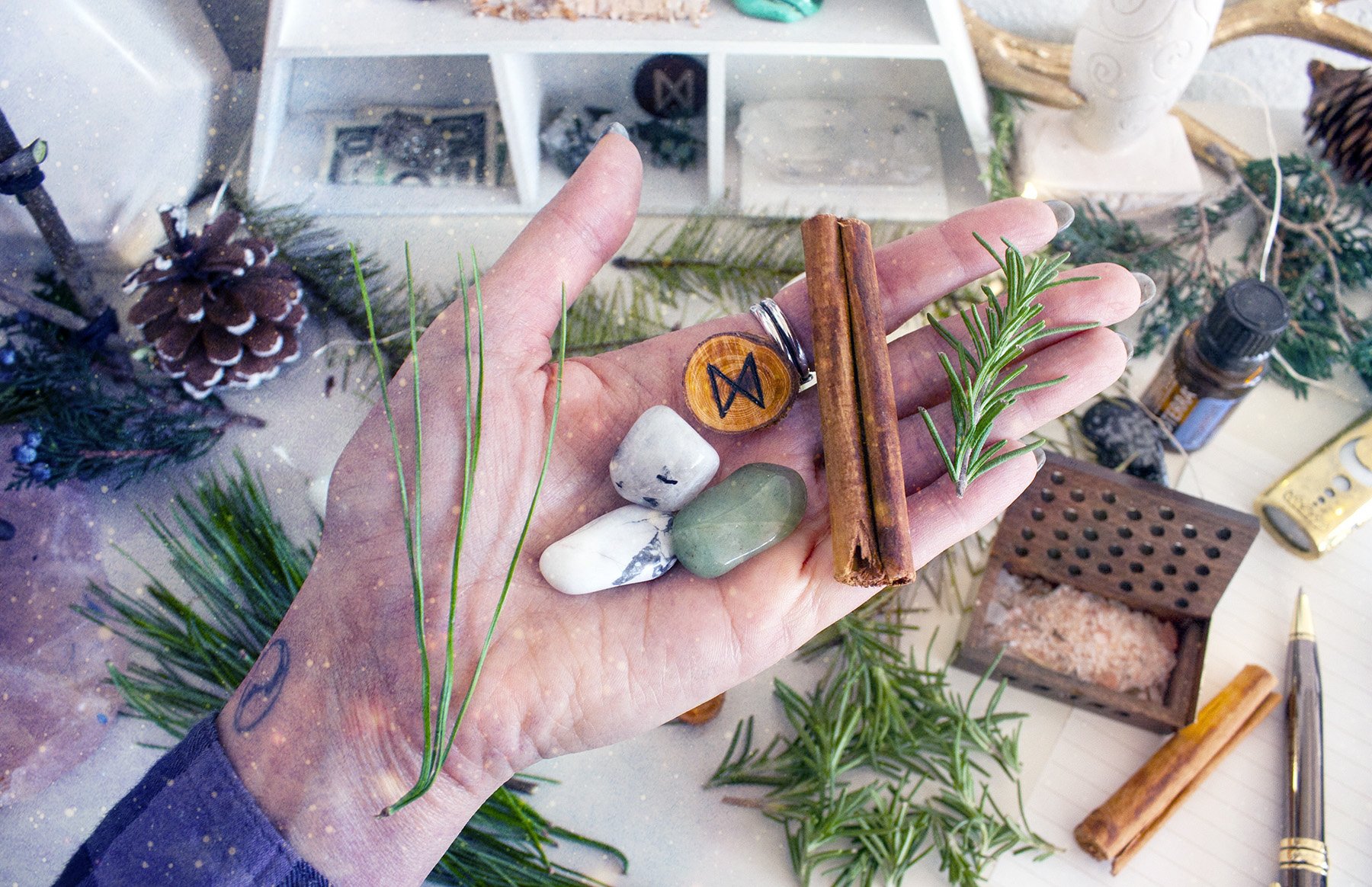
You waited for the perfect moon phase, gathered your supplies, and sent your magic out into the world. Now, you’re left with the remnants of your magical workings. What can be done with your leftover jars and bowls of notes, rocks, herbs, and candle wax?
Whether your magical workings have come to fruition or not, you have quite a few options when it comes to releasing or reusing your past spells. In this blog post, I’m going to share three different ways to honor and release your sacred spells and objects.
It is the very act of your spell and ritual work that releases your desires out into the universe. The remnants left behind can serve as helpful reminders, but repurposing or releasing your spell will not break or reverse anything. There are certainly some practices that may require you to keep the components of your spell intact, however, if that’s the case, you’ll undoubtedly know. Trust your inner guidance system.
As you read through these options, know that you can use one or all of these methods to repurpose or release your spell objects. Some objects may not work for certain methods outlined below, in that case, it’s okay to combine. You can also check out this quick video I created for our Instagram page.
1. Burning Ceremony
Fire is a transformative tool, so this method goes beyond simply making space for new spells. If your spell has ended it may be time to let it transform in new ways. This method can also be helpful to aid you in detaching from the outcome of your spellwork. Fire is powerful!
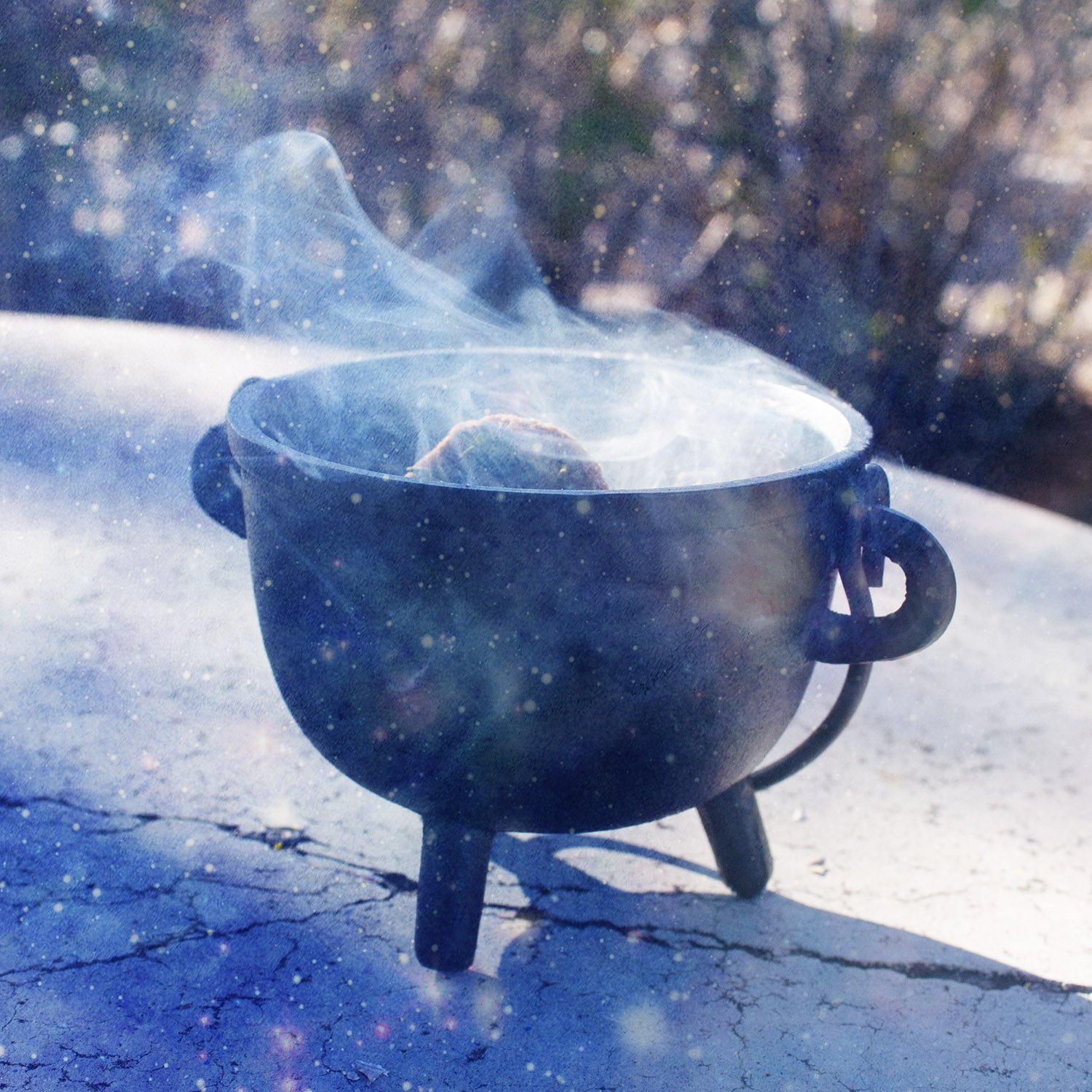
A burning ceremony is a great option for spells that include paper, herbs, candle wax, and other burnable objects. Most candle wax is paraffin, which means it’s not ideal for burying in the ground, and reusing it can be time-consuming. If your spell has leftover wax, burning it is one of the easiest and safest ways to release it.
For this method, you’ll need a large cauldron, fireproof dish, or outdoor fire. Depending on what the contents of your spell were, you’ll likely want to do this outside to prevent a huge plume of smoke from inhabiting your house. As you release your items into the fire, trust that the energy will continue to transform and benefit yourself and others.
2. Release to the Earth
A gentler option is to release your items back into the Earth. For this method, it’s imperative that you only release items that are natural and biodegradable. For example, most candles are made from paraffin wax and are not suitable for this method. I also do not recommend burying glass jars or bottles. Herbs, plants, biodegradable papers, and crystals are ideal for this method. If your spell was contained in a jar or vessel of some kind, I recommend reusing it, see the next section for tips on this.
Items that should not be given back to the Earth:
Salt: salt can harm or even kill plants
Candle wax: most candles are made with paraffin wax which is not biodegradable
Anything that is not 100% biodegradable
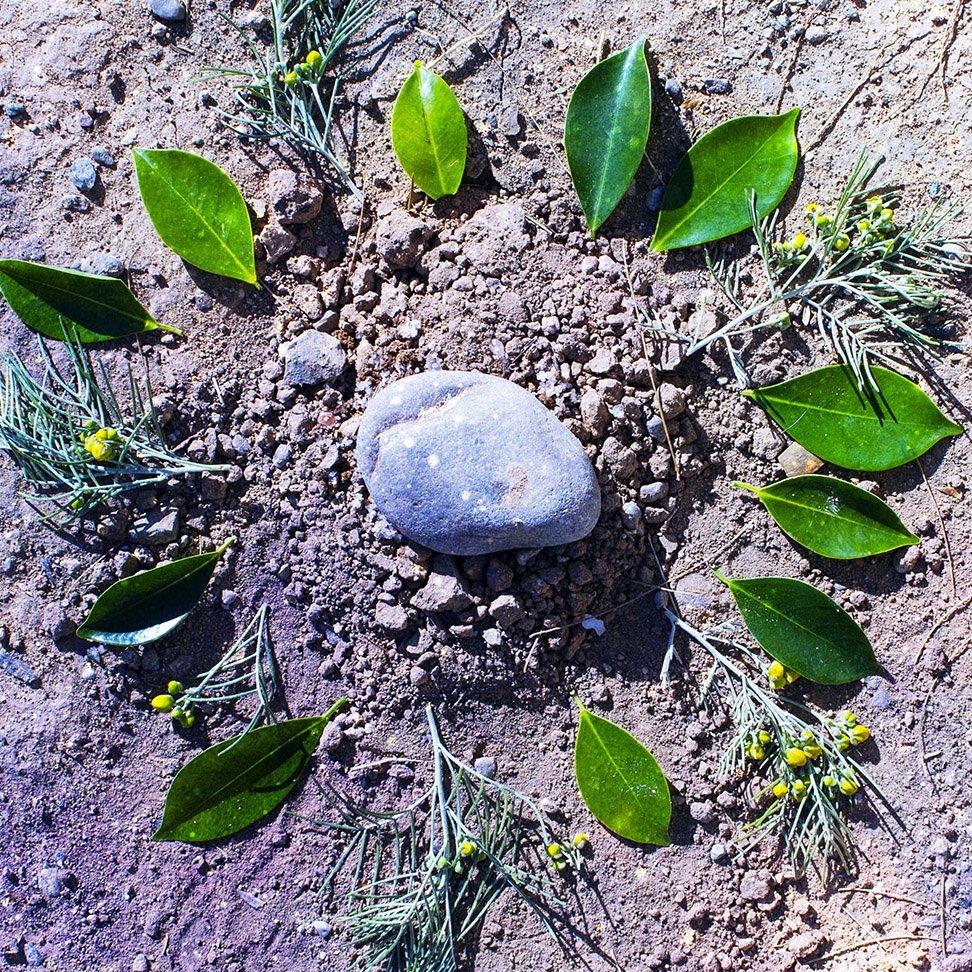
You can bury your items in a meaningful location or in your backyard, the location itself doesn’t need to be special. If you live near a natural body of water, releasing them into the water is a great option as well. This method can be transformative like the fire but in a gentler way. I find this method is great for inspiring a sense of gratitude and giving thanks to Mother Earth.
3. Cleanse and reuse
For all the objects you want to reuse like meaningful crystals and items that don’t burn or biodegrade, you’ll want to energetically cleanse them. Because spell and ritual work evokes such strong emotions, it’s important to energetically cleanse items before reusing them for another purpose. Unless, of course, the energy you imbued your items with is something you want to keep around. However, if you performed a spell for letting go of a past relationship, and then want to use the same jar or tools for helping you gain a new career, it’ll be best to cleanse your items.
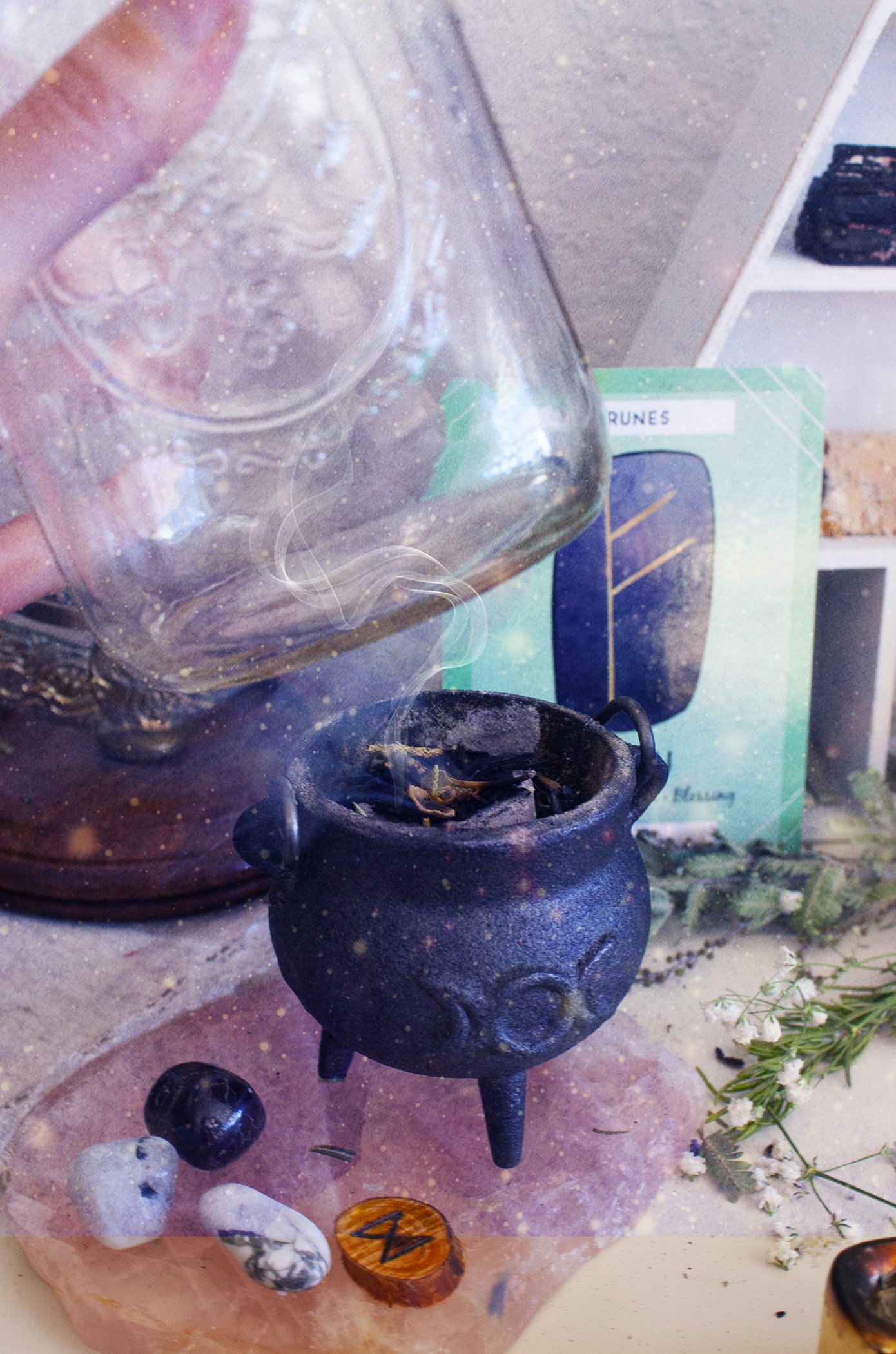
There are a variety of ways to cleanse physical objects. Here are a few simple techniques.
Place your items in salt overnight.
Hold your items in cleansing smoke like rosemary, cedar, lavender, or some other herb in line with your spiritual heritage.
For rocks or other items that are waterproof, hold them in running water.
Hold your items in your hands and call on any guides, spirits, or energies you work with to cleanse your items.
No need to let your sacred space fill up with spellwork from the past! I hope you enjoyed these tips to keep your spell and ritual practice open and flowing.

Card Spread & Sigil Ritual for Aquarius Season
Welcome to Aquarius season! Our fixed air sign, Aquarius energy is about authentic expression, bringing forth the new age and the next world, and upgrading the collective to its highest expression.To learn more about Aquarius energy, you can check out this blog post. In this post, I’ll be sharing a card spread and a sigil ritual to help you tap into the healing invitations of the Aquarius season. Practice these Aquarius offerings together or separately, whatever feels best for you. Scroll down to explore both of them!

Welcome to Aquarius season! Our fixed air sign, Aquarius energy is about authentic expression, bringing forth the new age and the next world, and upgrading the collective to its highest expression.
To learn more about Aquarius energy, you can check out this blog post. In this post, I’ll be sharing a card spread and a sigil ritual to help you tap into the healing invitations of the Aquarius season.
Practice these Aquarius offerings together or separately, whatever feels best for you. Scroll down to explore both of them!

Card Spread for Aquarius Season
For this card spread, you’re welcome to use a tarot deck or an oracle deck. In the spread, we’ll explore the Aquarius themes of authenticity and belonging.
I invite you to create a ritual space for you and your deck to communicate by taking a moment to ground and center yourself; lighting some incense, herbs, or candles that help you drop into your heart space; and opening to allow messages to come through.
When you feel centered and ready, shuffle your deck and draw a card for each of the following points:
Where do I have a block from authentic expression?
How can I support my authentic expression in this area?
What's keeping me from feeling a sense of belonging?
How can I create deeper belonging within myself?
Who will I be in my most authentic expression?

Take some time to journal and/or meditation on your cards to connect with the full meaning they have to offer you.
Sigil Ritual for Aquarius Season
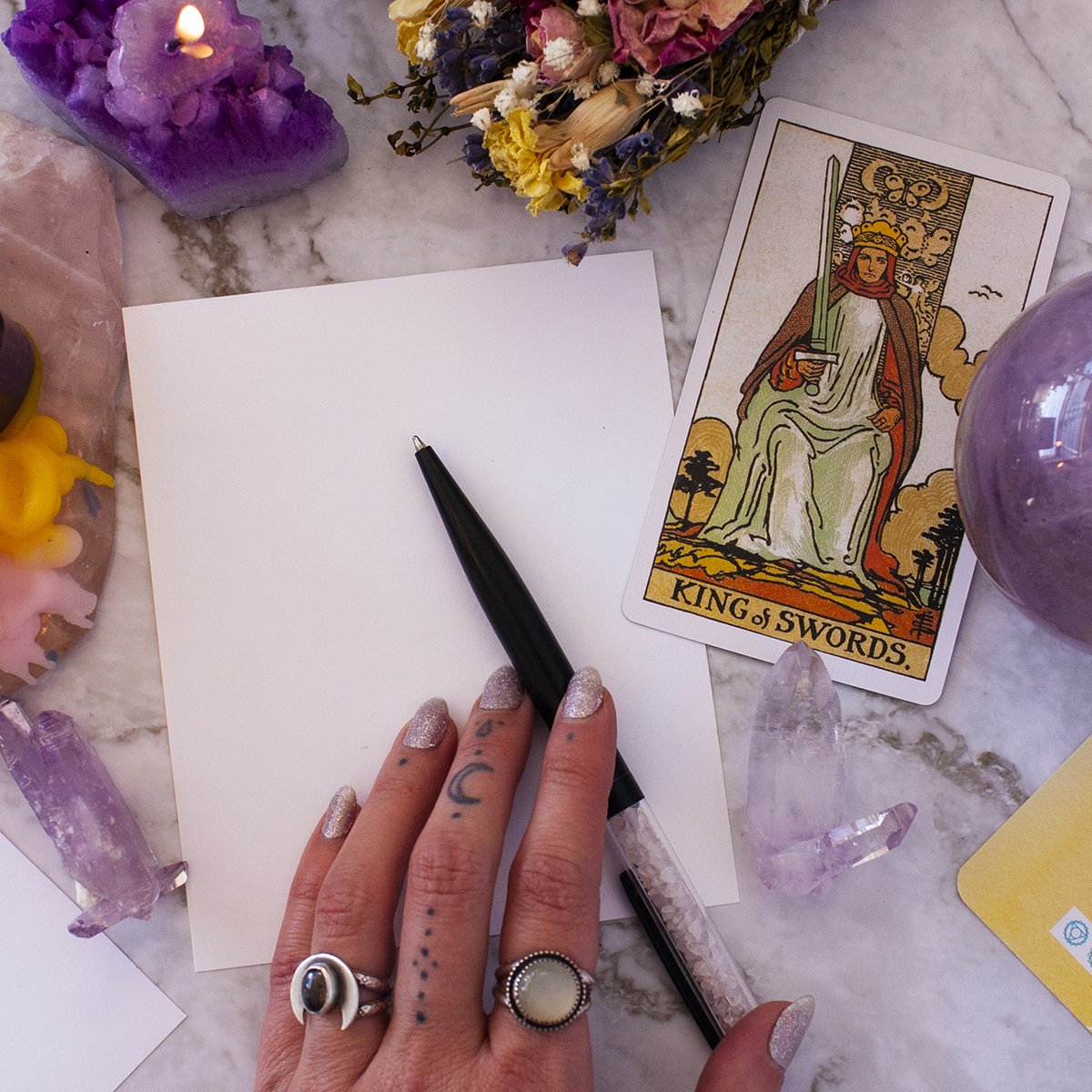
For this ritual, we’ll be creating a sigil to help you embody your truth. As an air sign, Aquarius evokes truth. You can see this in the King of Swords, our Aquarius card in the court cards of the tarot. It invites us to speak and embody our truth, to take up space with our voice and our message, and to not shrink - even when we’re afraid. When we embody our truth and share our voices, we create more authentic belonging. Associated with group energy and friendships, this is something Aquarius energy is deeply connected to. If sigils are new to you, think of them as a powerful symbol that is completely personal to you. What you’ll need:
paper
pencil
optional: crystals, herbs, or candles that support the element of air like yellow or blue candles, mint or citrus, and amethyst or kyanite.
Ritual Steps:
1. As with the card spread, open your ritual by taking some time to ground and center yourself. You might like to visualize yourself sending roots down into the core of the earth, take some deep breaths, place your hands on your body, or do something else that feels grounding to you.
2. After you ground, you might like to cast a circle to protect your ritual space and invite any well ancestors, spirit guides, or other loving beings you have relationships with to join you in ritual.
3. When you’re ready, it’s time to create your sigil. Write down some phrases and affirmations on your paper that support you in speaking your truth. Just let them flow! Some phrases to get you started: I EMBODY MY TRUTH. or I AM TRUTH.
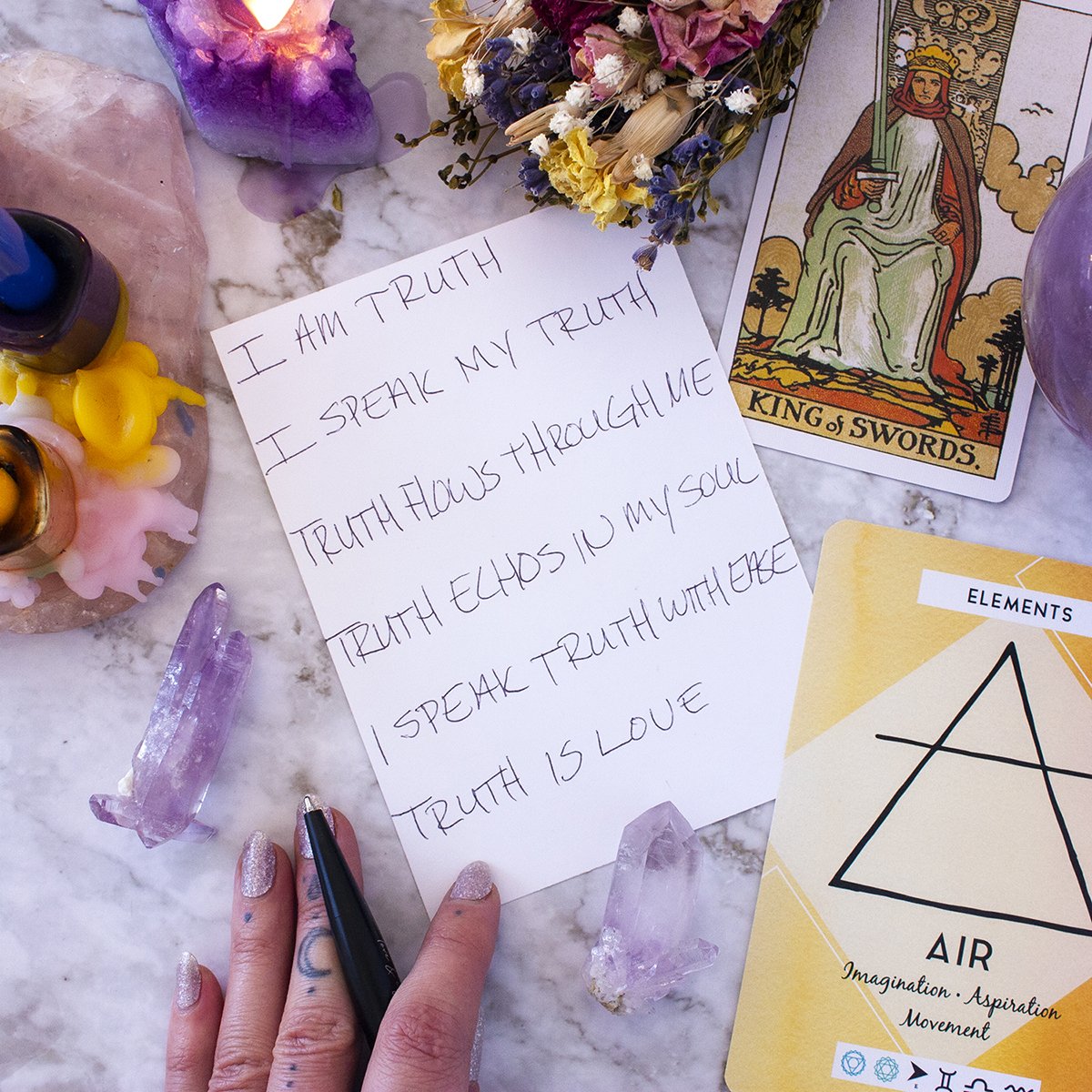
4. After you write them down, sit with the phrase (or phrases) you wrote. If you wrote multiple phrases, speak them out loud and see which one lands in your body. Choose one that feels alive and supportive.
5. Re-write that phrase or phrases on a new page. In the next few steps, you’ll work towards simplifying and unifying this phrase into a single symbol.
6. Re-write the phrase again, removing all of the repeating letters and vowels.
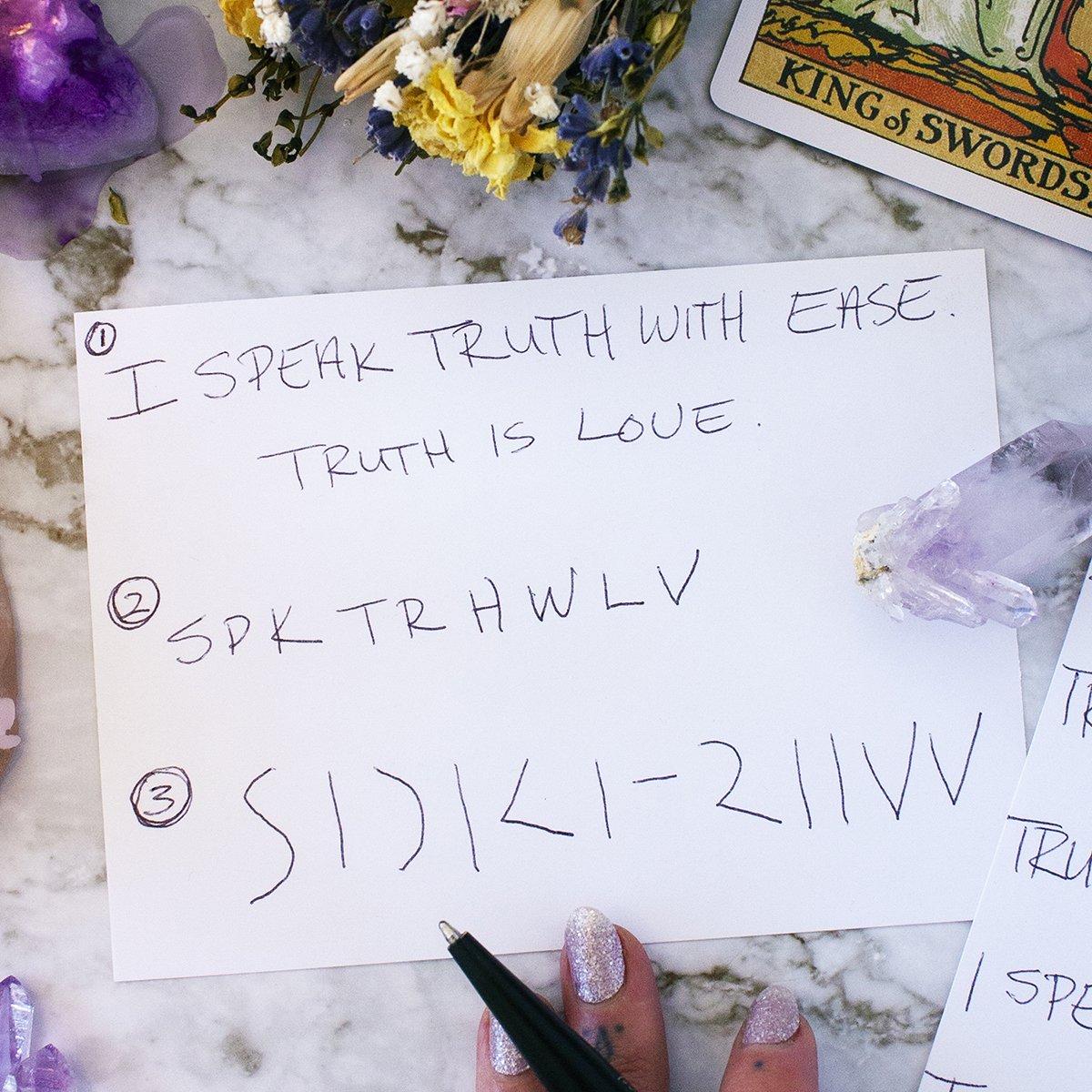
7. Re-write this line, turning the remaining letters into simpler symbols or shapes, like this.
8. Connect the lines together into a symbol in a way that feels intuitive and natural to you. This can be as simple or as elaborate as you’d like. As you create, breathe deeply and focus on your intention.
Tip: If drawing isn’t natural for you, this might feel uncomfortable, and that’s okay! Focus on the intention of your statement rather than what the sigil looks like. Remember this is a symbol for you and you alone.

Tip: Your sigil will look different than the one pictured.
9. When you’re ready, it’s time to activate your sigil. You can do this in many ways, but for this ritual, I recommend a brief meditation.
10. Place your sigil to your heart, with your palms on top of it, and breathe deeply. Visualize light (any color that comes intuitively is great) flowing from your heart to the sigil, activating each piece of it. Spend some time here letting energy flow, and when you feel an energy shift you’ll know that your sigil has been activated.
11. Close your ritual by placing your sigil on your altar, under your pillow, on your bedside, or somewhere else that you’ll see it regularly and be reminded of its power.
Wishing you a nourishing Aquarius season, and please feel free to share your ritual experience with us on Instagram!

Seeing the unseen // Scrying 101
Scrying is an ancient divination practice where you connect with your intuition and work to make the unseen seen by gazing onto a reflective surface.Scrying is a broad practice, therefore mentions of it pop up in a variety of places throughout history. Scrying is referenced in ancient Egypt, England, Greece, and Persia (to name a few.) Nostradamus reportedly relied on scrying for many of his predictions as well. The tools you can use for scrying are as vast as its history. You can use crystals, water, the moon, fire, smoke, a mirror, or really any reflective surface.

Scrying is an ancient divination practice where you connect with your intuition and work to make the unseen seen by gazing onto a reflective surface.
Scrying is a broad practice, therefore mentions of it pop up in a variety of places throughout history. Scrying is referenced in ancient Egypt, England, Greece, and Persia (to name a few.) Nostradamus reportedly relied on scrying for many of his predictions as well.
The tools you can use for scrying are as vast as its history. You can use crystals, water, the moon, fire, smoke, a mirror, or really any reflective surface.
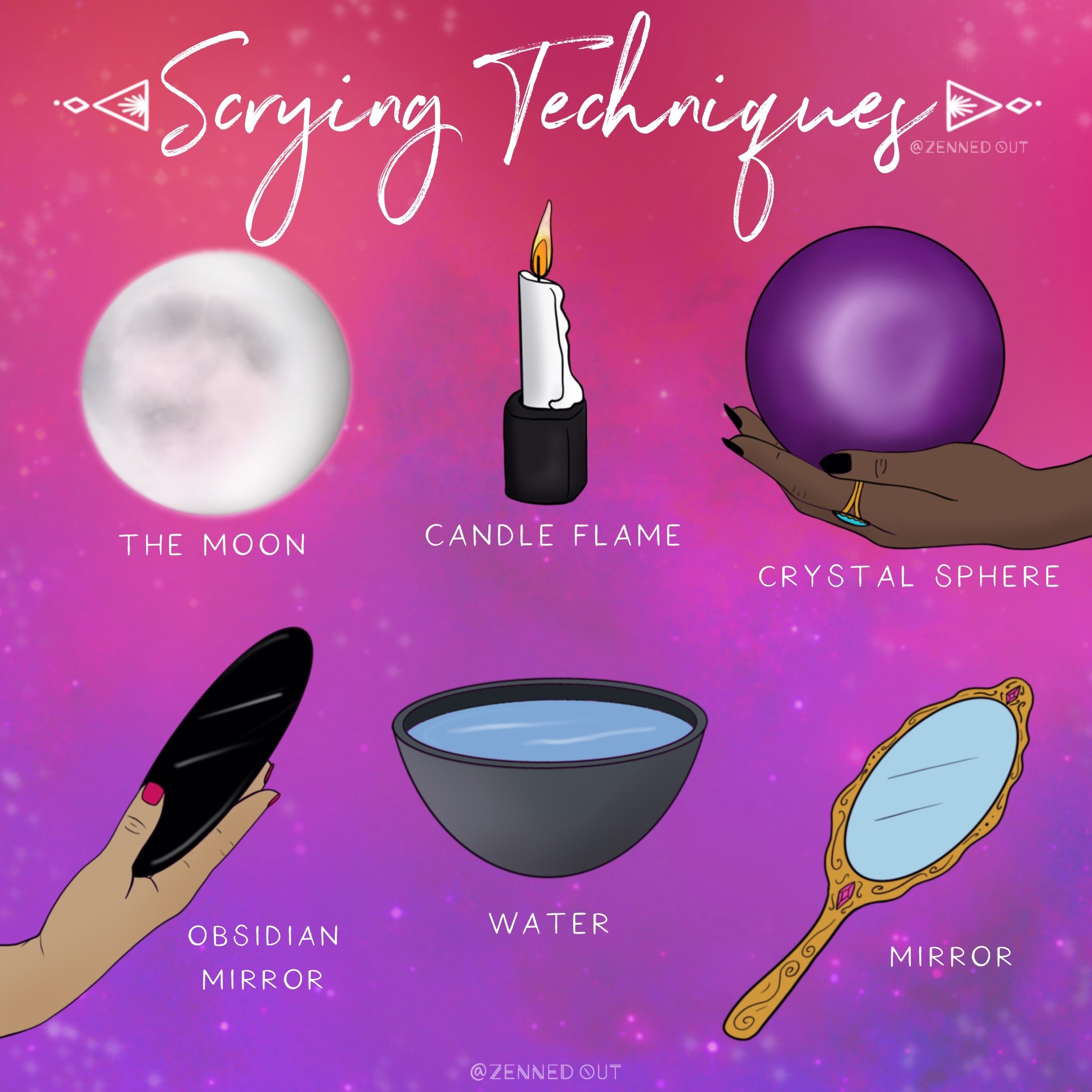
Artwork copyright Cassie Uhl 2020-infinity, please credit if shared.
Though clear crystal balls work for scrying and are commonly shown as a scrying tool, it is not the only kind of crystal used for this practice. Black obsidian mirrors are commonly used for scrying, but really any crystal with a reflective surface will do. You may even decide that you'd like to use a specific crystal in alignment with your desires for a scrying session. Sphere, larger palm stones, and flat mirrors or slabs all work well for this practice.
As varied as scrying is, the piece that remains consistent is the desire to reach an altered state to receive visions. The visions you receive from scrying could be from spirit or your subconscious. That’s for you to decide.
I love scrying for its power and simplicity. In this post, I’ll be sharing how to scry! Keep reading for five steps to try scrying for yourself.
A note on working with the moon. The full moon and the dark moon are ideal times to try this practice. I like scrying with the full moon to help illuminate and the dark moon for going within and accessing intuition. Don’t let the phase of the moon stop you from trying this practice; these are just suggestions.
Getting started with scrying:
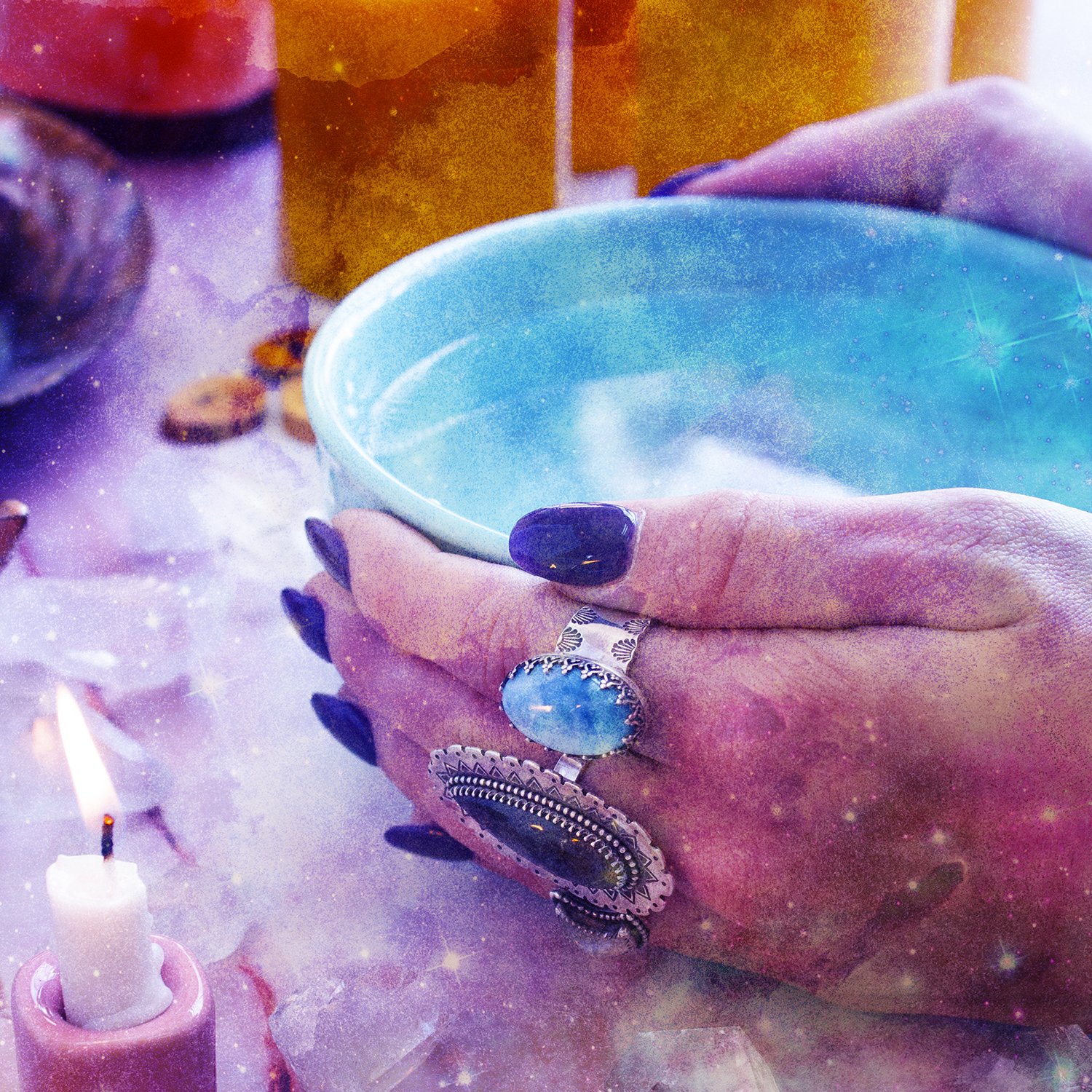
To begin your scrying practice, create a ritual space for yourself, and gather your bowl and water. (As I walk you through scrying, I’ll be using the example of a bowl of water, but remember that there are many other ways to scry that I shared above.)
You’ll want to be in a dark room with only one or two candles lit.
Once your space is ready, enter a trance state through meditating, energy work, drumming, chanting, breathwork, or any other practice that helps you drop into your subconscious mind.
Once you feel like you’re in an altered state of consciousness, relax your eyes and gaze into your bowl of water. Breathe deeply, let yourself soften, and ask a question silently (for example, what is holding me back in X situation? Or what do I need to know about Y?).
Gaze into the bowl and let yourself see what you see. It may take time for images to come up, but if you stay focused and present, they will. Allow the images, words, and sensations to flow, rather than holding on to them tightly.
When you feel like you’re done, you’re done! Spend some time journaling about what you felt and saw to help you answer the questions you came to receive answers for.
Remember, the subconscious mind works with symbolism, so don’t discount anything that you see even if you’re not quite sure what it means at first! Think of the information you receive, like the symbolism in dreams: sometimes we are left with more questions than answers. Sometimes the questions are the answers. Sometimes a thread is what you are offered, and you can choose to follow it or not. Sometimes symbols may not mean anything at first but are asking to be engaged with over time.
Let the process unfold, and see what comes up for you!


4 Ways to Perform Chakra Readings with The Ritual Deck
Your chakras are a primary energy source in your subtle energy body. They connect to your physical body and the rest of your subtle energy body, like your aura. If you'd like to connect with your chakra energy in new ways and learn different rituals for balancing your chakras, I created The Ritual Deck to help you do this. This oracle card deck is extremely versatile!In this post, I will outline four ways to use this deck as an energy and chakra reading tool.
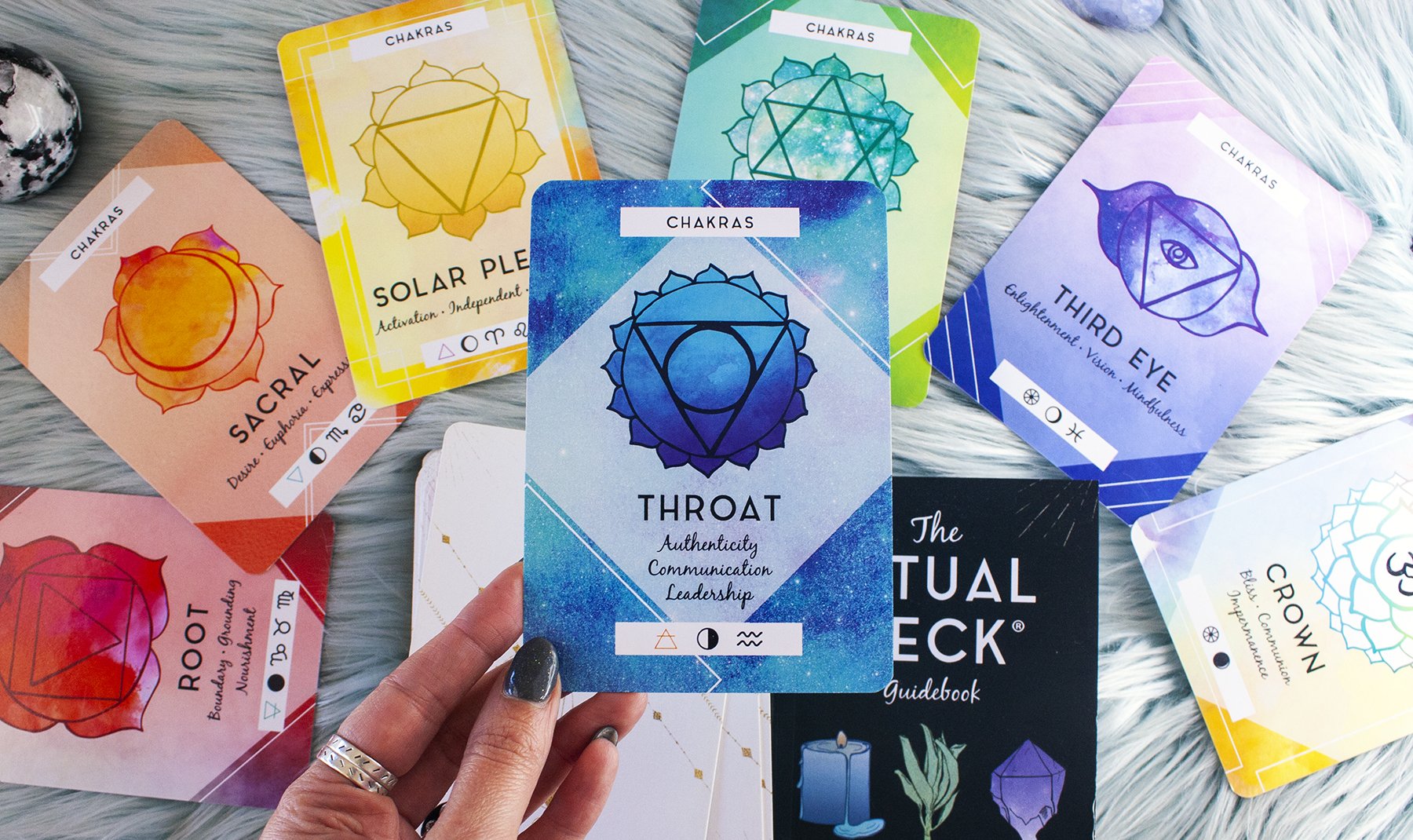
Your chakras are a primary energy source in your subtle energy body. They connect to your physical body and the rest of your subtle energy body, like your aura. If you'd like to connect with your chakra energy in new ways and learn different rituals for balancing your chakras, I created The Ritual Deck to help you do this. This oracle card deck is extremely versatile!
In this post, I will outline four ways to use this deck as an energy and chakra reading tool. If you have the Ritual Deck already, some of this is outlined in the guidebooks (along with other useful card spreads, like working with the moon phases.) Update 2022: The original Ritual Deck is currently discontinued but we're working on having a similar version eventually!
The four techniques I’ll outline in this post are:
Daily chakra reading
Chakra assessment card spread
Seven chakras balancing card spread
Using a pendulum with the chakra cards for an energy reading
If you want to learn more about the chakra system in general, you can deep dive into the chakra system, explore my new book, Understanding Chakras.
Keep reading to explore four ways to use The Ritual Deck to work with chakra energy.
Daily Chakra Reading
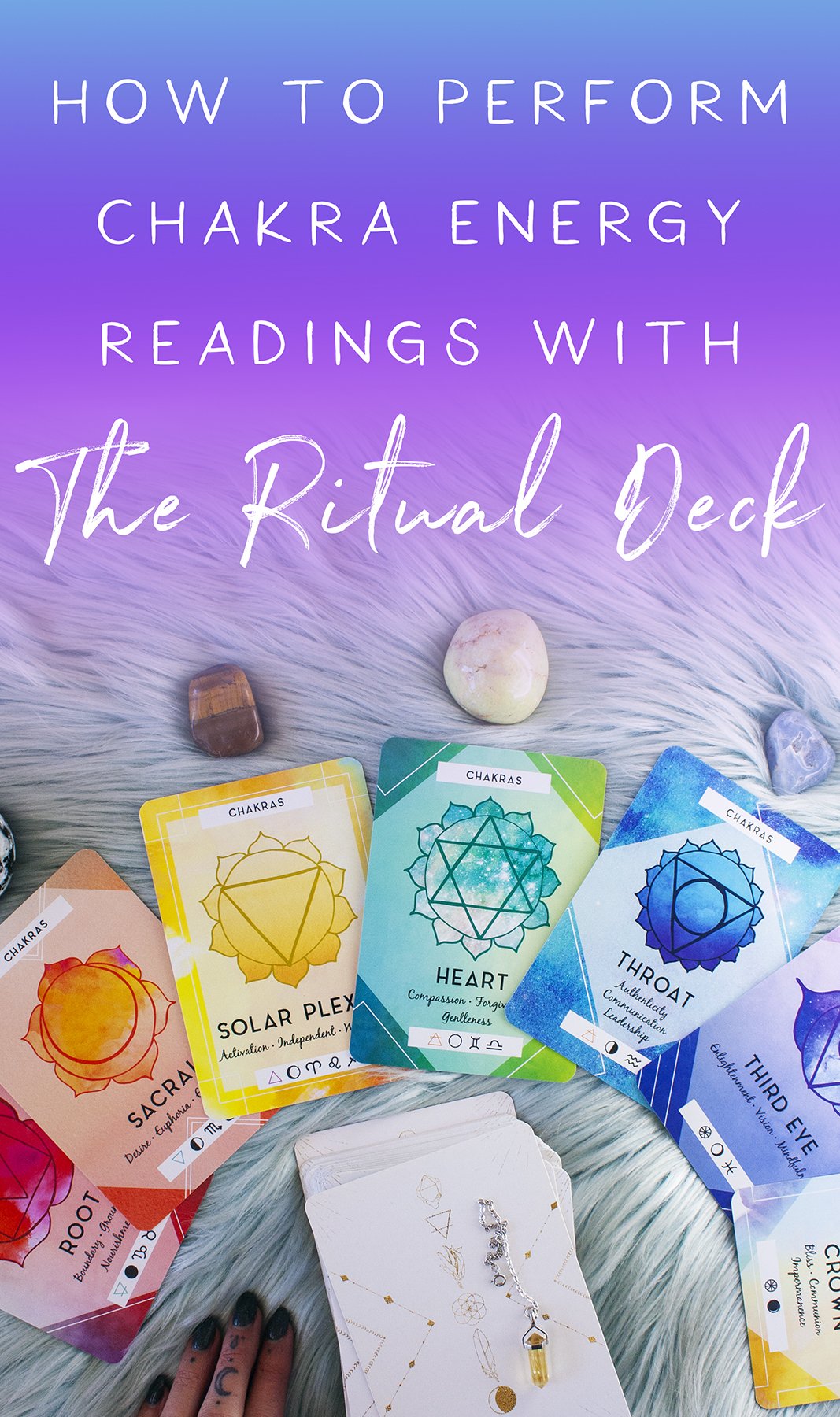
One of the simplest ways to use the Ritual Deck with your chakras is to separate the seven chakra cards and work with just those seven cards. Shuffle the seven cards and ask any of the following questions.
Which of my chakras is overactive?
Which of my chakras is underactive or blocked?
Which chakra should I focus on today?
You could also spread your cards out and hover your hand over them to make a selection. Here’s a video I shared with these techniques if you’d like to learn more about selecting your cards.
Select a card when you feel ready. Now that you have an idea of where you should focus your energy, you can separate the cards with that chakra and choose a ritual. For example, if you chose the throat chakra card, you would separate all of the cards with the throat chakra symbol in the correspondence bar and select a card (either intuitively or as a personal choice) to focus on for that day.
Chakra Assessment Card Spread
This technique works well if you’d like to gain general guidance about each chakra. It can tell you more about each chakra's health and where you may want to focus your energy to help each chakra. You’ll be using the entire deck for this method. This spread works well for yourself or others. Follow the steps below to try it out.
Start by gathering the chakra cards and placing them in order (either vertically or horizontally) from the crown chakra to the root chakra.
Hold the rest of the card deck in your hands and begin shuffling the cards. As you shuffle, ask aloud or in your mind, “What does each chakra have to share with me right now?” or “What do I have to learn from each of my chakras right now?”
When you feel ready to stop shuffling, start at one end of the chakras (either crown or root, wherever you feel called) and flip one card over for each chakra card.
The card you selected for each chakra is the guidance that the chakra wants to share with you. It could share a celebratory card indicating it’s happy and open or a card that may indicate that it needs some extra attention.
As with all card readings, rely on your intuition first and your guidebook second for what each card means for each of your chakras. If, after this spread, you feel like you have some chakras that need some extra love after performing this card spread, check out the one below for help balancing your chakras.
Chakra Balancing Card Spread
This card spread, outlined in the guidebook, works like a charm to balance specific or all of your chakras. This spread is great to use on yourself, or to use with other people. Follow these steps to perform a chakra balancing card spread.
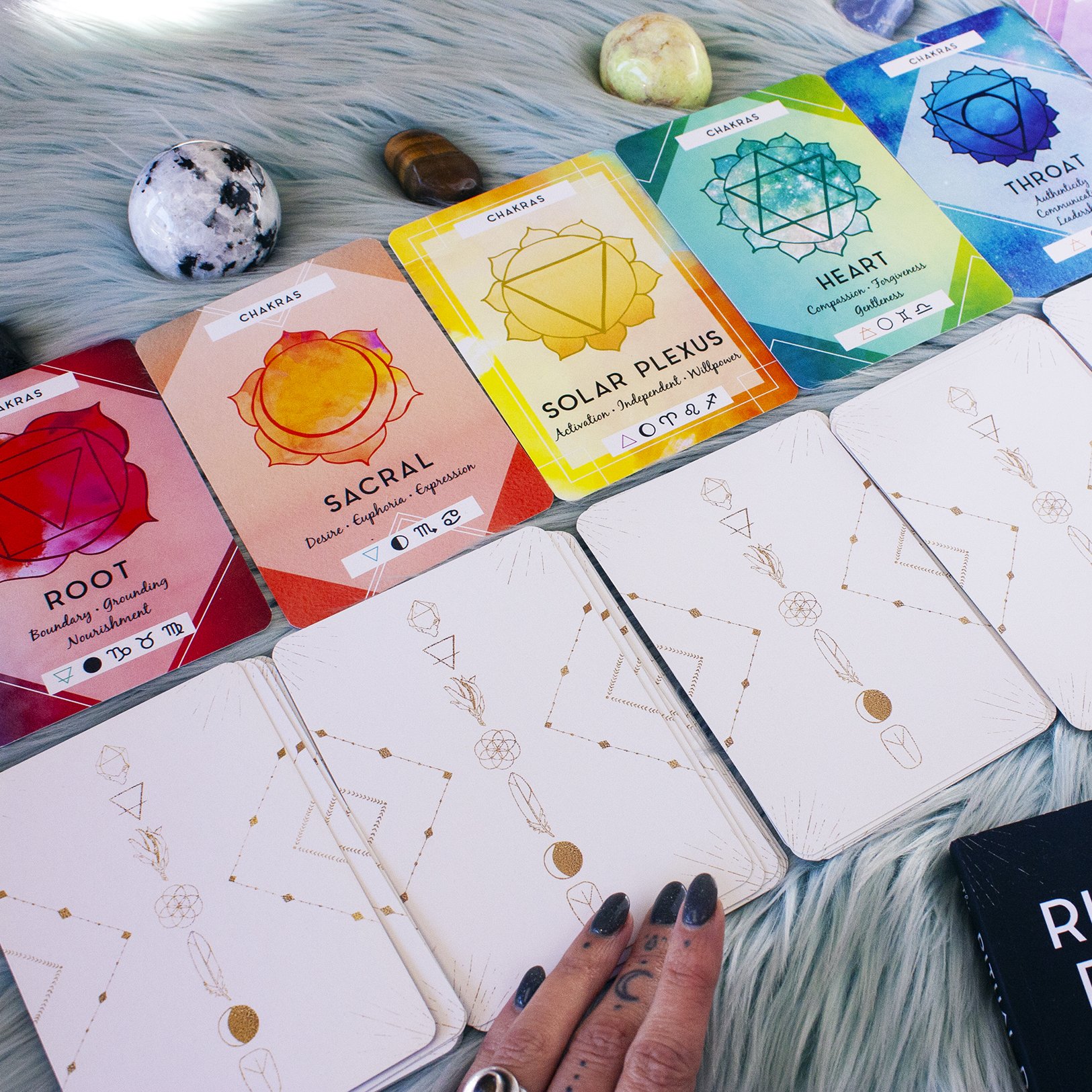
Start by gathering the chakra cards and placing them in order (either vertically or horizontally) from the crown chakra to the root chakra.
Separate all of the cards that correspond to each particular chakra and place them into piles. For example, all of the cards with a root chakra correspondence will go into a pile together. You should end up with seven piles (one for each chakra). There will be a different amount of cards in each pile. Tip: Use the correspondence legend at the end of the guidebook as a quick reference if you like.
Place each pile on top of its coordinating chakra, shuffle them, and turn them face down.
Allow your intuition to guide you in selecting one card from each pile.
Now you have seven cards, each corresponding to one of your seven chakras. Perform the ritual for each card to balance and restore your chakras.
You can use the same technique for one chakra, the upper chakras (crown chakra, third eye chakra, and throat chakra), or the lower chakras (solar plexus chakra, sacral chakra, and root chakra). If you’re focusing on one specific chakra, you may decide to select multiple cards to practice more than one ritual.
Performing a complete chakra body balance spread will require time, so feel free to spread out the rituals over the course of an entire week. This applies to any other lengthy card spreads outlined here.
Using a Pendulum with the Chakra Cards for Energy Readings
This is a technique I outline in my new book, Understanding Chakras. You don’t technically need the Ritual Deck to perform this one, but it does come in handy! You’ll also need a pendulum for this technique, preferably one that you’re already comfortable with using. If pendulums are new to you, you can read more about them here.

Using a pendulum for chakra readings may yield different pendulum movements than you usually receive. Your pendulum will usually react in one of three ways when using them to read chakra energy. The pendulum will circle clockwise, counterclockwise, or be completely still.
These are not firm guidelines and rather soft suggestions. Energy is unique and fluid. Use your intuition and trust your instincts when using this technique to determine chakra health.
Clockwise Spin: Chakra is healthy and open.
Very Large Clockwise Spin: Chakra may be overactive.
Counterclockwise Spin: Chakra may have a disruption or could be releasing negative energy.
No movement: Chakra is blocked or has experienced extreme trauma.
Follow these steps to try this technique.
Start by gathering the chakra cards and placing them in order (either vertically or horizontally) from the crown chakra to the root chakra. You won’t need the rest of the deck for this technique.
Hold your pendulum in your hands and ask it to help you determine the health of each of your chakras.
Hold your pendulum over each chakra and make a note of its movement for each. Using a notepad or journal is helpful for this technique.
Once you know each chakra's health, you may decide to back to the previous technique to help balance any chakras that need balancing.
I hope you feel even more empowered to work with your chakras using The Ritual Deck! Chakra energy is one of many ways to use this versatile oracle deck. You can use these techniques in similar ways with the five elements and the moon phases.
